Blooket vs Mentimeter: which tool fits your classroom
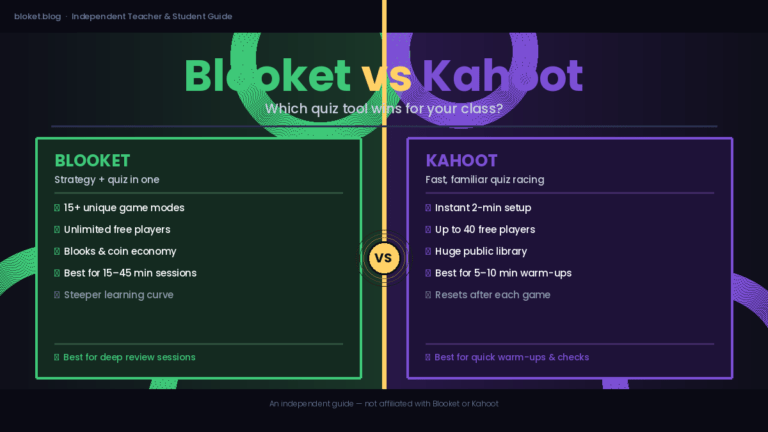
Blooket and Mentimeter both show up on “best classroom tech” lists, but they solve different problems. The Blooket vs Mentimeter question usually comes down to one thing: are you running a competitive review game, or are you collecting live feedback?
Blooket is a game-based review platform built around competitive quiz games and collectible characters. Mentimeter is a live presentation and polling tool built around word clouds, scales, and open feedback.
This guide breaks down what each platform actually does, how students join, what the free tiers allow, and which one fits a given classroom moment. It is written for teachers and trainers comparing the two, plus students who use Blooket and want to understand the alternative their instructor mentioned. Use the comparison table and the decision steps below to settle the question for your own session.
What blooket and mentimeter actually do
Blooket runs competitive quiz games where correct answers earn in-game currency and unlock collectible characters, while Mentimeter runs live polls, word clouds, and graded quizzes inside a presentation. One is built for review games, the other for audience feedback. Picking between them starts with knowing which job you actually need done.
What blooket is built for
Blooket turns a question set into a live, game-based competition. A teacher hosts a session, students join with a code, and they answer multiple-choice questions inside one of several arcade-style game modes such as Gold Quest, Tower Defense, or Battle Royale. Correct answers earn tokens, the in-game currency players spend on packs to unlock Blooks, the collectible characters that double as player avatars.
When I tested every hostable Blooket game mode in my own review sessions, the format that held attention longest was Battle Royale, since the elimination mechanic kept even reluctant players checking the leaderboard. Blook rarity runs across eight tiers, from Common up through Chroma and Mystical, and most standard packs cost in the 20-to-25-token range. That collection layer is what makes Blooket feel like a game rather than a worksheet with a timer.
Outside live hosting, Blooket also has a solo mode for homework or independent practice, where a student plays alone against no opponent and no clock pressure. Teachers can assign a question set as homework and review individual performance afterward through the dashboard. None of this requires a student account, since a game code is enough to join.
Question sets on Blooket can be built from scratch, imported, or pulled from the Discover library where other teachers have already shared decks on the same topic. That shared library cuts setup time significantly for a teacher building a review session the night before a test. A typical live round runs anywhere from five to twenty minutes depending on the game mode and the number of questions loaded.
What mentimeter is built for
Mentimeter turns a set of slides into a live, two-way presentation. A presenter builds a deck using question types like multiple choice, word cloud, open ended, scales, ranking, and Q&A, then shares a join code at menti.com. The audience answers from any device, and results animate on the screen in real time as votes come in.
In my classroom trials running both tools back to back in the same week, Mentimeter’s word cloud consistently produced the most honest responses, because quiet students who never raise a hand will type an anonymous one-word answer. Mentimeter also supports a graded quiz format with a leaderboard, so it can run a competitive round when that fits the session better than open feedback.
Mentimeter is not limited to classrooms. Corporate trainers, conference speakers, and lecture halls use it just as often, since the core use case, collecting live input, applies far beyond K-12 teaching.
A Mentimeter presentation can mix question slides with regular content slides, so a single deck doubles as both the lecture material and the interaction points. Audience size is rarely a limiting factor either, since the same join code works whether ten people are answering or several hundred are watching a conference keynote.
Who each tool is really for
Blooket’s avatar collection, sound effects, and arcade pacing land best with elementary through middle school students, though plenty of high school classes still use it for fast review. Mentimeter scales the other direction, showing up most often in upper secondary classrooms, university lectures, and adult training where the goal is discussion rather than competition. Neither tool is locked to one age group, but the design choices clearly favor different ends of that range.
How to choose between them for your class
Choose Blooket when the goal is competitive review of material students already know, and choose Mentimeter when the goal is gathering live opinions, checking understanding, or running a graded quiz inside a bigger presentation. The decision usually comes down to one question: are you testing recall, or are you collecting input?
Step 1: Define your session goal
Decide what you actually need to measure: if you want students to drill vocabulary, dates, or formulas through repetition and competition, Blooket’s game modes are built for that. If you want to know what the room thinks, gauge confusion mid-lecture, or collect open responses, Mentimeter’s poll and word cloud formats fit better.
A quick gut check helps here. If you can picture the activity as a quiz show with a winner, lean Blooket. If you picture it as a show of hands that updates itself on screen, lean Mentimeter.
Step 2: Match energy to your available time
Set expectations around how long each format runs: a Blooket round typically needs a full class period to set up, explain, and play through a game mode with any depth. A single Mentimeter poll or word cloud takes two to three minutes and slots neatly between two slides of an existing lesson.
This time difference is the most common reason teachers end up using both tools across a single week rather than picking one permanently. Mentimeter fits the small, frequent check-ins, while Blooket fits the occasional longer review session before a test or unit close.
Step 3: Check your tech setup
Confirm both platforms work the same way for access: students join Blooket through play.blooket.com with a game code, and they join Mentimeter through menti.com with a join code. Neither requires a student account or an app download, so device access is rarely the deciding factor between them.
One practical difference worth testing ahead of time is screen sharing in a virtual class. Blooket’s host screen shows the live leaderboard and game animation, which can be bandwidth-heavier over a video call than Mentimeter’s simpler slide-and-results layout.
Step 4: Decide how you will use the data afterward
Think past the live session itself: Blooket gives a post-game report showing which questions tripped up which students, useful for planning the next lesson’s review. Mentimeter lets you export poll and quiz results, which works well for tracking sentiment or comprehension across a semester.
If your school or department asks for documentation of formative assessment, Mentimeter’s export and slide history tend to fit that paperwork more naturally than Blooket’s game-focused reporting.
Blooket vs mentimeter side by side
Blooket offers around a dozen live, hostable game modes built around quiz questions, while Mentimeter offers roughly six question types built around polling and feedback. The tables below compare how each one handles gameplay, joining, and pricing so you can see the gap at a glance.
Game modes and question types
Blooket’s live-hostable modes include Monster Brawl, Deceptive Dinos, Gold Quest, Crypto Hack, Fishing Frenzy, Blook Rush, Battle Royale, Tower Defense, Cafe, Factory, Racing, and Classic. A couple of additional modes, including Crazy Kingdom, are solo-only or homework-only and cannot be hosted live. Every mode pulls from the same multiple-choice question set, with the game mechanic layered on top.
Mentimeter’s question types include multiple choice, word cloud, open ended, scales, ranking, and a graded quiz format with a timer and leaderboard. There is no equivalent to Blooket’s arcade mechanics. The variety in Mentimeter comes from question format, not game mechanics, since the platform is built around a presentation flow rather than a playable map or arena.
How students join and play
Both platforms use a join-code system that skips account creation for participants. A Blooket player enters a code at play.blooket.com, picks a nickname, and selects a Blook avatar before landing in the lobby. A Mentimeter participant enters a code at menti.com and answers directly, with no avatar selection and anonymous responses by default.
That difference in identity matters for tone. Blooket’s avatar and leaderboard setup leans into visible competition, which works for review games but can discourage shy students from speaking up. Mentimeter’s anonymous-by-default setup is what makes its word cloud and open-ended questions useful for collecting honest feedback rather than performance.
Pricing and free tier limits
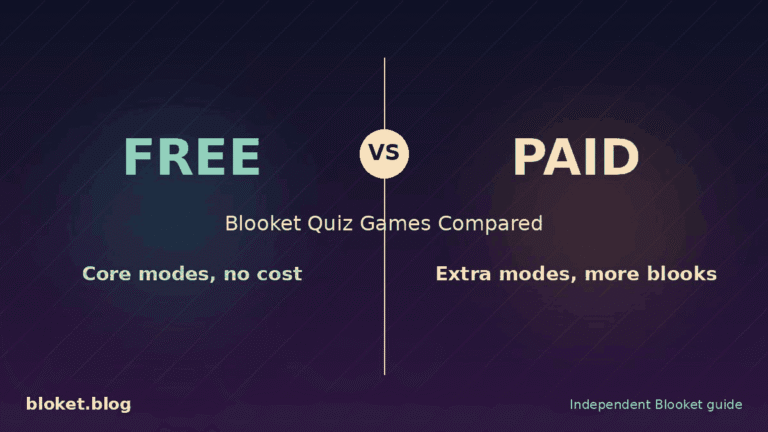
Both platforms run on a freemium model: a usable free tier for individual teachers, plus a paid subscription that unlocks extra modes, question types, or analytics. Exact pricing changes over time, so check each platform’s own pricing page for current numbers before budgeting for a paid plan.
| Feature | Blooket | Mentimeter |
|---|---|---|
| Core format | Game-based quiz review | Live polling and presentation |
| Live-hostable formats | About 12 game modes | About 6 question types |
| Solo or async use | Yes, dedicated solo mode | Limited, built for live sessions |
| Student join method | Game code at play.blooket.com | Join code at menti.com |
| Account needed to join | No | No |
| Free tier | Yes, with limited modes | Yes, with a capped question count |
| Paid tier | Blooket Plus | Mentimeter paid plans |
| Best fit | Competitive review games | Polls, feedback, and presentations |
Analytics and classroom management
Blooket’s reporting centers on accuracy by question and by student, which makes it easy to spot a concept the whole class missed after a single round. The dashboard also lets a teacher manage multiple question sets and assign them as homework without running a live session at all.
Mentimeter’s reporting centers on response patterns across an audience rather than individual scoring, since most of its question types, like word clouds and scales, are not built to have a single correct answer. For quiz-format questions specifically, Mentimeter does track correctness and ranks participants on a leaderboard, similar in spirit to Blooket’s scoring but without the surrounding game mechanics.
Common mistakes and myths when comparing blooket and mentimeter
The biggest mistake in this comparison is treating Blooket and Mentimeter as competitors for the same job, when they are built for different moments in a lesson. Most of the friction teachers report comes from picking the wrong tool for the task, not from a flaw in either platform.
Myth: they do the same job
Some lists group Blooket and Mentimeter together simply because both are live, code-based classroom tools. They overlap on delivery mechanism only. Blooket is built for repeated practice through gameplay, and Mentimeter is built for one-time feedback collection inside a presentation.
Myth: more game modes always means better learning
Blooket’s dozen-plus game modes can suggest that variety drives engagement on its own. In practice, rotating through too many unfamiliar modes in one term means students spend more time learning controls than reviewing content. Picking two or three modes and reusing them consistently teaches faster than constant novelty.
Mistake: running a competitive review session in mentimeter
Mentimeter’s quiz format has a leaderboard, but it was not built for sustained, round-based competition the way Blooket was. Trying to recreate a Blooket-style game night in Mentimeter usually falls flat, since the platform lacks the arcade mechanics, power-ups, and pacing variety that make Blooket’s game modes replayable.
Mistake: using blooket for open-ended discussion
Blooket’s question format is multiple choice only, so it cannot collect the kind of open text response or word cloud that Mentimeter handles natively. Teachers who want a discussion-starter or an anonymous opinion poll will hit a wall trying to force that into Blooket’s quiz structure.
Mistake: ignoring how each tool handles shy or slower students
Blooket’s visible leaderboard and timer reward speed and confidence, which can leave slower or more anxious students at the bottom of the screen for the whole class to see. Mentimeter’s anonymous responses remove that pressure entirely, since no name or rank is attached to a word cloud or open-ended answer. Matching the tool to the student dynamic in the room, not just the content being reviewed, avoids turning a review game into a source of embarrassment.
FAQs
Can I use Blooket and Mentimeter in the same lesson? Yes. A common pattern is opening with a Mentimeter word cloud or poll to gauge prior knowledge, teaching the content, then closing with a Blooket game mode to review what was just covered. The two tools complement each other well across a single class period.
Which one is free? Both have a usable free tier for individual teachers. Blooket’s free tier includes most core game modes with some advanced ones reserved for Blooket Plus, and Mentimeter’s free tier caps the number of graded quiz questions per presentation while still allowing word clouds and polls.
Does Mentimeter have game modes like Blooket? No. Mentimeter has a graded quiz format with a timer and leaderboard, but it does not include arcade-style mechanics, maps, or collectible characters. If gameplay variety and visual rewards are the priority for your students, Blooket remains the closer match for that specific need.
Can students join without an account on either platform? Yes, on both. Blooket players join with a game code at play.blooket.com and Mentimeter participants join with a join code at menti.com, and neither requires the student to create an account first. Account creation only becomes relevant if a student wants to save progress or collections over time.
Which is better for younger students? Blooket generally lands better with younger students because of its visual rewards, collectible characters, and competitive game modes. Mentimeter works at any age but is more commonly used with older students, university lectures, and adult training where discussion matters more than play.
Can I export data from both tools? Yes. Blooket gives a post-game performance report by question and by student, and Mentimeter allows exporting poll and quiz results, which is useful for tracking responses across multiple sessions. Both exports work well for sharing progress with parents, department heads, or training managers.
Is Mentimeter only for live sessions, or can it be used asynchronously? Mentimeter is built primarily for live, synchronous sessions where a presenter controls the pace of each slide. It is not designed as a self-paced homework tool the way Blooket’s solo mode is, though some teachers reuse a Mentimeter link for ungraded reflection outside class time.
Which tool is better for corporate training instead of a classroom? Mentimeter is the more common choice outside education, since its polling and presentation format fits meetings, conferences, and corporate training as naturally as it fits a classroom. Blooket is built specifically around K-12 and study-group review games, so it sees far less use in adult professional settings.
Do I need to install anything to host either platform? No. Both Blooket and Mentimeter run entirely in a web browser for the host and for participants, with no software install required on either side. Dedicated mobile apps exist for convenience, but a laptop or tablet browser is all either platform actually needs.
Can I switch between Blooket and Mentimeter mid-lesson without losing momentum? Yes, as long as you plan the transition rather than improvising it. Closing one join code and opening the next takes under a minute, so a short Mentimeter check-in followed by a longer Blooket review round works well as a two-part class structure.
Conclusion
The Blooket vs Mentimeter comparison is not really about which platform is better overall, since they are not competing for the same slot in a lesson plan. Blooket wins for competitive review games built around a question set, and Mentimeter wins for live polls, word clouds, and quick comprehension checks inside a presentation. Try matching one tool to your next session’s actual goal, rather than picking by reputation, and the right choice tends to become obvious within the first few minutes of planning.
For more side-by-side breakdowns and Blooket-specific guides, browse the rest of bloket.blog.
Prepare to be thoroughly amazed by what you find—our curated features are overflowing with pure, usable value.