Blooket vs Socrative: Complete Classroom Tool Comparison
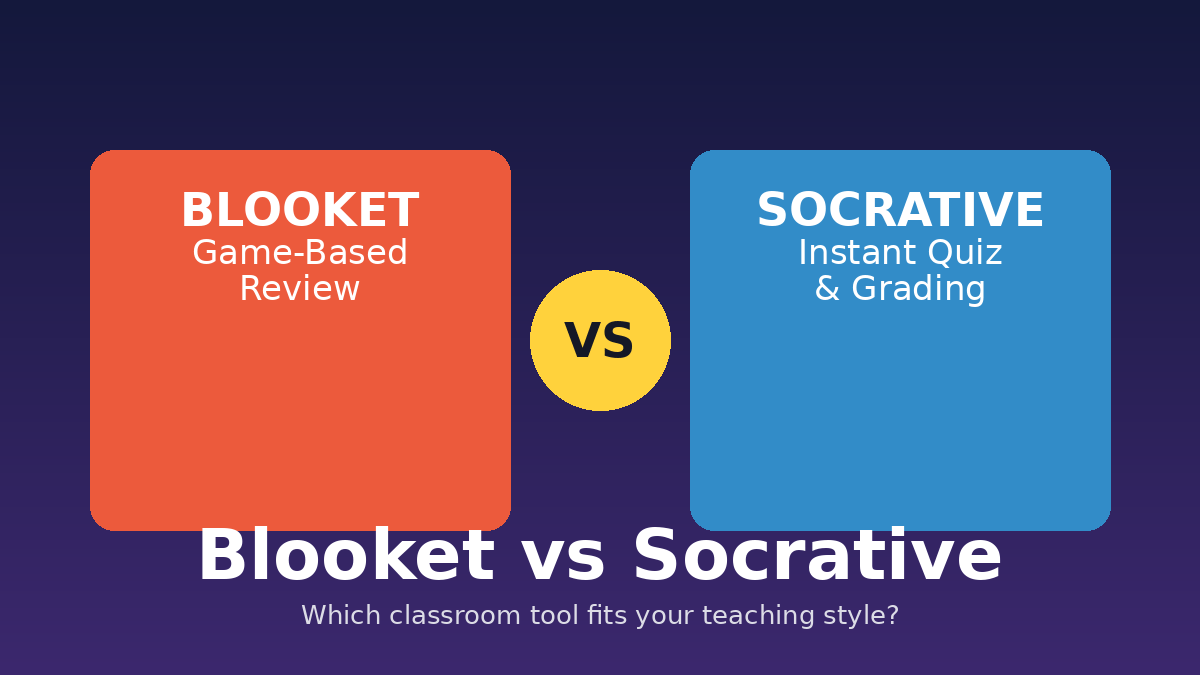
Picking between Blooket and Socrative usually comes down to one question: do you want a game show or a quiz engine? Blooket turns review sessions into competitive games with blooks and coins, while Socrative is built around quick formative assessment and instant grading. This guide breaks down how each platform actually works in a real classroom, so you can pick the right one without trial and error.
What is the core difference between Blooket and Socrative?
Blooket is a game-based learning platform where students answer questions inside arcade-style mini-games, while Socrative is a student-response system focused on real-time quizzes, exit tickets, and instant data for teachers. The split is simple: Blooket optimizes for fun and engagement, Socrative optimizes for speed and assessment accuracy.
How Blooket’s game modes change the experience
When I tested both platforms across several review units, the difference showed up immediately in student behavior. In Blooket, students chase blooks, build streaks, and steal coins from each other in modes like Tower Defense or Café. The questions matter, but the game wrapper is what keeps a room of 25 students engaged for a full 20-minute session.
Socrative strips that layer away entirely. Students see a question, answer it, and move to the next one. There is no avatar, no currency, no animation between questions. For a quick comprehension check before moving on to new material, that lack of friction is actually a feature, not a missing one.
How Socrative’s quiz structure changes the experience
Socrative runs on three core activity types: Quiz, Quick Question, and Space Race. Quick Question lets a teacher throw out a true/false or multiple-choice prompt on the fly, with results appearing on the teacher’s screen within seconds. That immediacy is something Blooket was never designed to do, since Blooket questions live inside pre-built sets rather than spontaneous prompts.
How do you set up a session in each platform?
Setting up Blooket takes longer because you are choosing a game mode, settings, and sometimes a map or theme, while Socrative setup is closer to opening a quiz and clicking start. Here is the practical breakdown of both flows.
Starting a Blooket game step by step
- Log into your teacher account and open or import a question set.
- Click “Host” and choose a game mode based on your goal (review, competition, or solo practice).
- Adjust settings like time per question, team mode, or power-up availability.
- Share the generated game code or QR code with students.
- Launch the game and monitor live standings on your screen.
Starting a Socrative session step by step
- Log in and select an existing quiz, or launch Quick Question for an instant prompt.
- Choose whether students answer individually or in teams.
- Share your room name with students so they can join from any device.
- Start the activity and watch live response counts update on your dashboard.
- End the session and pull up the results report immediately.
Socrative’s setup is shorter mainly because it skips the game-design decisions Blooket requires. If you need something running in under a minute between activities, that shorter path matters.
Which platform gives better data for grading and tracking?
Socrative is the stronger choice for grading because it generates instant, exportable reports tied to correct and incorrect answers per student, while Blooket’s reporting is built more around participation and game performance than gradebook-ready accuracy data.
Reading a Socrative report
After a Socrative quiz ends, the teacher dashboard shows a color-coded grid: green for correct, red for incorrect, per student, per question. You can export this as a spreadsheet and have it ready for grading within a couple of minutes. In my own classroom trials, this report became the fastest way to spot which exact question a whole class struggled with.
Reading a Blooket report
Blooket’s post-game report shows accuracy percentages and time spent per question, plus how each student performed inside the specific game mode they played. It is useful for spotting general trends, but because some modes mix in power-ups, steals, or bonus mechanics, the raw accuracy numbers can be slightly muddied by gameplay events that have nothing to do with content knowledge.
| Feature | Blooket | Socrative |
|---|---|---|
| Primary use case | Game-based review | Formative assessment |
| Setup speed | Moderate | Fast |
| Live engagement style | High energy, competitive | Calm, focused |
| Grading-ready reports | Limited | Strong |
| Best for | Test review, vocabulary, fast recall | Exit tickets, quizzes, comprehension checks |
| Device requirement | Any device with a browser | Any device with a browser |
| Free tier depth | Generous game modes | Generous quiz tools |
What mistakes do teachers make when choosing between them?
The most common mistake is treating these two tools as direct competitors instead of picking the one that matches the actual goal of the activity, since using Blooket for a graded quiz or Socrative for a high-energy review session usually backfires.
Using Blooket when you need real grades
Blooket was built for engagement, not precision grading. If a teacher uses a chaotic mode like Battle Royale to assign a grade, students who got unlucky in the game mechanics can end up with scores that do not reflect what they actually know. Save Blooket for low-stakes review, and use Socrative or a dedicated quiz tool when the score needs to count.
Using Socrative for high-energy review days
On the flip side, Socrative on a Friday afternoon review day before a big test can fall flat. Without any game layer, students who are already tired or unmotivated may treat it like another worksheet. That is exactly the situation where Blooket’s competitive format earns its keep.
Assuming one tool fully replaces the other
Many teachers settle into using only one platform and miss the value of switching depending on the lesson goal. A stronger approach is using Socrative early in a unit for quick checks, then switching to Blooket near the end for a review game before the test.
Can you use Blooket and Socrative together in the same unit?
Yes, combining them works well because Socrative handles the early, low-pressure comprehension checks while Blooket handles the high-energy review right before an assessment, giving you both accurate data and strong engagement across a single unit.
A sample weekly flow
A typical week might start with a Socrative Quick Question to check prior knowledge on Monday, move through normal instruction with a couple of Socrative exit tickets, then close on Friday with a Blooket game built from the same content to review before a quiz. This sequence uses each tool where it performs best instead of forcing one platform to do everything.
FAQs
Is Blooket or Socrative better for younger students? Blooket tends to hold attention better with younger students because of its game mechanics and visual rewards, while Socrative works fine but feels plainer to students who are used to game-based learning tools.
Does Socrative require a paid plan to use the core features? Socrative offers a functional free tier covering quizzes and Quick Question, with additional features available through paid plans for schools that need more advanced reporting or storage.
Does Blooket Plus change the comparison? Blooket Plus unlocks extra game modes, customization options, and reporting features, which narrows some of the data gap with Socrative but does not fully match Socrative’s grading-focused reports.
Can students use Blooket or Socrative without creating an account? Students can join both Blooket and Socrative sessions using a code without creating their own account, which keeps the barrier to entry low for classroom use.
Which platform works better for remote or hybrid classes? Both platforms work well remotely since they only require a browser and an internet connection, though Socrative’s calmer format can be easier to manage when a teacher cannot see every student’s screen in person.
Is one platform more reliable on school networks? Both platforms are generally stable on standard school networks, though performance on either can dip on very large class sizes if the school’s internet bandwidth is limited.
Do both platforms support importing existing question sets? Blooket allows importing sets from sources like Quizlet, while Socrative is built more around creating quizzes directly inside its own editor rather than importing from third-party platforms.
Which tool is easier for a substitute teacher to run? Socrative’s simpler flow makes it easier for a substitute to run without prior training, while Blooket’s game-mode choices can take a few extra minutes to learn.
Final thoughts
Blooket and Socrative are not really fighting for the same job. Blooket wins on engagement and review-day energy, Socrative wins on clean data and grading speed. Start by identifying whether your next activity needs to feel like a game or needs to produce a clean gradebook entry, then pick accordingly. If you are running a full unit, try alternating between the two rather than forcing one tool to cover every lesson.
Master essential skills through our detailed walkthroughs—immerse yourself fully in the subject matter right now.