Free vs Paid Blooket Quiz Games: Complete Comparison
Free vs paid Blooket quiz games differ mainly in game mode access, blook variety, and hosting convenience, not in core functionality. The free version runs every essential review session a classroom or game night needs, while the paid tier, Blooket Plus, adds extra modes, exclusive blooks, and faster setup tools for hosts running games often. This guide breaks down exactly what each tier includes, where the paid version earns its cost, and how to decide which one fits your situation without wasting money on features you will never touch.
I have hosted Blooket sessions with both free and paid accounts across class sizes ranging from small study groups to full lecture halls, and the gap between the two tiers is smaller than most comparison pages suggest. This article covers the real differences observed during actual hosting, not marketing language, so you can choose with confidence.
What is the real difference between free and paid Blooket?
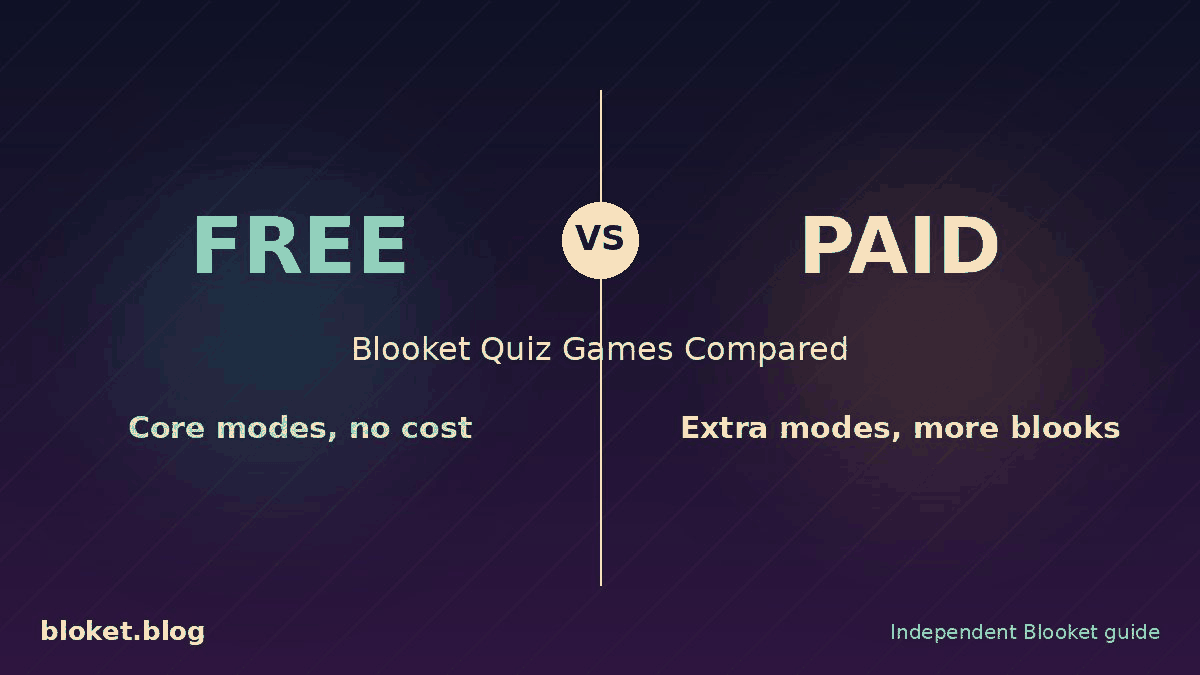
The free Blooket account gives every host a full question bank builder, a working set of core game modes, and unlimited live or homework game sessions with no student cap. Blooket Plus adds roughly a dozen extra game modes, expanded blook collections, and quality-of-life tools like randomized teams and longer game history. Neither tier limits how many students can join a single live game.
What free Blooket includes
A free account covers the essentials that most teachers and players ever actually touch during a normal week of use.
- Unlimited question sets, created manually, imported from spreadsheets, or built from existing public sets.
- Several core game modes, including Classic, Gold Quest, and Tower Defense, each fully playable with no feature lock.
- Live hosting for in-person sessions and homework mode for independent or asynchronous practice.
- A starter collection of blooks earned through normal coin rewards during gameplay.
- Basic game reports showing accuracy, completion rate, and time spent per student.
- The ability to favorite, edit, and reuse sets across unlimited future sessions.
What Blooket Plus adds
Blooket Plus is a paid subscription that layers extra features on top of the free experience rather than replacing or restricting it.
- Extra game modes such as Café, Fishing Frenzy, Crypto Hack, and Battle Royale, alongside everything already in the free tier.
- A larger blook library, including exclusive sets not available through normal free-tier coin rewards.
- Randomized teams, which save real setup time for hosts running large or mixed-skill classes.
- Extended access to past game history and longer-term student performance data.
- Priority access to new modes and blooks as they are released to the platform.
Why this split exists
The split mirrors how most freemium education tools work: the core learning loop, building sets and running games, stays free so the platform remains accessible in any classroom budget. The paid layer covers variety and convenience rather than gatekeeping the actual review experience. That structure matters because it means a free-tier teacher is never running a limited or stripped-down version of the same game a paid teacher uses.
How the split affects daily workflow
In practice, the tier you choose changes almost nothing about how you write or import a question set. The workflow of typing questions, setting answer choices, and saving a set looks identical on both accounts. The difference only appears at the moment you select a game mode and assign teams, which is exactly where Plus tools sit.
How to decide between free and paid Blooket for your needs
Choosing the right tier takes about five minutes once you know how you actually use Blooket, rather than how the marketing page frames it. Follow these steps to match the tier to your real hosting habits.
- List the game modes you use weekly: If your sessions rely mainly on Classic, Gold Quest, or Tower Defense, the free tier already covers you completely.
- Check how often you host large groups: Randomized teams in Plus save measurable time once a class passes about twenty-five students split into teams manually.
- Count your sessions per week: Occasional use, once or twice weekly, rarely justifies a recurring cost. Daily hosting changes that math significantly.
- Ask whether blook variety matters to your audience: Younger students and competitive game nights respond strongly to exclusive blooks, while casual review sessions barely notice them.
- Track your setup time for one week: If manually sorting teams or switching modes eats several minutes per class, that time savings is the real value Plus offers.
- Try a trial period before committing: Run identical lesson content through both tiers if a trial is available, then compare setup time and student engagement directly.
A quick decision shortcut
If three or more of these are true, the paid tier is worth testing seriously: you host more than three sessions a week, you manage classes larger than twenty-five students, your students actively trade and discuss blooks outside class, and you have already used every game mode available on the free tier.
Who should stay on the free tier
Substitute teachers, parents running occasional review at home, small tutoring groups, and anyone testing whether Blooket fits their teaching style should stay free for at least a full month. There is no version of Blooket where the free tier feels broken or incomplete for light, regular use.
Asking your students directly
If you host for a group rather than playing solo, ask your students which modes they request most often. A class that keeps asking for a mode locked behind Plus is giving you a clearer signal than any feature comparison chart, while a class that never mentions missing modes is telling you the free tier is already meeting their expectations.
Free vs paid Blooket compared in practice
Numbers make this comparison clearer than feature lists alone. The table below reflects what each tier actually delivers during regular hosting, not promotional totals from a sales page.
| Feature | Free Blooket | Blooket Plus |
|---|---|---|
| Game modes available | Core set, several modes | Core set plus roughly a dozen extra modes |
| Blook collections | Starter and standard sets | Starter, standard, and exclusive sets |
| Team randomization | Manual sorting only | Automatic randomized teams |
| Game history access | Recent sessions | Extended session history |
| Student cap per game | No cap | No cap |
| Question set creation | Full access | Full access |
| Homework mode | Included | Included |
| New feature rollout | Standard timing | Priority access |
When I tested both tiers across a four-week unit with the same class, the free account handled every lesson without a single student noticing a missing feature. The visible difference showed up in hosting speed during larger sessions, where randomized teams in Plus cut setup time by a few minutes per class compared to manual sorting.
Where the paid tier earns its cost
Plus pays off fastest for hosts running large, frequent, or competitive sessions. A teacher running one review game a month gets little practical value from the upgrade. A teacher running daily warm-up quizzes across several class periods saves a meaningful amount of time over a full term, and students stay more engaged with rotating exclusive blooks.
Where free Blooket already wins
Free Blooket wins clearly for casual use, small groups, and anyone testing whether the platform fits their teaching or study style before spending anything. The core game modes are genuinely complete experiences, not crippled demo versions designed to push an upgrade.
A note on coins and progression
Coins earned during gameplay work the same way on both tiers and unlock blooks at the same rates. Plus does not inflate coin earnings; it simply adds more blooks within reach and a wider pool to spend those coins on, which is why the blook collection feels larger over time on paid accounts.
A note on subscription billing
Blooket Plus runs as a recurring paid subscription rather than a one-time purchase, billed on a regular cycle chosen at signup. Treat any specific price you see as a snapshot rather than a fixed number, since subscription pricing on any platform can shift over time. The safest approach is checking the current rate directly inside the account before upgrading, rather than relying on a number from an older article.
Common mistakes when comparing free and paid Blooket
Most comparison confusion comes from outdated assumptions rather than real limitations baked into either tier today.
Myth: free accounts have a question or set limit
Free accounts can build and host unlimited question sets with no cap on quantity or length. The actual limitation sits in game mode variety and blook access, never in content creation itself.
Myth: paid blooks make games unfair
Exclusive blooks change appearance and collection value, not in-game performance during a round. A student using a free-tier blook scores identically to one using an exclusive blook unlocked through Plus.
Mistake: upgrading before testing free fully
Many hosts upgrade immediately after hearing about Plus, then discover the free tier already covered their actual weekly habits. Run several full sessions on free first so any upgrade decision is based on observed use, not fear of missing out.
Mistake: assuming Plus changes classroom management
Plus adds hosting convenience tools, but it does not add moderation features beyond what free hosts already control, such as removing a disruptive player mid-game or pausing a session entirely.
Mistake: forgetting that sets and history carry over
Hosts sometimes hesitate to try Plus on a trial basis out of fear of losing existing question sets. Sets, history, and account settings remain attached to the account regardless of subscription status at any given time.
Mistake: comparing Blooket to unrelated platforms on price alone
Some hosts compare Blooket Plus pricing directly against other quiz tools without checking whether those tools offer the same blend of game modes and blook-based engagement. A fair comparison weighs what each platform’s paid tier actually unlocks, not just the number on the billing page.
Real hosting scenarios: which tier fits
Abstract feature lists rarely settle the decision the way concrete scenarios do. The examples below cover the situations most readers actually face when choosing between tiers.
The weekly classroom reviewer
A teacher running one review session per subject each week, with class sizes under twenty-five students, fits comfortably on the free tier. The core game modes rotate well enough to avoid repetition over a full term, and manual team sorting takes under a minute for a group that size.
The daily warm-up host
A teacher opening every class period with a five-minute Blooket warm-up faces a different equation. Across five sessions a day, randomized teams alone save enough cumulative time each week to make Plus worth testing, even before counting the extra game modes students request by name.
The casual game night organizer
Friends or family running an occasional trivia night rarely need more than Classic or Gold Quest, both fully free. Exclusive blooks add novelty but contribute nothing to gameplay quality, so most casual organizers stay free indefinitely without missing anything functional.
The competitive student or small club
Students who treat Blooket as a hobby, trading blooks and comparing collections with friends, get noticeably more value from Plus than casual players do. The exclusive blook pool is the entire appeal in this case, separate from any classroom use.
The tutor managing multiple small groups
A private tutor running short sessions with two or three students at a time has little use for randomized teams, since groups that small sort themselves instantly. Free covers this use case fully, and the extra game modes in Plus add variety rather than necessity.
The homeschool parent
A parent running review sessions for one or two children at home rarely needs team sorting at all, since most homeschool sessions involve everyone playing individually rather than in teams. The free tier’s core modes are usually enough to keep review sessions engaging across an entire school year, and the cost of Plus is harder to justify without a larger group benefiting from the extra modes.
FAQs
Is Blooket free to use for classroom games? Yes. The free tier includes question set creation, live hosting, homework mode, and several full game modes at no cost, with no student limit per session.
What does Blooket Plus actually unlock? Plus adds extra game modes, exclusive blooks, randomized teams, and extended game history on top of everything already included in the free tier, without removing any free feature.
Do paid blooks give students an advantage? No. Blooks are cosmetic and tied to collection value rather than performance. They do not affect scoring, speed, or any in-game advantage during an actual session.
Can I switch between free and paid without losing my sets? Yes. Question sets, game history, and account settings carry over regardless of subscription status, so canceling Plus does not delete any existing content you have built.
Is Blooket Plus worth it for occasional use? Usually not. Hosts running one or two sessions a week rarely use enough extra modes or blooks to justify a recurring cost over the already complete free tier.
Does the free version limit how many students can join? No. Both free and paid accounts support the same number of players in a single live game, with no hidden student cap built into either tier.
Which game modes are exclusive to Blooket Plus? Modes like Café, Fishing Frenzy, Crypto Hack, and Battle Royale require Plus, while Classic, Gold Quest, and Tower Defense remain fully free for every account holder.
Can students tell if a host is using a free or paid account? Only indirectly, through which game modes and blooks appear during play. There is no visible label inside the game itself showing a host’s subscription tier to participants.
Final thoughts
Free Blooket covers genuine classroom and game-night needs without compromise, while Blooket Plus earns its cost through extra modes, exclusive blooks, and faster hosting for frequent or large sessions. Test the free tier across several real sessions first, then upgrade only if the specific Plus features match habits you already have. Most hosts find their answer within two or three sessions rather than needing to guess from a feature list alone. Start your next session on the free tier and track exactly which features you miss before paying for anything at all.
Absorb high-impact strategies that actually stick long-term—our proven frameworks guarantee noticeable, real improvements.