Blooket vs IXL: Complete Comparison for Classrooms
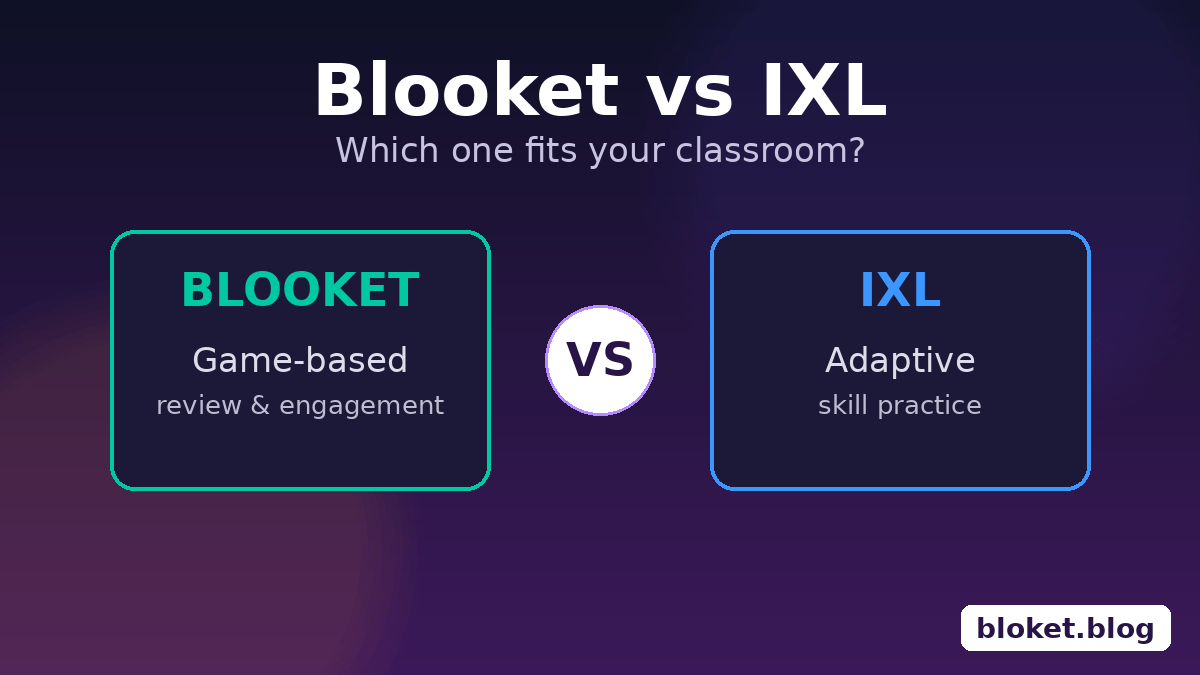
Picking between Blooket and IXL usually comes down to one question: do you need students excited to review, or do you need a system that tracks mastery skill by skill? Blooket turns teacher-made or shared question sets into fast, game-based rounds that students genuinely ask to replay. IXL is a structured practice platform built around thousands of skill levels in math, language arts, science, and social studies, with detailed analytics behind every answer. This guide breaks down what each platform actually does well, where they fall short, and which one fits different classroom goals, based on hands-on testing of both tools across several subject areas.
What are Blooket and IXL built to do?
Blooket is a game-based review tool where teachers load questions into one of several arcade-style modes, while IXL is a skill-practice system that adapts question difficulty as students answer. The core difference is purpose: Blooket reviews what students already learned, and IXL teaches and reinforces skills through repetition.
Blooket’s core model
Blooket runs on question sets, either built by the teacher, imported from Quizlet, or pulled from a public library shared by other educators. Once a set is loaded into a game mode such as Gold Quest, Tower Defense, or Factory, students join with a six-character code and answer questions to earn in-game rewards like coins or blooks, which are collectible characters.
The competitive layer is what drives replay value. In several classroom trials, the same 20-question set held attention for three or four rounds because students wanted to unlock a rarer blook or beat their own score, something a flat worksheet never achieves.
IXL’s core model
IXL organizes content into a skill tree spanning multiple grade levels per subject. A student picks a skill, answers questions that adjust in difficulty based on accuracy, and earns a SmartScore that climbs from 0 to 100 as mastery improves.
Behind the scenes, IXL logs every question attempt, time spent, and error pattern, then feeds that data into diagnostic reports teachers can use to spot gaps before a test. This depth makes IXL closer to a curriculum supplement than a game.
Where the two platforms overlap
Both tools position themselves as supplements rather than replacements for direct instruction, and both work across a wide age range, from early elementary through high school. Neither expects a teacher to abandon a textbook or curriculum; instead, each slots into the practice or review portion of a lesson cycle.
The overlap mostly ends there. Blooket has no built-in content library beyond what the community shares, while IXL’s entire value proposition rests on its pre-built skill library. A teacher choosing Blooket is choosing a delivery mechanism; a teacher choosing IXL is choosing both content and delivery at once.
Account setup and onboarding
Setting up a Blooket class takes a few minutes: create an account, build or import a set, then generate a game code for students to join. There’s no roster syncing required unless a teacher wants to track individual results by name rather than nickname.
IXL setup takes longer upfront because it usually involves linking a school or district roster, assigning grade levels per student, and sometimes coordinating with an administrator who manages the subscription. Once that initial setup is done, assigning practice to individual students or whole classes becomes quick.
How do Blooket and IXL compare on engagement and learning depth?
Blooket wins on short-term engagement through game mechanics, while IXL wins on sustained skill-building through adaptive repetition and detailed feedback. Neither replaces the other; they solve different classroom problems.
Engagement style
Blooket’s games are built around quick rounds, usually 5 to 15 minutes, with visible rewards and live leaderboards. Students see their rank update in real time, which keeps energy high even in a class of 30.
IXL’s interface is calmer by design. There are no avatars racing across a screen, no power-ups, and no countdown timers in most skill types, so it suits independent practice better than a whole-class activity.
Depth of skill coverage
IXL covers an enormous range, often thousands of skills per subject across K-12, each broken into specific standards. A single grade-level math skill might have ten related sub-skills, letting a teacher target exactly where a student is struggling.
Blooket depends entirely on what’s loaded into a question set. A teacher or community member has to build that content, and depth is only as strong as that one set, not a built-in curriculum.
Adaptivity
IXL adjusts question difficulty within a skill based on how a student answers, slowing down for repeated mistakes and speeding up after a string of correct answers. Blooket does not adapt question difficulty; every student in a game sees the same set unless the teacher manually creates variations.
Whole-class versus individual pacing
Blooket games run on a shared clock; everyone moves through the same rounds at roughly the same pace, which works well for a live classroom moment but means faster or slower students wait or rush along with the group. A few modes, like homework-style assignments, let students play solo on their own time, but the experience is still built around one shared set of questions.
IXL is built for individual pacing from the start. Two students sitting next to each other can be on entirely different skills at entirely different difficulty levels, with no need for the teacher to manage multiple versions of an activity.
Motivation over time
In several weeks-long classroom trials, Blooket’s novelty stayed strong when used once or twice a week, with students asking when the next game would happen. Used daily, the excitement faded faster, since the same modes and reward systems became predictable.
IXL’s progress-based motivation tends to hold up better over longer stretches, since the SmartScore and mastery certificates give students a visible, personal goal rather than a one-time reward. Students working toward 100 on a skill stay engaged even without a live leaderboard pushing them.
Blooket vs IXL: features, pricing, and reporting side by side
The table below lines up the practical differences that matter most when choosing a tool for a classroom or for independent study.
| Feature | Blooket | IXL |
|---|---|---|
| Primary use | Game-based review of existing content | Adaptive skill practice and mastery tracking |
| Content source | Teacher-built or shared question sets | Built-in skill library across subjects |
| Best class size | Whole class, live or homework mode | Individual or small group, self-paced |
| Adaptivity | None; same questions for everyone | Adjusts difficulty per student in real time |
| Reporting | Basic score and accuracy per game | Detailed SmartScore, error patterns, diagnostics |
| Subjects covered | Any subject, depends on the set creator | Math, language arts, science, social studies, Spanish |
| Free tier | Game hosting and most modes at no cost | Limited free questions per day |
| Paid tier | Blooket Plus adds extra modes and customization | Full subscription unlocks unlimited practice and reports |
| Setup time | Minutes, using existing or imported sets | Minimal, skills are pre-built |
| Student motivation driver | Competition, collectibles, live leaderboard | Progress bars, mastery scores, certificates |
Pricing approach
Blooket’s free tier covers most game modes and unlimited question sets, with Blooket Plus available as a paid subscription that unlocks extra customization options and modes. IXL operates on a subscription model with a capped number of free practice questions per day before a paywall appears, and a full subscription is needed for unlimited use and complete reporting.
Reporting depth
IXL’s reporting is built for tracking long-term progress against standards, showing exactly which skills a student has mastered and which need more time. Blooket’s reporting is built for a single game session: who answered what, how fast, and how many questions they got right, useful for a quick formative check but not for tracking growth over a semester.
Device and access requirements
Blooket runs in any modern web browser on desktops, tablets, or phones, and students don’t need an account to join a live game, only a code and a nickname. This makes it simple to use in a one-device classroom or a bring-your-own-device setup.
IXL also runs in-browser and on dedicated apps for tablets, but students generally need an individual login tied to their account, since progress and SmartScores are stored per student. This is a small extra step but matters for younger students who may need help logging in.
Content freshness and updates
Blooket’s question sets are only as current as whoever built them; a teacher-made set on a specific topic stays accurate until the underlying facts change, and outdated community sets are common since anyone can publish one. IXL’s skill library is maintained centrally, so the underlying practice questions and explanations stay consistent and aligned with standard curricula over time without relying on outside contributors.
When should you choose Blooket over IXL, or use both?
Choose Blooket when the goal is a fun, fast review of content already taught, and choose IXL when the goal is structured, adaptive practice that tracks mastery over time. Many classrooms use both, switching between them based on the moment in a lesson cycle.
Use Blooket for these situations
- Reviewing before a test: A 15-minute Blooket round the day before an assessment surfaces which topics need a quick re-teach.
- Warming up a lesson: Starting class with a short, energetic game resets attention better than jumping straight into new material.
- Substitute-friendly activities: A pre-built Blooket set gives a substitute teacher an easy, low-prep activity that still reinforces content.
- Vocabulary and fact recall: Quick-answer formats suit memorization-heavy content like vocabulary, dates, or formulas.
Use IXL for these situations
- Closing skill gaps: When diagnostic data shows a student is behind on a specific standard, IXL’s targeted skill practice addresses that exact gap.
- Homework and independent practice: IXL’s self-paced format works without teacher supervision, since difficulty adjusts automatically.
- Standards-based progress tracking: Schools that need documentation of mastery against specific standards benefit from IXL’s detailed analytics.
- Differentiated instruction: Each student can work on a different skill at their own level simultaneously, something a single Blooket game cannot do.
Combining both tools
A common pattern that worked well across multiple classroom trials: assign IXL skill practice for homework to build the foundation, then use Blooket the next day to review what was practiced in a competitive, low-stakes format. This pairs targeted skill-building with the engagement boost that makes review days less of a chore.
Planning a weekly rotation
A simple rotation that several teachers have used successfully looks like this: two days of IXL practice tied to current skill gaps, one day of direct instruction on new content, and one Blooket review session before a quiz or test. This keeps independent skill-building and live engagement balanced across a normal week without overloading either tool.
For older students working more independently, IXL can carry more of the weekly load, with Blooket reserved for occasional review days or as a reward activity after a stretch of focused practice. For younger students who need more structure, a shorter daily Blooket warm-up paired with brief, supervised IXL sessions tends to work better than long unsupervised stretches on either platform.
Common mistakes and myths when comparing Blooket and IXL
Most confusion between these two tools comes from expecting one to do the other’s job, or assuming a paid tier is required to get real value from either platform.
Myth: Blooket teaches new content as well as IXL
Blooket is a review and engagement layer, not a primary instruction tool. It reinforces content a teacher already taught or that students already studied; it does not introduce new skills through adaptive scaffolding the way IXL does.
Myth: IXL is too dry to keep students engaged
While IXL lacks game mechanics, its progress bars, mastery certificates, and visible score climbs do motivate many students, particularly those who respond better to personal achievement than competition. The engagement style is just different, not absent.
Mistake: loading a Blooket set with too many questions
A set with 50 or more questions slows down fast-paced modes like Gold Quest and drains the energy that makes Blooket effective. Sets of 15 to 25 focused questions tend to perform better in live games.
Mistake: ignoring IXL’s diagnostic data
Many teachers assign IXL practice without ever opening the analytics dashboard, missing the main advantage the platform offers over simpler practice tools. The diagnostic reports are where IXL’s real value lives, not just the practice itself.
Mistake: assuming free tiers are too limited to use
Both platforms offer enough in their free tiers for regular classroom use; Blooket’s free games cover nearly every core mode, and IXL’s daily free questions are enough for light, supplementary practice without a subscription.
FAQs
Is Blooket better than IXL for test prep? Blooket works well for quick review sessions before a test, since it surfaces gaps fast in a low-pressure format. For deeper test prep that targets specific weak skills, IXL’s adaptive practice and diagnostic reports go further.
Can Blooket and IXL be used together in one classroom? Yes, many teachers assign IXL for homework practice and use Blooket for in-class review, since the two tools complement rather than duplicate each other’s strengths.
Does IXL adjust difficulty like a real adaptive system? Yes, IXL changes question difficulty within a skill based on a student’s accuracy, slowing down after mistakes and increasing challenge after correct streaks, which Blooket does not do.
Is Blooket free to use in a classroom? Blooket’s free tier includes most game modes and unlimited question sets; Blooket Plus is an optional paid subscription that adds extra customization and modes but is not required for regular use.
Which platform has better reporting for tracking student progress? IXL has deeper reporting, including SmartScores and skill-level diagnostics built for tracking mastery over time. Blooket’s reporting is limited to single-game results like accuracy and speed.
Can students use IXL without teacher supervision? Yes, IXL is designed for independent use since the platform adapts automatically and gives immediate feedback, making it suitable for homework or self-paced study.
Does Blooket cover every school subject? Blooket can cover any subject, but only if a teacher or community member has built a relevant question set, since the platform has no built-in curriculum of its own.
Is IXL only useful for math? No, IXL covers language arts, science, social studies, and Spanish in addition to math, though math tends to have the most extensive skill coverage across grade levels.
Final verdict
Blooket and IXL solve different problems well: Blooket turns review into a game students look forward to, and IXL builds and tracks mastery through adaptive, skill-specific practice. Start by identifying whether the immediate need is engagement or skill-building, then pick the tool, or pair both, accordingly. If you’re unsure where to begin, try loading one Blooket set for tomorrow’s review and assigning one IXL skill for tonight’s homework, then compare how each fits your class.
Challenge your existing beliefs with bold and fresh theories—venture into our eye-opening articles and reshape your entire worldview.