Blooket vs Quizlet Live: Which Is Better for Class?
Two platforms, one classroom, and a room full of students who would rather scroll than study. Blooket and Quizlet Live both solve the review engagement problem, but they take opposite approaches to get there.
The core difference is this: Blooket puts every student in their own solo game, while Quizlet Live builds the quiz around team communication. Understanding that split is the fastest way to know which one belongs in your next lesson.
This guide breaks down Blooket vs Quizlet Live across game mechanics, setup workflow, student engagement, pricing, and classroom fit — so you can make the call without having to test both blind.
What are Blooket and Quizlet Live?
Both are browser-based platforms that let teachers run live quiz sessions with students. The surface-level experience looks similar: students join on their devices, questions appear, and points are scored. But the mechanics underneath each platform serve different learning goals.
How Blooket works
Blooket is a game-based learning platform where teachers host a session and students join with a six-digit code. Once inside, every student plays a mini-game independently — answering questions earns in-game currency that powers different mechanics depending on the mode. In Gold Quest, students gamble their gold after each correct answer. In Tower Defense, correct answers place units that defend against waves of enemies. In Crypto Hack, students steal from rivals while protecting their own wallet.
The questions are the entry fee to the gameplay, which keeps answer rates high even with students who would normally disengage. Coins and blooks — the platform’s collectible characters — accumulate across sessions, giving students a personal stake that outlasts any single lesson.
How Quizlet Live works
Quizlet Live is a live classroom feature inside Quizlet. Teachers launch it from any existing Quizlet study set, and the platform splits the class into randomized teams of three to four students. Each student sees different answer choices for every question, so only one teammate holds the correct option. The team has to communicate to find who has the right answer before their progress resets.
That reset mechanic creates genuine stakes. The communication requirement makes students verbalize the material — which tends to embed it more deeply than silent individual answering alone.
How do the game mechanics compare?
The mechanical split between Blooket and Quizlet Live is sharper than most comparisons suggest. It is not just individual vs. team — it is two different theories of how students learn under game conditions.
Blooket game modes
Blooket’s standout feature is its game mode variety. Teachers choose from over a dozen modes before launching, and each one uses questions as a gateway to a different mini-game. Factory mode turns correct answers into production output that generates passive currency. Café mode has students serving menu items to earn tips. Monster Brawl adds a combat layer where students attack each other’s characters.
The variety solves a real classroom problem: repetition fatigue. Running Gold Quest on Monday and Tower Defense on Thursday uses the same question set but delivers a completely different experience, which helps students stay engaged with material they have already seen multiple times.
Quizlet Live team and solo modes
Quizlet Live offers two formats. Team mode is the core experience — randomized groups, split answer choices, forced communication. Solo mode removes the teams and turns it into a straightforward individual race to the finish.
Solo mode is cleaner and faster to manage, but it removes the main reason most teachers reach for Quizlet Live specifically. The communication layer is what makes team mode educationally distinctive. Students have to say the term, read the definition aloud, and negotiate with teammates — all of which reinforce retention in ways that silent, solo answering rarely does.
Which is easier to set up as a teacher?
Both platforms take under two minutes to launch once your content is ready. The setup difference shows up in how you create and manage that content.
Creating and importing content
Blooket lets teachers build question sets from scratch inside the platform or pull from its public library, which covers most subjects and grade levels. A particularly useful feature: Blooket supports direct import from Quizlet, so existing Quizlet sets can be brought into Blooket without rebuilding anything from scratch.
Quizlet Live has a structural advantage here — it runs on your existing Quizlet sets with no additional setup. If you already assign Quizlet for homework, you can launch the same set as a Live game the next day with two clicks.
Running a live session
To run a Blooket game, you select a set, choose a mode, set your parameters (time limit or question cap), and share the code. The host dashboard shows live scores, lets you pause or skip questions, and displays which students have not joined yet.
To run Quizlet Live, you open a set, click Live, choose team or solo, and share the code or join link. Quizlet forms the teams automatically. During the game, a shared screen view shows each team’s progress and flags which terms are getting missed most — information directly useful for planning your next lesson.
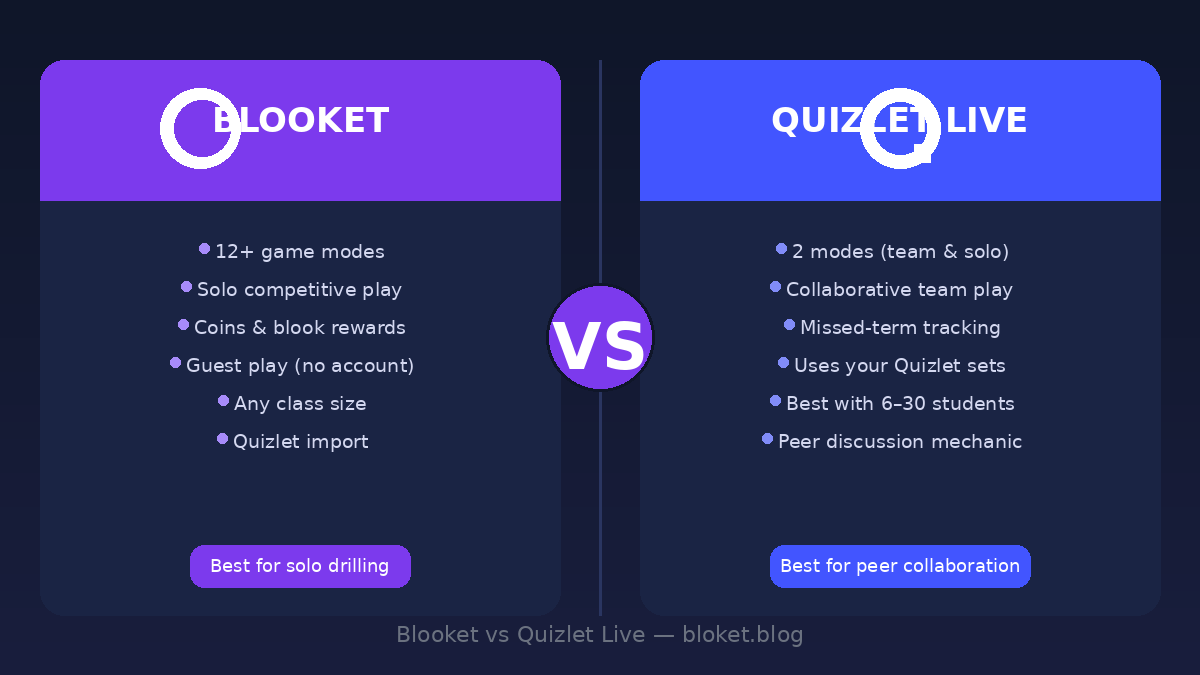
Blooket vs Quizlet Live: side-by-side comparison
| Feature | Blooket | Quizlet Live |
|---|---|---|
| Play style | Individual, competitive | Team-based or solo race |
| Game variety | 12+ distinct modes | 2 modes (team, solo) |
| Content source | Built-in sets, public library, Quizlet import | Quizlet sets only |
| Persistent rewards | Yes (coins, blooks, market) | None between sessions |
| Student accounts required | Optional (guest play available) | Required for team mode |
| Ideal class size | Any size | Best with 6–30 students |
| Setup time | Under 2 minutes | Under 2 minutes |
| Free tier | Generous (most modes available) | Limited Live features free |
| Paid subscription | Blooket Plus | Quizlet Teacher subscription |
| Platform focus | Game-based individual motivation | Collaborative peer review |
Which platform keeps students more engaged?
Engagement is contextual — what hooks one class leaves another cold. Both platforms have distinct profiles that make them work better with certain groups.
Individual vs. team play
Blooket’s solo structure means every student is always active. There is no waiting for a teammate, and no student who quietly lets others carry the group. In classes where participation is uneven, that individual accountability makes a real difference. Quieter students who disengage in group settings often show stronger participation in Blooket precisely because there is nowhere to hide.
Quizlet Live creates a different kind of engagement: social urgency. Students search for who holds the correct answer, ask questions about why one option fits, and argue choices in real time. In classes where students already have comfortable working relationships, that discussion layer can produce better retention than any individual game.
Sound, visuals, and rewards
Blooket commits harder to game aesthetics. Animated modes, a collectible character market, coin accumulation across sessions — these are the motivational engine. Students driven by collection and status among peers respond strongly to Blooket’s persistent reward system. The blook market gives them something to work toward before class even starts.
Quizlet Live is visually cleaner and deliberately minimal. Its engagement hook is competitive tension within the team race, not cosmetic rewards. Older students and adult learners who find Blooket’s style too young generally prefer Quizlet Live’s stripped-back approach.
Pricing: what’s free and what costs money
Both platforms run on a freemium model, but their free tiers cover different amounts of functionality.
Blooket free and Plus
Blooket’s free tier is genuinely functional for most classroom use. Teachers can create question sets, access the public library, and host games in most modes without paying. Students always play for free, with no account required for guest sessions.
Blooket Plus is a paid subscription that adds longer session hosting, more detailed post-game analytics, and extra classroom management features. The upgrade is worth considering for teachers who use the platform weekly, but the free version handles occasional use without meaningful limitation.
Quizlet free and paid tiers
Quizlet’s free tier allows study set creation and basic flashcard use, but it restricts full access to Live. Complete Quizlet Live functionality — ad-free hosting, detailed missed-term data, and folder sharing — requires the Quizlet Teacher subscription. Students can join Live games without a paid account, though they do need a Quizlet account to participate properly in team mode.
For schools where students already have Quizlet accounts, this is no barrier. For classes where accounts are not universal, it adds friction that Blooket’s guest-play option sidesteps entirely.
When to use Blooket vs. Quizlet Live
The Blooket vs Quizlet Live question does not have a single right answer. The smarter framing is: which platform fits this specific learning goal for this specific group of students?
Best use cases for Blooket
Blooket handles large, mixed-skill groups well. Because every student plays independently and simultaneously, class size does not affect the mechanic — 45 students running Tower Defense works the same as 12. It is also the better pick when student motivation is inconsistent; the coin and blook system creates a personal investment that persists across lessons.
Reach for Blooket for end-of-unit reviews, math fact practice, vocabulary drilling, and any session where you want high individual answer volume at a fast pace.
Best use cases for Quizlet Live
Quizlet Live earns its place when peer discussion is part of the learning goal. Team mode forces students to read options aloud, explain why one answer fits, and listen to their teammates. All of which encode the material more thoroughly than silent individual answering. It is especially effective for foreign language vocabulary, science terminology, and history terms where hearing and saying the word matters as much as recognizing it on a page.
Use Quizlet Live for collaborative review early in a unit, for warm-up activities at the start of class, and for sessions where you want students thinking out loud rather than just clicking answers.
Using both in the same class
Many teachers run Blooket and Quizlet Live in rotation, and there is a clear logic to the sequence. Use Quizlet Live early in a unit when the material is new and students benefit from talking through it together. Switch to Blooket as an exam approaches and individual speed and accuracy become the priority. The platforms complement each other rather than compete — they cover different phases of the review cycle.
FAQs
Can students join Blooket without an account? Yes. Students can join any Blooket session as a guest using only the game code — no account required to play. However, coins and blooks earned during guest sessions are not saved. Students who want to keep their rewards need to sign in with a free Blooket account before joining the game.
Does Quizlet Live work with any Quizlet set? Yes, and that’s one of its clearest practical strengths. Any study set you have built in Quizlet launches as a Live game instantly — no reformatting, no separate question input required. Teachers who already assign Quizlet for study can run the same set as a Live game the next day with almost no extra prep.
Which platform is better for large classes? Blooket handles large classes more comfortably. Since every student plays independently and simultaneously, having 40 students doesn’t change the experience at all. Quizlet Live’s team mechanic works best with groups of 6 to 30 students; very large classes can make team coordination noisier and harder to monitor from the front of the room.
Is Blooket or Quizlet Live better for younger students? Blooket tends to suit younger students, roughly ages 8 to 14, better. The animated game modes and blook collecting align with that age group’s motivators in a way that Quizlet Live’s more minimal design does not. Quizlet Live works across a wider age range and often lands better with high school and university students who respond to peer competition over character collecting.
Can teachers track which questions students missed? Both platforms offer reporting. Blooket shows live accuracy data during the game and provides post-session results by question. Blooket Plus adds more detailed per-student analytics over time. Quizlet Live flags the most-missed terms in real time during the game, which is immediately useful for adjusting the pacing of the session or planning a follow-up lesson.
Do all students need their own device? Yes, for both platforms. Even in Quizlet Live’s team mode, every student needs their own screen because teammates see different answer choices — the entire mechanic depends on that split information across individual devices. Shared devices break the experience in both tools.
Which platform has more ready-made content? Quizlet’s public library is substantially larger, built over many years by teachers and students worldwide. Blooket’s library is growing and covers common subjects well, and it supports direct import from Quizlet — so that content gap is largely bridgeable without manually rebuilding sets.
The verdict
Blooket wins on game variety, solo engagement, class size flexibility, and the persistence of its reward system across sessions. Quizlet Live wins on collaborative learning, peer discussion, and effortless content reuse for teachers already working inside Quizlet.
The Blooket vs Quizlet Live comparison is ultimately a question of what your class needs on any given day — not a permanent choice between two competing tools.
Start with whichever platform your students already have accounts on, run a few sessions, and pay attention to participation patterns. That real-world feedback tells you more than any feature list. Once you have seen how your class responds to each, running both in rotation is the approach most experienced teachers settle on — and for good reason.
Need a reliable roadmap to success? Turn to our expert-driven articles for proven guidance you can trust.