Blooket for High School Teachers: A Complete Guide
High school students are harder to impress than middle schoolers. They have seen every Kahoot round, survived every Quizlet Live scramble, and will raise an eyebrow at anything that feels like it belongs in fifth grade. Blooket is different — but only when you set it up the right way.
This guide is written specifically for high school teachers. It covers which game modes land with teenagers, how to build or find question sets worth using, and the classroom strategies that turn a short review tool into something students look forward to. The goal is practical and specific: by the end, you will know exactly how to run your first session and what to do differently the second time.
What makes Blooket click with high school students
Blooket succeeds with older students because it separates game strategy from correct answers. A student who answers every question right can still lose to someone who plays the in-game mechanics smarter. That tension keeps high schoolers engaged in a way that pure quiz formats rarely do.
Why the age gap matters
Freshmen through seniors are acutely aware of being labeled “the smart kid” or “the bad test-taker.” Blooket disrupts that dynamic. In Gold Quest, a wrong answer costs coins, but a well-timed steal can flip the entire leaderboard. In Tower Defense, a student who understands the game mechanics can outperform a student who knows every answer. That unpredictability levels the playing field in a way older students find genuinely fair — not because every student wins, but because the outcome is not predetermined by academic rank.
There is also the blook collection system. Students spend coins earned in-game to unlock new character designs. Teenagers who claim not to care about the game will still quietly check their blook inventory. The cosmetic layer provides a low-stakes motivation hook that does not require external prizes or grade incentives.
How Blooket fits against other tools for this age group
Kahoot’s live buzzer format tends to favor fast processors over deep thinkers, which frustrated older students notice quickly. Quizlet Live is team-based, which removes individual accountability. Gimkit is Blooket’s closest competitor at the high school level, offering similar economic mechanics but with a different question-delivery rhythm and fewer built-in game mode variations.
In classroom use across multiple subjects, Blooket’s mid-game strategy layer consistently produces longer sustained attention than straight flashcard formats. That is the core reason it belongs in a high school teacher’s toolkit — and why it works on students who have long since stopped caring about who buzzed in first.
How to set up Blooket as a high school teacher
Getting started takes under 20 minutes from a blank account to a live game. The platform is designed for teachers, and the setup flow reflects that.
Creating your teacher account
Go to blooket.com and sign up with your school email or a personal Gmail. Select the teacher role during registration. A free account gives you access to all game modes, basic analytics, and the ability to host unlimited live games. Blooket Plus is a paid subscription that unlocks additional features — longer question sets, detailed per-student reports, and extra hosting options — but the free tier is fully functional for most classroom needs and a reasonable starting point before committing to anything.
Building a question set from scratch
Click “Create Set” from your teacher dashboard. Add a title that maps directly to your unit, then enter questions one by one. Each question supports a text prompt plus up to four answer choices. You can also add an image to any question, which makes Blooket genuinely useful for diagram-based content in biology, chemistry, geography, or art history.
Keep sets between 20 and 40 questions for a typical 10–15 minute game session. Fewer than 15 questions causes repetition before the timer ends; more than 50 means a large portion of your questions never appear at all in a standard game.
Finding and vetting ready-made sets
Click “Discover” in the top navigation to search public question sets created by other teachers. Use specific search terms — “AP Biology cell division” or “SAT vocabulary tier two” will return far more useful results than broad category names. Before using any public set with students, preview every question yourself. Errors in public sets are common, and presenting a factually wrong answer to a room full of high schoolers will cost you credibility fast.
Build a personal folder of vetted sets organized by unit as you go. By the end of one semester, you will have a library of ready-to-launch reviews that require almost no preparation time to run.
Which game modes work best in high school classrooms
Not every Blooket mode fits a high school setting. Some reward speed over strategy in ways that frustrate older students; others create exactly the kind of competitive tension that keeps a class focused through the final five minutes of a period.
Gold Quest
Gold Quest is the most reliable mode for high school review. Students answer questions to earn gold coins, then choose to keep their coins, steal from a classmate, or swap totals with another player. The strategy layer is simple enough to explain in 60 seconds but creates genuine drama throughout — a student with half the coins of the leader can close the gap in two turns.
It works well for mixed-ability classes because correct answers are necessary but not sufficient for winning. Run it for 10–12 minutes as a unit warm-up, a mid-class reset, or a closing review before an assessment.
Tower Defense
Tower Defense asks students to answer questions to earn resources, which they spend placing defense towers to stop incoming waves of enemies. It takes two to three minutes for students to understand the mechanics on first play, but after that initial session they will ask for it by name.
This mode works best for individual play on personal devices. It is harder to monitor student progress in real time, so use it when your primary goal is self-directed review rather than formative assessment. It is also one of the few Blooket modes that feels genuinely different from a quiz — students report feeling absorbed in the strategy layer in a way that incidentally drives question repetition.
Cafe
In Cafe, students answer questions to earn ingredients and serve customers at a virtual café. The mode is more relaxed than Gold Quest and works well for warm-ups or low-stakes vocabulary review. Some high school students find the aesthetic a little young, so read your class before assigning it. In creative writing or English classes, however, it tends to land better than you might expect — it does not feel like a test, which is the point.
Factory and Fishing Frenzy
Factory mode involves producing blooks by answering questions, with stealing and sabotage mechanics similar to Gold Quest. Fishing Frenzy has students catch fish of varying point values after each correct answer. Both are solid alternatives when you want variety without introducing entirely new mechanics. They run at approximately the same pace as Gold Quest and require no extra setup.
Modes to use carefully or sparingly
Classic mode is essentially a straight quiz with leaderboard scoring and no strategy layer. It works well as a diagnostic at the start of a unit — you see exactly who knows what — but it does not hold attention the way game-mechanic modes do. Racing mode can tip into chaos in larger classes. Crypto Hack has interesting mechanics but a longer learning curve that makes it better for classes already familiar with Blooket.
Game mode comparison
| Mode | Best use | Competition level | First-time setup | High school fit |
|---|---|---|---|---|
| Gold Quest | Unit review, mixed ability | High | Under 2 min | Excellent |
| Tower Defense | Self-directed review | Medium | 3–4 min (first time) | Excellent |
| Cafe | Vocabulary warm-up | Low | Under 2 min | Good |
| Factory | Variety review | High | Under 2 min | Good |
| Fishing Frenzy | Short review bursts | Medium | Under 2 min | Good |
| Classic | Diagnostics | None | Under 1 min | Limited |
Subject-specific strategies for high school use
Blooket is format-agnostic. It works equally well for history terms, chemistry definitions, literary devices, foreign language vocabulary, or algebra rules. The question design strategy changes by subject.
Standardized test prep
Blooket’s four-choice question format mirrors multiple-choice assessments directly, which makes it well-suited for SAT, ACT, AP, and IB review. Build sets that mirror the vocabulary and conceptual framing of the target exam. For AP classes, focus sets on vocabulary, definitions, and cause-effect relationships rather than long reading passages, which do not translate into four-answer choices.
Run prep sets in Classic mode first to establish a baseline accuracy score, then use the same question set in Gold Quest in the following session. Our guide to the best Blooket sets for test prep covers how to structure SAT, ACT, and AP review. Students frequently report remembering which questions they got wrong during the game — the emotional spike of a stolen coin appears to sharpen retrieval in a way that passive review does not.
Vocabulary and term review
Term-definition pairs are ideal Blooket content: one question, four choices, one clear correct answer. For English, history, psychology, and foreign language classes, Blooket can replace or supplement paper flashcard drills without students feeling like they are doing extra work. For science classes, tie vocabulary sets to specific lab units rather than creating generic term lists — students engage more with content they can connect to something they did in the lab. Our roundup of the best Blooket sets for science class covers vetted options across biology, chemistry, and physics.
Mid-unit check-ins vs. post-unit review
Mid-unit Blooket sessions are underused and highly valuable. A 10-minute game after two or three lessons identifies gaps before they compound into test failures. Post-unit, Blooket functions as a low-stakes reset before an assessment — students are more likely to engage with review when it feels like a game than when it feels like another study guide. Use both types deliberately rather than defaulting to Blooket only as a reward at the end of a unit.
Getting high school students actually engaged
The biggest obstacle with older students is not the platform — it is buy-in. A class that collectively decides not to care will sit through Blooket just as passively as they sit through a lecture. The strategies below address that problem directly.
Solving the buy-in problem before the game starts
Give students a reason to care before launching the game. That reason does not have to be a grade. A class leaderboard posted near the door, the ability for the weekly top scorer to choose the next game mode, or a homework-pass for Friday’s highest score are all low-cost incentives that produce outsized engagement.
When I tested Blooket sessions with skeptical seniors in a twelfth-grade English class, the most effective motivator was not academic credit. Announcing that the top three scores could eat lunch in the classroom on Friday produced more genuine effort than any grade-based system I tried that semester. The actual prize mattered far less than the public acknowledgment.
Individual play vs. team formats
Blooket games run individually by default, but you can split a class into teams by having groups share a device and make choices collaboratively. Team play works better in classes where individual competition creates visible anxiety. It also changes the dynamic usefully in very large classes where individual attention is hard to distribute.
For most high school subjects and most class compositions, individual play is the stronger starting point. It generates more data per student, it is easier to debrief, and it preserves the personal stakes that make the game mechanics matter.
Calibrating game length
Twelve to fifteen minutes is the sweet spot for high school engagement — long enough for the game mechanics to influence the outcome, short enough to leave five minutes for debrief and transition. Games that run past 20 minutes see a clear drop in effort in the final stretch, as students who are trailing stop investing in catching up.
Display a visible timer and announce when five minutes remain. That countdown reliably triggers renewed effort from students who have been coasting. Build the announcement into your routine from the first session so students know to expect it.
Common mistakes high school teachers make with Blooket
Even well-planned sessions hit predictable friction points. Knowing them in advance makes them easy to sidestep.
Running it too frequently
The fastest way to flatten Blooket’s engagement is to run it every Friday as a standing routine. Once or twice per unit keeps the format feeling like a reward rather than a predictable obligation. High schoolers are particularly sensitive to anything that becomes a ritual — and predictable rituals lose their motivational value quickly.
Skipping the debrief
Blooket generates data, but the learning happens after the game, not during it. Spend five minutes at the end of every session reviewing the two or three questions most students got wrong. Pull up the question, explain the reasoning briefly, and connect it back to the unit. Skipping this step turns Blooket into entertainment without assessment value — which is fine occasionally but should not become the norm.
Ignoring the analytics
After a hosted game, Blooket shows each question’s accuracy rate across the class. That report is more useful than the final scores. A question that 60% of students answered wrong is a concept that needs to be retaught, not evidence that the question was hard. Check this data after every session and carry it directly into your next lesson plan.
Choosing the wrong mode for the moment
A high-intensity mode like Gold Quest during the last period on a Friday can tip from energetic to unmanageable. A calm mode like Classic used as a promised reward will visibly disappoint students expecting something dynamic. Match the mode to the moment: competitive modes for mid-week sessions with alert classes, lower-stakes modes for warm-ups and end-of-week wind-downs.
FAQs
Is Blooket free for high school teachers? The core Blooket features are entirely free, including all game modes, question set creation, and live game hosting. Blooket Plus is a paid subscription that adds extended question limits, detailed per-student reports, and additional hosting options. The free plan is fully functional for most high school classroom needs and a reasonable starting point before upgrading.
Can students join a Blooket game without creating an account? Students can join any live game using only the game code — no account required. Creating a free student account lets them save blooks and coins between sessions, which strengthens long-term engagement, but it is not a prerequisite. Student account creation requires only a username and password, with no email address needed.
How many questions should a high school Blooket set have? For a standard 10–15 minute session, 25–35 questions is the practical range. Fewer than 20 questions causes repetition before the game ends; more than 50 means a large portion of your content will never appear in a single session. For AP or standardized test prep sets, 35–45 questions allows more coverage without forcing repetition in shorter games.
Which Blooket mode works best for AP class review? Gold Quest is the most reliable starting point for AP review because it combines competitive stakes with consistent question exposure. Tower Defense is a strong alternative for students who prefer self-paced, individual practice. Avoid Classic mode for AP unless you are running a diagnostic to measure baseline knowledge before instruction begins.
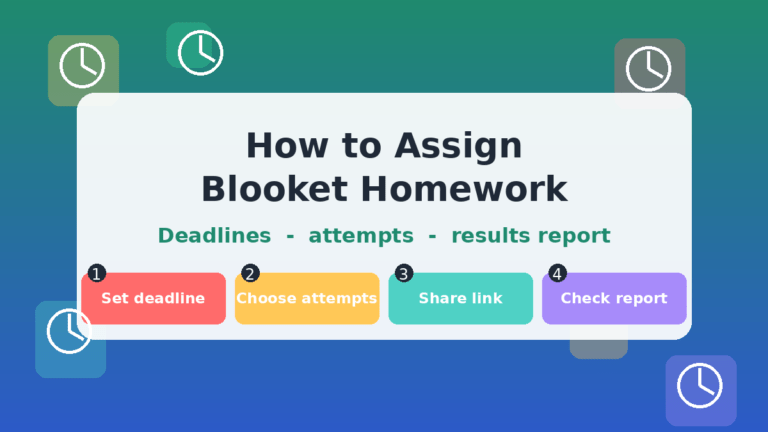
Can I assign Blooket as homework? Blooket includes a solo practice option that lets students play through any question set independently, outside a live hosted session. Assigning a specific set before the next class works well as a low-pressure review task. Completion is trackable through the teacher dashboard, though solo mode does not have the same competitive mechanics as live games.
What subjects benefit most from Blooket at the high school level? Blooket works for any subject with discrete recall content: vocabulary, historical events and dates, scientific definitions, grammar rules, foreign language terms, and math formulas. It is less well-suited for content requiring extended written reasoning or multi-step problems that cannot be distilled into four answer choices. Adapt question design to play to that strength.
How do I handle a student who is disruptive during a Blooket session? Remove in-game advantages rather than ending the session for the whole class. In Gold Quest, a student who loses device access temporarily also misses earning coins — that consequence is immediate and concrete without punishing other students. For scripts, screen-copying, and answer lookups specifically, our guide on managing Blooket cheaters in class covers detection and prevention. Ending the game entirely as a response to one student’s behavior penalizes the engaged majority, which creates its own classroom management problem.
Is it possible to use Blooket for group projects or presentations? Blooket is designed primarily as a review and assessment tool rather than a collaborative creation platform. However, assigning student groups to build their own question sets as a review project — then playing each other’s sets — is a genuinely effective use of it. Students who write the questions often remember the content better than students who only answer them.
Conclusion
Blooket earns a place in a high school classroom when it is used with intention: the right mode, a question set tied to current content, a calibrated game length, and a real debrief afterward. Used that way, it is one of the few review tools that can compete for a teenager’s attention without requiring a bribe.
Start with Gold Quest and a question set pulled directly from your next unit. Run it for 12 minutes, check which questions the class missed most, and carry that data into the following day’s lesson. That one session will tell you more about what your students actually know than a week of exit tickets.
Build your set library as you go, one unit at a time. By the end of a term, you will have a collection of ready-to-launch reviews that take two minutes to open and zero time to prepare — which is exactly what a high school teacher’s planning time actually allows.
Grow faster with smart reads—curated picks that actually move the needle.