Best Blooket alternatives for classrooms and self-study
Blooket is a great tool, but it is not the only one. Teachers run into content limits, students get bored of the same format, and some schools block it entirely. Whatever the reason you are searching, there are platforms out there that match or beat Blooket in specific areas — you just need to know which one fits your situation.
This guide covers the strongest Blooket alternatives available, what each one does well, where it falls short, and exactly who it is best suited for. No filler, just a clear comparison so you can pick and start using something new today.
What makes a Blooket alternative worth using?
A platform is worth switching to only if it solves the actual problem you have with Blooket. The best alternatives share three qualities: they make students want to participate, they give teachers enough control, and they do not require a steep learning curve to get a game running in under five minutes.
Game mechanics that keep students engaged
Blooket works because it wraps review questions inside mini-games with earning, stealing, and upgrading mechanics. A strong alternative needs some form of game loop — not just a timer on a quiz. Platforms like Gimkit use in-game currency. Quizizz uses power-ups. Kahoot uses a live leaderboard. Each of these creates a reason to keep playing beyond simply answering questions.
Teacher controls and classroom management
The teacher side matters as much as the student side. Look for platforms that let you import existing question sets, see individual student performance, and control pacing. A flashy student experience means nothing if you cannot pull a report afterward or if setup takes 20 minutes every class.
The best Blooket alternatives ranked
These are the platforms I have tested in real classroom and study sessions. Each one earns its spot because it solves a specific need better than Blooket does.
Gimkit — the closest feel to Blooket
Gimkit is the most direct Blooket alternative. Students answer questions to earn in-game money, then spend it on upgrades that help them earn faster. The loop is nearly identical to Blooket’s Gold Quest and Crypto Hack modes. Teachers can import questions from Quizlet or build sets from scratch.
The free plan limits you to a small number of question sets and game modes. Paid plans unlock more modes and a kit bank. If your students already enjoy Blooket’s economy mechanics, Gimkit is the smoothest transition.
Best for: Teachers who want Blooket’s feel with a slightly different game library.
Kahoot! — live competition with zero setup friction
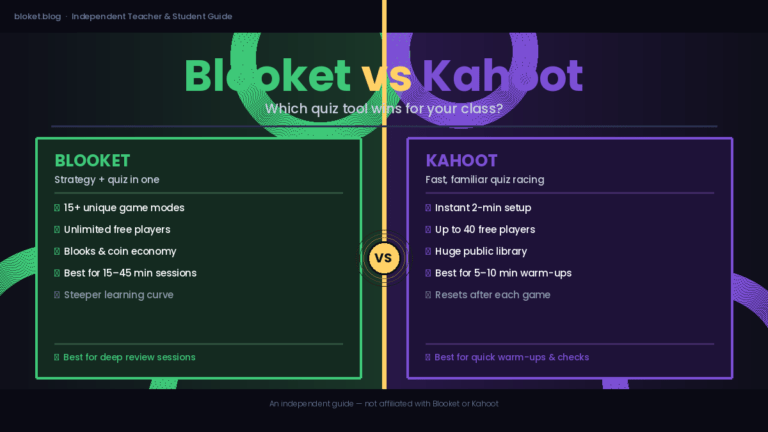
Kahoot is the most recognized name in classroom quizzing and for good reason. A game can be live in under two minutes. Students join with a PIN on any device, no account required. The competitive countdown timer and real-time leaderboard create genuine excitement, especially with larger groups.
The weakness is that Kahoot’s game format is almost entirely time-based. Faster students win, not necessarily more knowledgeable ones. It also lacks the persistent game-world mechanic that makes Blooket sticky. Still, for a quick energizer or review at the start of class, nothing launches faster.
Best for: Quick whole-class reviews, no-login situations, and new teachers who want something that just works.
Quizizz — self-paced with personality
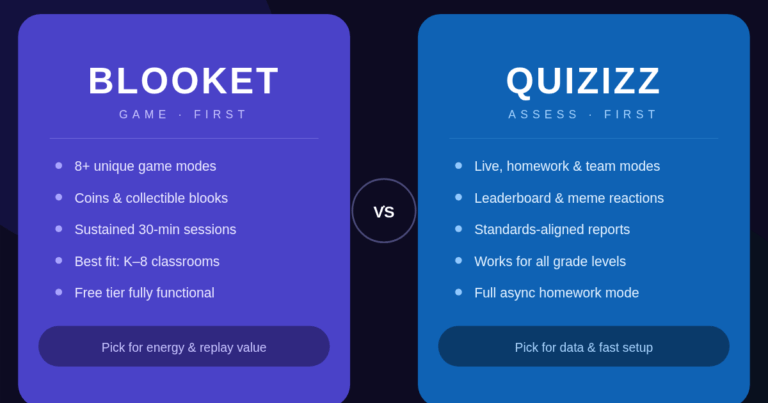
Quizizz lets every student move at their own speed, which immediately separates it from both Blooket and Kahoot. Questions come with memes, sound effects, and power-ups. Students can use power-ups to slow down opponents or skip questions, adding a strategy layer.
The teacher dashboard is one of the strongest in this list. You get detailed reports per student, per question, and per session. Quizizz also has a homework mode where students complete a quiz on their own time, and the results land directly in your dashboard.
Best for: Teachers who want detailed analytics and classes where ability levels vary widely.
Quizlet Live — collaboration built in
Quizlet is primarily a flashcard app, but Quizlet Live turns those card sets into a team game. Students are randomly grouped and must work together to answer correctly without knowing which team member has the right answer on their screen. One wrong answer resets the group’s progress, so communication actually matters.
The catch is that you need a Quizlet account to access Live, and the team format does not work well with very small classes. But for building collaboration alongside content recall, it is one of the only platforms that genuinely requires students to talk to each other.
Best for: Classes where you want to combine review with teamwork skills.
Wordwall — the widest game variety
Wordwall offers more game template types than any other platform on this list. The same set of questions can be turned into a quiz, a matching game, an anagram, a spin wheel, a crossword, or a maze — all from a single question set. Students can also play Wordwall games as homework without needing a teacher to host.
The free tier is limited to a handful of templates. The paid plan unlocks all of them and allows unlimited sets. For teachers who teach younger students or who need variety to avoid review fatigue, Wordwall’s range is genuinely hard to match.
Best for: Elementary and middle school teachers who need different game formats for different learning styles.
Nearpod — interactive lessons beyond quizzes
Nearpod is not a quiz tool. It is a full lesson delivery platform where quizzes are one part of a larger slide-based lesson. Teachers build or import presentations and drop in polls, draw-it activities, simulations, virtual reality slides, and quiz questions throughout.
This is overkill if you just want a five-minute review game. But if you want to replace a passive slideshow lesson with something interactive, Nearpod does it better than any other platform here. The student experience is fully teacher-paced, meaning everyone sees the same slide at the same time.
Best for: Teachers building full interactive lessons, not just standalone review games.
Bamboozle — free and team-based
Bamboozle is almost entirely free and runs team-based quiz games on a shared classroom screen. Teams answer in rounds, earn points, and compete on a live scoreboard. There is no student device needed beyond the projector view, which makes it work in classrooms with limited tech access.
The question library is growing but still smaller than Kahoot or Quizizz. You can build your own sets easily, but importing from other platforms is limited. For budget-constrained schools or situations where student devices are not available, Bamboozle is a practical choice.
Best for: Low-tech classrooms, budget schools, and quick team games on a single projector.
Factile — Jeopardy-style review
Factile builds Jeopardy-style board games. Teachers set up categories and questions, and students pick squares to reveal point values. It mirrors the TV format almost exactly and is especially popular for end-of-unit reviews where covering specific categories matters.
The free plan is functional but shows ads. A paid subscription removes ads and adds team features. Students who recognize the Jeopardy format engage quickly because the rules need no explanation.
Best for: High school teachers running structured end-of-unit reviews.
Side-by-side comparison
| Platform | Free tier | Student accounts needed | Self-paced | Best age range | Strongest feature |
|---|---|---|---|---|---|
| Gimkit | Limited modes | Optional | No | 10+ | Economy game loop |
| Kahoot! | Yes | No | No | All ages | Speed and energy |
| Quizizz | Yes | Optional | Yes | All ages | Analytics depth |
| Quizlet Live | Yes (with account) | Yes | No | 12+ | Collaborative play |
| Wordwall | Limited templates | No | Yes | 6–14 | Game format variety |
| Nearpod | Limited slides | Optional | No (teacher-paced) | All ages | Full lesson delivery |
| Bamboozle | Yes | No | No | 8–14 | Zero cost, team play |
| Factile | Yes (with ads) | No | No | 12+ | Jeopardy format |
How to pick the right platform for your class
The biggest mistake teachers make is picking the most popular option rather than the most appropriate one. Here is how to narrow it down fast.
Match the platform to your subject
Language arts and vocabulary work best on Quizlet Live and Wordwall because both platforms support matching, definitions, and word-based formats natively. STEM subjects work well on Quizizz and Gimkit where numerical answers and multi-step problems are easy to format. History and humanities benefit from Factile’s category-based structure.
Consider your students’ age and tech comfort
Younger students (ages 6–10) do best with Wordwall and Bamboozle because the mechanics are simple and visual. Middle schoolers handle Gimkit and Quizizz well because they can manage accounts and understand game economies. High schoolers can use any platform but tend to respond better to Nearpod when the content is genuinely complex.
Free vs paid: what you actually get
Every platform on this list has a workable free tier, but they differ in what they lock behind payment. Gimkit locks game modes. Wordwall locks templates. Quizizz locks advanced reports. Nearpod locks slide count and VR content. Before committing to a paid plan, run the free version for a full month and check whether you actually hit the limit — many teachers never do.
Common mistakes when switching from Blooket
Assuming all platforms work the same way
Blooket games run asynchronously — students can join late, play at their own pace, and the game runs until the teacher ends it. Kahoot and Bamboozle are synchronous and teacher-controlled. If you switch to Kahoot expecting the same drop-in experience, your late arrivals will be locked out. Always check whether a platform is live-hosted or self-paced before class day.
Skipping the teacher dashboard
Most teachers test the student view and forget to explore the teacher side. Every platform listed here has a reporting dashboard, and the quality varies significantly. Spend ten minutes after your first test game reading the reports before you decide whether a platform fits your workflow.
Overlooking student data and reports
If you ever need to justify game-based learning to an administrator or use quiz scores for grades, you need exportable data. Quizizz and Nearpod offer the most detailed exports. Kahoot’s free tier gives basic summaries. Bamboozle and Factile offer minimal reporting on free plans. Know your data needs before you pick.
FAQs
What is the best free Blooket alternative? Kahoot and Quizizz both offer strong free tiers with no meaningful feature walls for basic classroom use. Bamboozle is the best option if you need zero cost and no student accounts at all.
Which Blooket alternative is most similar to Blooket? Gimkit is the closest match. It uses the same currency-and-upgrade game loop that makes Blooket addictive, and students who enjoy Blooket typically take to Gimkit within one session.
Can students play these alternatives at home without a teacher? Quizizz, Wordwall, and Quizlet all support self-paced solo play. Students can review on their own time using assigned sets. Kahoot and Bamboozle are designed for live hosted sessions and are less useful for independent study.
Are these platforms safe for younger students? All platforms listed here have student-safe environments and comply with standard education privacy laws (COPPA and FERPA in the US, and equivalent laws in other countries). Platforms like Kahoot and Bamboozle do not require students to create accounts at all, which is the safest option for younger children.
Do any of these alternatives support multiple languages? Quizizz and Wordwall support multiple interface languages. Kahoot allows question sets in any language but the interface itself is primarily in English. Nearpod’s slides can be built in any language since teachers control all text content.
Which alternative works best without reliable internet? None of these platforms work fully offline, but Quizlet allows downloaded sets to be reviewed without a live connection. For low-bandwidth situations, Bamboozle and Wordwall are the lightest on data usage.
Can I import my Blooket question sets into these platforms? Direct import from Blooket is not supported on most platforms, but Quizizz, Gimkit, and Quizlet all allow CSV imports or Quizlet set imports, which means you can rebuild sets quickly. Gimkit also allows direct Quizlet import, cutting rebuild time significantly.
Conclusion
No single platform replaces everything Blooket does, but that is actually the point. Gimkit fills the game-economy gap. Quizizz fills the analytics gap. Kahoot fills the speed-and-simplicity gap. Wordwall fills the format-variety gap.
Start by identifying the one thing Blooket is not doing well enough for your class, then pick the platform from this list that solves exactly that. Run it for two weeks before judging it — the learning curve is short but real.
If you are not sure where to start, try Quizizz first. It has the most flexible free tier, the strongest reporting, and the gentlest learning curve of the group
Expand your understanding of today’s most complex issues—our extensive library holds all the missing pieces you seek.