Blooket Plus School Plan Details: What Teachers Get
If you’re trying to get your school or department onto a shared Blooket subscription, the information you actually need — feature lists, seat counts, billing options, admin tools — is scattered in ways that make it hard to evaluate quickly. This guide puts it all in one place. The Blooket Plus school plan gives multiple teachers access to premium features under one institutional subscription, with billing options that work for schools rather than individual credit cards. Whether you’re the teacher making the case to your principal or the admin signing the purchase order, here’s a complete breakdown of what the plan includes, how to apply, how it stacks up against free and individual accounts, and where it genuinely earns its cost.
What is the Blooket Plus school plan?
The Blooket Plus school plan is a paid subscription tier designed for schools or departments that want to extend premium Blooket access to several teachers at once. Rather than each educator purchasing an individual Plus subscription independently, the school pays for a set of teacher seats under one account umbrella — usually through a purchase order or institutional invoice.
The core idea is straightforward: teachers get all the features of a Blooket Plus individual account, and a designated coordinator or admin gets visibility across those seats. That admin layer is what separates the school plan from simply buying multiple individual Plus subscriptions. It adds a management dimension that individual plans don’t offer at any price point.
Who benefits most from this plan
The school plan suits situations where Blooket is a shared tool across a team, not a one-teacher experiment. It fits a department head who wants consistent access for every teacher in the group, an instructional coach overseeing formative assessment practice, or a technology coordinator rolling out a standardized set of classroom tools across a building. If several teachers are already hitting the limits of the free tier in their daily practice, the school plan formalizes and extends that use collectively.
How the school plan differs from individual Plus
An individual Blooket Plus account upgrades one teacher’s access. Everything happens within that teacher’s profile. The school plan bundles multiple Plus-equivalent seats under one paid agreement — similar to how a family plan covers a household and adds administrative oversight — a coordinator can monitor which teachers are active, what games are being run, and how student performance looks across different classrooms. This distinction matters most for administrators justifying the expense. A school plan generates data reviewable at a program level, not just within individual teachers’ accounts.
Every feature included in the Blooket Plus school plan
Each teacher seat on the school plan gets access to the same feature set as an individual Blooket Plus subscription, plus school-level admin tools on top. Here is what that means in practice.
Unlimited question sets
Free Blooket accounts cap how many question sets a teacher can create. That limit becomes a genuine problem for experienced users building review libraries across multiple units, subjects, or grade levels. Plus removes the cap entirely. For a department sharing sets, this means no one has to delete older content to make room for new material — the library can grow continuously across a school year.
Detailed student analytics
This is the feature that shifts Blooket from a fun review game into an instructional tool. After each game session, Plus accounts give teachers a granular breakdown of student performance — not just a final leaderboard, but data on which specific questions students answered correctly or incorrectly, how many attempts each question required, and how performance trended across the class.
Running games with student groups regularly, the question-level analytics surface patterns that a simple score completely hides. A class can finish a session with decent overall results while 60 percent of students consistently miss the same two questions. That’s exactly where reteaching effort should go, and the analytics make it visible in minutes rather than in the next unit test. The school plan extends this with an admin view, so a coordinator or department head can review usage and outcome data across multiple teachers’ classrooms without having to chase down individual reports.
Advanced game customization
Plus accounts unlock additional settings when hosting games. This includes finer control over game timing, student pacing options, and access to features the free tier either restricts or excludes. Teachers can tailor each session more precisely — a longer game for a comprehensive review unit, a shorter and faster format for a quick end-of-lesson check. That flexibility matters when you’re teaching different class periods with different energy levels and time constraints.
Expanded blook access
Blooks are the collectible characters at the center of Blooket’s reward system. Students earn in-game currency and use it to unlock blooks. Plus subscribers, and students playing in Plus-hosted games, have access to a wider pool than free-tier accounts allow.
For students, blook variety is a stronger motivator than it might appear from the outside. The collectible element drives consistent return engagement. Classes where the expanded pool is available tend to have students who bring up blooks independently as a reason they look forward to Blooket sessions — that kind of intrinsic pull is difficult to manufacture through other means.
Ad-free environment
Free Blooket accounts display ads in parts of the interface. The Plus school plan removes advertising for every teacher seat on the plan. In a classroom context, ads create practical concerns — they can distract during timed game sessions, and some school districts require additional policy review before using tools that display commercial advertising to students. Removing ads sidesteps both problems cleanly.
Priority support
School plan subscribers get faster access to Blooket’s support team compared to the standard free-tier queue. For a teacher running Blooket as a regular part of their lesson cycle, a technical issue mid-semester is genuinely disruptive. Priority support means problems get addressed in hours rather than days — a meaningful difference when a planned review session is sitting on your schedule for tomorrow.
Early feature access
School plan subscribers often receive access to new Blooket features through early-access rollouts before they roll out to the broader user base. This positions the school plan as a closer partnership with Blooket’s development cycle, and practically means your department gets to evaluate and adapt to changes before they land for everyone else.
How to get a Blooket Plus school plan
Purchasing a school plan is not the same process as buying an individual Plus subscription through standard checkout. It goes through a separate path built for institutional buyers.
Step 1: Count how many teacher seats you actually need
Before contacting Blooket, get a realistic number. Count only teachers who are already using the free version regularly or who have explicitly committed to using the platform. Paying for unused seats wastes budget and makes it harder to justify renewal. If you’re uncertain, start conservatively — adding seats later is typically possible.
Step 2: Contact Blooket through their schools or pricing page
School plans are not available through the standard checkout flow. Go to the official Blooket website and find the Schools or Pricing section. Submit a contact request for a school or bulk plan. You’ll be asked for your school name, the number of teachers, your role, and how you intend to pay.
Step 3: Request a quote and review the terms
Blooket will respond with a quote based on your seat count. Compare this against the cost of individual Plus subscriptions and pricing plans multiplied by your teacher count — per-seat pricing on school plans is generally lower at most seat volumes, but confirm that with the actual quote before committing. Review the terms carefully, particularly around subscription renewal, seat reassignment procedures, and what happens if teachers leave before the subscription period ends.
Step 4: Arrange institutional payment
School plans support purchase order billing. This means you can route the purchase through your school’s standard procurement process: submit a PO, get finance department approval, and have Blooket invoice the school rather than charging a personal card. For public schools operating within district purchasing rules, this is the most important practical feature of the school plan. Standard card payment also works for schools with simpler purchasing setups.
Step 5: Activate and assign seats to teachers
Once the subscription is confirmed and payment is arranged, the coordinator or lead teacher receives access and distributes it to the educators on the plan. Each teacher activates their own seat and has full Plus-level access within their individual account from that point forward. The coordinator retains the admin view across all active seats.
Blooket free vs. individual Plus vs. school plan
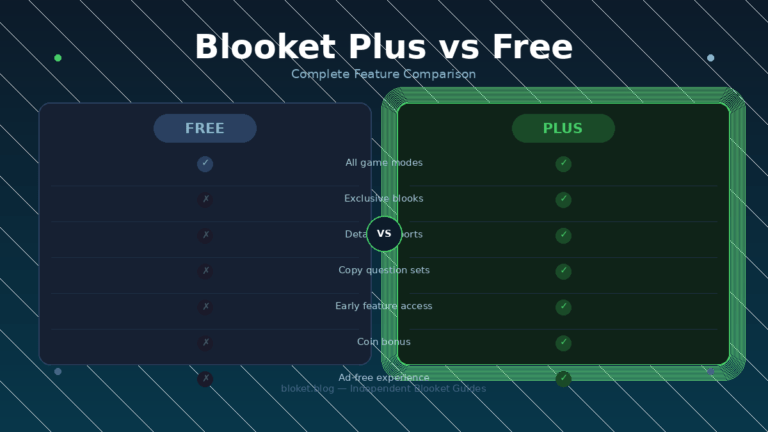
| Feature | Free | Plus (Individual) | School Plan |
|---|---|---|---|
| Question set limit | Capped | Unlimited | Unlimited |
| Student analytics | Basic | Full detail | Full detail + admin view |
| Ad-free | No | Yes | Yes |
| Advanced game settings | Limited | Full | Full |
| Blook pool | Standard | Expanded | Expanded |
| Payment method | None | Card | Card or purchase order |
| Admin/coordinator view | No | No | Yes |
| Cross-teacher set sharing | No | No | Yes |
| Priority support | No | No | Yes |
| Seats covered | 1 teacher | 1 teacher | Multiple teachers |
The school plan includes everything in individual Plus, adds administrative tools, and accommodates institutional payment. Individual Plus suits a single teacher working independently. The school plan is the right choice when two or more teachers want consistent access and a coordinator needs oversight of how the platform is being used.
Is the Blooket Plus school plan worth the cost?
The value depends on three factors: how many teachers will use it, how consistently they’ll use it, and how much the admin reporting layer matters to decision-makers in your building.
When the school plan pays off most clearly
The plan makes financial sense when three or more teachers in a department are actively running Blooket sessions on a regular schedule. At that scale, the per-seat cost of the school plan is typically lower than buying the equivalent number of individual Plus accounts, and the admin view adds something no individual account can offer regardless of price.
Schools working to build a formative assessment culture around student performance data benefit disproportionately from the school plan. The cross-classroom analytics give instructional coaches and department heads a way to see where students are struggling at scale — across an entire grade level or subject area — rather than inferring it from one teacher’s summary at a staff meeting.
When individual accounts are a better fit
If only one or two teachers in a building use Blooket, individual Plus subscriptions are simpler to manage and purchase. The school plan’s advantages — bulk pricing and admin oversight — only pay off when there’s genuine volume and a coordinator who will actually use the management layer. A two-person use case does not need a school plan.
How to make the case to an administrator
Lead with analytics, not engagement. Most administrators respond better to “question-level formative assessment data across classrooms” than to “students enjoy playing the game more.” Frame the school plan as a data infrastructure decision that happens to increase engagement, not the reverse.
The ad-free argument works well for administrators who are sensitive about commercial content in student-facing tools. And the PO billing option signals that this vendor works within institutional purchasing norms — something finance departments notice and appreciate after dealing with SaaS tools that only accept personal cards.
Signs the plan is delivering value
Watch for these indicators: teachers are running games consistently, students are completing question sets rather than just collecting blooks, and post-game analytics are influencing actual reteaching decisions. If any of those three are missing, the plan is being underused relative to what it offers.
How to get the most out of the school plan
Having access to Plus features is different from using them effectively. These practices make a meaningful difference over a school year.
Build a shared question set library across the department
Assign one teacher per unit or subject to serve as the lead builder for that content area. Others review and suggest edits. Over a semester, four teachers collaborating intentionally will build a library that any one teacher working alone could not match in the same time. The unlimited set cap means there’s no ceiling on how large that library can grow — so the habit compounds.
Review analytics directly after each game session
Set aside ten minutes after each game to look at the question-level breakdown before moving on to the next task. Identify the two or three questions most students missed and flag them for the next lesson. Teachers on a shared school plan can compare these patterns across their classes — if the same question is tripping up students in every period, that’s a signal about instruction, not just a quirk of one class group.
Rotate game modes across the school year
Students disengage when every Blooket session runs the same format. Plus access opens more customization and a variety of game modes. A fast-paced competitive mode suits a high-energy pre-test review. A slower, individual-paced mode works better for self-directed practice. Teachers on the same school plan can share what’s working for different class types, grade levels, or subjects, building a shared understanding of which modes suit which instructional moments.
Audit seat usage at least once per quarter
If you coordinate the school plan, check which seats are generating active game data at regular intervals. A seat that has been idle for two months represents budget going nowhere. Teachers who aren’t using their access might need training or a reminder — or the seat might be better reallocated to a colleague who would use it actively. Quarterly audits catch this before it compounds across a full subscription year.
Use blooks as structured unit incentives
Some teachers build blook goals into their unit structure — a class that completes a full review cycle correctly earns a special game session, or a student who reaches a personal analytics milestone unlocks a reward. This kind of structured use deepens the motivational pull of the platform without requiring additional prep time. Students who know what they’re working toward stay engaged across multiple sessions rather than treating each game as a one-off event.
Common misconceptions about the school plan
Misconception: the school plan includes student accounts
Students do not need Blooket accounts to play games. They join via a unique game code the teacher generates, and their session data is collected under the teacher’s analytics dashboard. The school plan seats and features all apply to teacher accounts only. Student-side access works the same way regardless of whether a teacher is on a free or paid plan — the differences students notice are the expanded blook pool and any game mode variations the teacher activates with Plus settings.
Misconception: each teacher handles their own billing
All seats on a school plan sit under one subscription and one payment arrangement. The coordinator manages billing on behalf of the group. Individual teachers on the plan have no separate billing relationship with Blooket. When a teacher joins or leaves the school, the coordinator adjusts the seat allocation — there’s no individual subscription to create or cancel on a per-teacher basis.
Misconception: sets are automatically shared across all seats
Question sets do not automatically become visible to all teachers on a school plan. Sharing is an intentional action — a teacher actively chooses to share a set with colleagues. The school plan enables that sharing capability, but it does not push sets out to all seats by default. You have to build the habit of sharing deliberately, usually by assigning someone to own that process for each subject or grade level.
FAQs
Can a single teacher purchase the school plan instead of individual Plus? The school plan is designed for multiple teacher seats and typically has a minimum seat threshold. A single teacher wanting Plus features should buy an individual Blooket Plus subscription, which is simpler to set up, manageable through standard checkout, and does not require a separate conversation with Blooket’s team.
Does Blooket offer a free trial of the school plan? Blooket’s free tier lets any teacher test the platform before committing to a paid plan. For school plan-specific features, contact the Blooket team directly — larger institutional purchases sometimes come with a preview period, but this is not a standard public offer and varies based on the situation.
How many teacher seats does a school plan include? There is no single fixed seat count. The plan is quoted based on your school’s specific request. Contact Blooket through their Schools or Pricing page with your teacher count, and they will provide pricing for that number of seats. You are not locked into a preset tier.
Can a school district use the plan across multiple buildings? District-level deployments spanning multiple schools are possible but involve a separate conversation with Blooket’s team about volume, billing structure, and admin access. A district covering many schools has different logistical needs than a single building, and the setup is handled on a case-by-case basis.
What payment methods work for the school plan? School plans support purchase order billing, which makes them compatible with most institutional procurement processes. Standard card payment also works for schools with simpler purchasing setups. The PO option is the one that matters most for public schools — a key advantage over many other paid tools operating within district procurement rules.
Is the per-seat cost on the school plan lower than buying individual Plus accounts? Per-seat pricing on school plans is generally lower than buying the equivalent number of individual Plus subscriptions, particularly as seat count increases. The exact difference depends on your seat count. Request a quote from Blooket and compare it directly against individual plan pricing for your situation before committing.
What happens to a seat when a teacher leaves the school mid-year? The coordinator can reassign the seat to a new teacher. The subscription continues under the school’s agreement, and departing teachers do not retain access after their seat is reallocated. Seat management sits with the coordinator account, not with individual teachers.
Does the school plan include student data privacy compliance documentation? Blooket maintains a privacy policy addressing student data in line with applicable regulations, including COPPA and FERPA requirements. School plan purchasers should review the current policy on the official Blooket website and request specific compliance documentation directly from Blooket’s team, since policy details are updated periodically and the most accurate version will always be on the official site.
Conclusion
The Blooket Plus school plan works best for schools where Blooket is already part of regular classroom practice and multiple teachers want to move beyond the limits of the free tier together. The combination of unlimited question sets, detailed analytics, ad-free gameplay, cross-teacher set sharing, and admin oversight gives a department more than a collection of unconnected individual accounts would — both in features and in the ability to measure impact at a program level. The PO billing option makes the procurement process workable for schools with formal purchasing requirements.
To move forward, go to the official Blooket website and find the Schools or Pricing section to request a quote for your seat count. Before you do, compare that quote against the cost of individual Plus accounts for the same number of teachers — in most cases, the school plan wins on per-seat price and adds tools that no individual subscription includes. That comparison makes the conversation with your admin straightforward.
Make every minute count by consuming quality content—invest your time in our posts and reap the rewards.