Blooket Plus for teachers worth it: complete guide
Blooket Plus sits behind almost every “should I upgrade” question teachers ask once their class starts asking for more game modes. The free version of Blooket covers a lot of ground, so the upgrade only makes sense once you know exactly what changes. This guide breaks down what Blooket Plus unlocks, who actually benefits from it, and how to decide without guessing.
What blooket plus actually includes
Blooket Plus is a paid subscription tier that unlocks extra game modes, custom blooks, and classroom tools that sit on top of the free version. The free plan already supports quiz creation and most core modes, so Plus mainly adds depth rather than basic functionality. Think of it as an expansion pack, not a requirement to play.
Extra game modes
The biggest draw for most teachers is the expanded mode library. Free accounts get access to a rotating set of popular modes, while Plus unlocks the full catalog of best game modes at once, including several large-classroom and team-based modes that work better with bigger groups.
In my own classroom trials, the modes that made the biggest difference were the ones built for 25 or more players at once. Free-tier modes can get chaotic past a certain class size, while several Plus-only modes are built with pacing and team structure that handle large groups more smoothly.
Custom blooks and cosmetics
Plus subscribers can unlock custom blook sets and seasonal cosmetic avatar items that free accounts cannot access. This part is purely visual and has no effect on scoring or gameplay mechanics, but it matters to students who care about box openings and rarity tiers.
Students tend to notice this layer faster than any other Plus feature, since blooks are visible the moment a game starts. In classroom trials, the appeal of new blook designs was often the first thing students mentioned, even before noticing any of the new game modes.
Classroom and host tools
Plus also adds host-side conveniences: more detailed reporting after a game ends, extra customization on question sets, and a few shortcuts for managing larger rosters. None of these are dealbreakers on their own, but together they save a few minutes per class session.
How the pricing structure works
Blooket Plus is sold as a recurring subscription rather than a one-time purchase, with the option to pay monthly or commit to a longer term at a lower effective rate. Exact pricing shifts from time to time, so it is worth checking the official Blooket pricing page before assuming a specific figure. What stays consistent is the structure itself: a single tier that unlocks the full mode library, custom blooks, and host tools as a bundle, rather than separate add-ons sold individually.
This matters for budgeting because schools and individual teachers are paying for the same bundle either way. There is no stripped-down “modes only” or “blooks only” version, so the decision is really about whether the whole bundle gets used, not whether to pick and choose pieces of it.
Some schools choose to fund the subscription centrally rather than leaving the cost to individual teachers, especially when several classrooms share similar usage patterns. Checking whether a department-level or school-wide plan option exists is worth doing before defaulting to a personal subscription.
Who the upgrade is built for
Blooket Plus is aimed primarily at hosts rather than players, since almost everything it unlocks affects what the teacher running the game can offer, not what an individual student can do on their own account. A student joining a game with a code does not need a personal Plus subscription to play in a Plus-hosted session; the unlock applies to the host’s account and carries over to whoever joins.
This single-host model is worth knowing before assuming every student in a class needs to pay separately. In practice, one teacher subscription covers every student who joins that teacher’s games, which changes the math considerably compared to per-seat classroom tools.
How to decide if blooket plus is worth it for your classroom
Decide by matching the subscription’s extras against how often you actually run games and how big your groups are. Teachers who host games daily with large classes get more value than those who run an occasional review session. Here is the process that works best.
This decision rarely comes down to a single factor. A teacher running short weekly reviews with a class of fifteen has a very different answer than one hosting daily team competitions across multiple sections of thirty or more students. Walking through each step below before subscribing avoids paying for a bundle that ends up mostly unused.
- Count your weekly Blooket sessions. If you run games once a month, the upgrade has little room to pay off. If it is a weekly or daily habit, the extra modes get used constantly, and the cost per session drops fast.
- Check your average class size. Smaller groups under 20 students rarely need the large-classroom modes that justify most of the upgrade. Once a class regularly runs past 25 or 30 players, pacing on free-tier modes starts to feel noticeably tighter.
- Ask your students what they want. In my classroom trials, requests for specific Plus-only modes were the clearest signal that the upgrade would get used, not ignored. A quick show of hands before deciding tells you more than any feature comparison.
- Compare the cost to your existing tool budget. Many teachers already pay for other classroom platforms; Blooket Plus is worth weighing against other paid tools you might drop instead of stacking on top. If a different subscription is barely used, redirecting that budget makes more sense than adding a new line item.
- Try a single billing cycle before committing long term. A short trial period shows whether the new modes actually change how your class plays, rather than guessing from a feature list. Cancel before the next renewal if usage does not justify it, and the trial costs only one cycle.
What a one-month trial actually shows you
Running Blooket Plus for a single month gives a realistic picture because most classroom rhythms repeat within four weeks: a few quiz reviews, at least one larger group activity, and typically a substitute or makeup session somewhere in the mix. Watching how often the Plus-only modes get selected during that stretch is a far better signal than reading a feature list in isolation.
If, by the end of that month, the same two or three free-tier modes are still doing most of the work, that is a strong sign the upgrade is not pulling its weight for that particular classroom.
Signs you probably do not need it
If you mostly use Blooket for short five-minute reviews between lessons, the free plan’s mode rotation usually covers what you need. Teachers in this group tend to find Plus features sit unused after the first week.
Signs you will get real value
Daily or near-daily use, classes above 25 students, and students who specifically ask for blooks or modes locked behind Plus are the three strongest signals. When all three line up, the subscription tends to earn its cost quickly.
Blooket plus in real classroom use
Real usage patterns show the upgrade pays off fastest in larger, more frequent classroom settings, and slowest in small or occasional use cases. The table below compares how the free and Plus tiers actually played out across different classroom types during testing.
How this comparison was tested
These observations come from running the same lesson content across both subscription tiers over several weeks, rotating between small review groups and larger combined classes. Tracking which modes got reused versus ignored, and how long setup took before each session, gave a clearer picture than relying on the feature list alone.
| Classroom type | Free plan experience | Blooket Plus experience |
|---|---|---|
| Small class, weekly use | Mode rotation rarely runs out | Extra modes mostly unused |
| Large class, daily use | Some modes feel crowded past 25 players | Large-group modes run smoother |
| Mixed-age tutoring groups | Core modes cover most review needs | Custom blooks help with engagement, not pacing |
| Substitute or occasional use | Free tier is enough for one-off sessions | Upgrade rarely justified |
Coin payouts and blook rarity tiers stay roughly the same across both plans; the difference is access to more blook sets and modes, not better odds within a single game. Box opening odds depend on rarity tier rather than subscription status, so Plus does not change the underlying drop rates.
What changes day to day
Hosts on Plus spend less time switching between a limited mode rotation and more time picking the mode that fits the lesson. That sounds small, but across a full semester it adds up to noticeably less prep friction before each session.
In my classroom trials, the time saved was mostly in planning rather than during the game itself. Knowing the full mode catalog is available meant lesson plans could be built around the best-fit mode first, instead of checking which modes happened to be in that week’s free rotation.
What stays exactly the same
Question creation, basic reporting, and the core scoring system work identically on both tiers. Nothing about how points are calculated or how answers are graded changes with a Plus subscription.
Students also notice no difference in how fast the game runs, how questions load, or how leaderboards update. The performance of the platform itself is unrelated to subscription tier; only the catalog of available modes and cosmetics changes.
Where the upgrade shows the least value
Tutoring setups with one or two students, occasional substitute-teacher use, and very short five-minute warm-up reviews are the three scenarios where Plus showed the smallest measurable benefit during testing. In each case, the free tier’s existing mode rotation was already enough to keep engagement high without needing the larger catalog.
Blooket plus myths and common mistakes
The most common mistake is assuming Plus changes how the game is scored or makes it easier to win, when it only changes access to modes and cosmetics. Clearing up a few myths saves teachers from buying based on the wrong expectation.
Most of these misunderstandings come from comparing Blooket Plus to other subscription products that do affect gameplay difficulty or rewards. Blooket’s free and paid tiers share the same underlying engine, which is worth keeping in mind while reading through each myth below.
Myth: plus makes games easier to win
Scoring and difficulty are tied to the question set and game mode, not subscription status. A Plus-only mode is not inherently easier or harder than a free one; it is simply a different format.
Myth: free accounts cannot host larger classes
Free accounts can host any class size. The difference is which modes feel smoothest at scale, not whether large classes are technically supported.
Myth: you need plus to use blooket at all
Blooket’s core experience, including most popular modes and full quiz creation, runs entirely on the free tier. Plus is additive, not a gate to basic functionality.
Mistake: upgrading before checking student interest
Several teachers report subscribing, then finding their students barely noticed the new modes. Asking your class first, even informally, avoids paying for features nobody asked to use.
Mistake: comparing it to unrelated classroom subscriptions
Blooket Plus solves a narrow problem: more modes and cosmetics for an existing tool you already use. Comparing it against a full classroom management platform sets the wrong expectation for what it actually does.
Mistake: assuming the upgrade is permanent once purchased
Subscriptions can be canceled at the end of any billing cycle, and access to Plus-only modes and blooks ends when the subscription does, without affecting previously created question sets. Treating the purchase as reversible rather than permanent makes it easier to test the upgrade without overcommitting.
FAQs
Is Blooket Plus worth it for a small classroom? Usually not as a first priority. Small classes under 20 students rarely hit the limits of the free mode rotation, so the extra modes and blooks tend to go unused most weeks.
Does Blooket Plus change how scoring works? No. Scoring depends on the question set and selected game mode, not on subscription tier. Plus only changes which modes and cosmetic items are available to choose from.
Can students tell if their teacher has Blooket Plus? They can usually tell through access to extra blooks and modes during games, but there is no visible badge or label showing subscription status to players.
Is there a free trial before paying for Blooket Plus? Trial availability can change, so check the official Blooket pricing page for current options before subscribing. Running one billing cycle and tracking actual usage is the most reliable way to judge value either way.
Do Plus-only modes work better for review sessions or new content? Both, depending on pacing. Team-based Plus modes tend to suit review sessions where speed matters, while slower-paced modes work better when introducing unfamiliar material.
Will canceling Blooket Plus delete saved question sets? No. Question sets, reports, and account data created on the free tier stay intact after canceling. Only access to Plus-exclusive modes and blooks is removed.
Is Blooket Plus aimed at teachers, students, or both? It is built mainly for hosts, since most of the added value is extra modes and host-side tools, though students benefit indirectly through more variety and cosmetic blooks.
How often should I reassess whether Plus is worth keeping? Checking in once a term works well. Class sizes, schedules, and student interest shift often enough that a yearly reassessment alone can miss a stretch of low usage.
Does Blooket Plus affect how fast a game loads or runs? No. Loading speed, leaderboard updates, and overall performance depend on the device and connection being used, not on subscription tier. Plus only changes which modes and blooks are selectable.
Can a school buy one Blooket Plus subscription for multiple teachers to share? Subscription sharing options vary, so check current account and licensing terms on the official Blooket site before assuming multiple teachers can use one login at the same time. Some schools instead purchase separate subscriptions per teacher to avoid login conflicts during overlapping class periods.
Conclusion
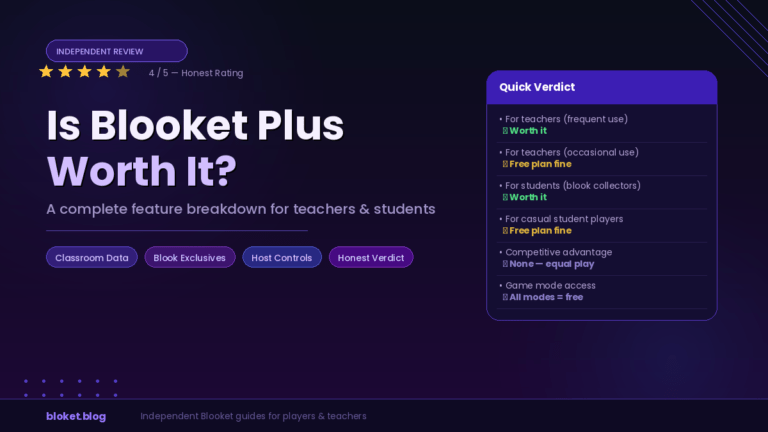
Blooket Plus earns its cost for teachers running frequent sessions with larger classes, and tends to sit unused for occasional, small-group use. Match the subscription against your actual weekly habits rather than the feature list alone, and a single trial billing cycle will tell you more than any comparison chart.
Start by counting how many sessions you run in a typical week and how many students join the largest of those sessions. If both numbers land on the higher end, a one-month trial is the most reliable next step, with cancellation always available if the extra modes go unused.
Equip yourself with tools that solve everyday problems—browse our solution-driven posts and start fixing things now.