Best Quizizz Alternatives Like Blooket for Classrooms
Quizizz works fine until a class starts asking for something with more game variety or a different pacing style. Plenty of teachers land on Blooket first, then wonder what else sits in the same category. This guide breaks down the strongest alternatives, what each one actually does differently, and how to match a platform to your classroom instead of guessing.
What makes a good Quizizz alternative?
A strong Quizizz alternative needs live or self-paced quiz modes, real-time class data for teachers, and enough game variety to keep repeat use interesting. The best options also import existing question sets instead of forcing a rebuild from scratch.
Quizizz built its reputation on self-paced quizzes students can complete on their own timeline, paired with a meme-and-leaderboard layer for engagement. Alternatives compete by offering different pacing models, different game formats, or stronger free tiers.
Why teachers look beyond Quizizz in the first place
The most common reasons are repetition fatigue from students seeing the same format every week, a desire for more game modes, and frustration with features locked behind a paid tier. A platform that rotates game styles tends to hold student attention longer across a school term.
In my own classroom trials, switching tools every few weeks kept review sessions feeling fresh, even when the underlying question content stayed identical. The format mattered more than the content in terms of student energy in the room.
The best Quizizz alternatives worth trying
Blooket, Kahoot, Gimkit, Quizlet Live, and Wordwall each cover a different gap left by Quizizz, ranging from richer game variety to stronger vocabulary-specific tools. Picking the right one depends on whether speed, strategy, or self-paced review matters most for a given lesson.
Blooket
Blooket runs the same question set through a rotating library of game modes, so the identical content feels new depending on which mode a teacher picks that day. Modes range from fast-paced racing formats to longer strategy-based games where students manage in-game resources.
The strategy modes are the biggest differentiator from Quizizz, since they reward planning and risk decisions on top of just answering correctly. A free tier covers most core game modes, with a paid Blooket Plus subscription unlocking extra features and a wider mode selection.
Kahoot
Kahoot popularized the live, projector-led quiz format where every student answers the same question at the same moment, racing against a visible countdown timer. The energy is built around speed and simultaneous competition rather than self-paced review.
This format works well for quick warm-ups and review games but offers less flexibility for homework-style self-paced assignments compared to Quizizz. Kahoot’s free tier covers basic live games, with a paid tier adding more advanced question types and reporting.
Gimkit
Gimkit was built by a student rather than a classroom company, and it shows in how much the game modes lean into in-game economies, where correct answers earn currency to spend on power-ups. This adds a layer of strategy closer to Blooket than to Kahoot’s pure speed format.
Gimkit’s live, simultaneous-play model means the whole class moves through the same session together, similar to Kahoot’s pacing rather than Quizizz’s self-paced model. A subscription unlocks additional modes and AI-assisted question generation on top of the free version.
Quizlet Live
Quizlet Live turns existing Quizlet flashcard sets into a team-based matching game, which makes it a strong fit for vocabulary and definition-heavy review rather than general trivia. Teams have to communicate to find matching answers across separate devices, which builds in a collaboration element the other tools don’t emphasize.
This narrower focus is both its strength and its limit, since it works best specifically for term-and-definition content rather than open-ended question formats. It pairs naturally with classes already using Quizlet for vocabulary study.
Wordwall
Wordwall stands apart by offering a wide library of game templates beyond quizzes, including matching games, word searches, and sorting activities built from the same content set. This makes it useful for younger classrooms or content that doesn’t fit a straightforward question-and-answer format.
The trade-off is that Wordwall’s quiz-specific modes feel less polished than tools built primarily around live quiz competition. It works best as a supplement for activity variety rather than a full Quizizz replacement on its own.
How these alternatives compare on key features
Pacing style, game variety, and free-tier generosity are the three factors that separate these tools the most clearly. The table below summarizes how each platform handles those factors compared to Quizizz’s self-paced quiz model.
| Platform | Pacing style | Game variety | Free tier coverage |
|---|---|---|---|
| Quizizz | Self-paced or live | Quiz format with themes | Broad, with some locked features |
| Blooket | Live, rotating modes | High, multiple distinct modes | Covers most core modes |
| Kahoot | Live, synchronized | Moderate, live quiz focus | Covers basic live games |
| Gimkit | Live, synchronized | Moderate, economy-based modes | Covers core gameplay |
| Quizlet Live | Live, team-based | Narrow, vocabulary matching | Tied to existing Quizlet account |
| Wordwall | Mixed, template-based | High, non-quiz activity types | Limited without upgrade |
Matching a platform to your teaching goal
For pure review speed, a live synchronized format like Kahoot or Gimkit keeps a full class engaged at once. For independent, self-paced practice similar to Quizizz’s original strength, sticking with Quizizz or pairing it with Blooket’s self-paced-friendly modes covers that gap better than the live-only tools.
Importing existing content between platforms
Most of these tools allow importing questions from a spreadsheet or a shared set, which removes the biggest barrier to trying a new platform. Testing an import with a small ten-question set before committing a full unit’s worth of content avoids wasted setup time if formatting doesn’t transfer cleanly.
Common mistakes when switching from Quizizz
The most frequent mistake is assuming every alternative copies Quizizz’s self-paced model, when several of these tools run live and synchronized instead. Checking the pacing style before a lesson, not during it, avoids a confused first run with a new class.
Myth: All quiz platforms work the same way
This is false. Pacing model, scoring approach, and game variety differ enough between these tools that a strategy built for one rarely transfers directly to another without adjustment.
Myth: A paid tier is required to get real value
Most of these platforms, including Blooket, cover core gameplay on a free tier, with paid upgrades adding extra modes or reporting depth rather than gating basic functionality entirely. Testing the free tier thoroughly before paying avoids an unnecessary upgrade.
Mistake: Switching tools mid-unit without a trial run
Introducing a brand-new platform in the middle of a graded unit risks losing class time to setup confusion rather than review value. Running a short, low-stakes trial game first lets students learn the interface before it matters for a grade.
FAQs
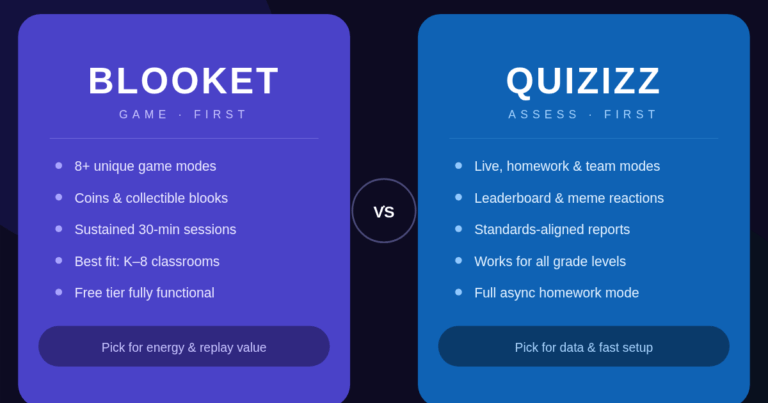
Is Blooket actually better than Quizizz? Neither is universally better. Blooket offers more game mode variety and strategy elements, while Quizizz offers stronger self-paced assignment features, so the right choice depends on the lesson goal.
Which Quizizz alternative is best for younger students? Wordwall’s broader activity templates and Blooket’s simpler game modes tend to work well for younger classrooms, since both keep instructions short and visual.
Can I import my existing Quizizz questions into Blooket? Blooket supports importing question sets from a spreadsheet format, so existing questions can usually be reformatted and brought over without rewriting them from scratch.
Do these alternatives work without a paid subscription? Yes. Blooket, Kahoot, and Gimkit all offer free tiers that cover core gameplay, with paid subscriptions adding extra modes or reporting features rather than gating basic use.
Which alternative is closest to a live, fast-paced classroom game? Kahoot and Gimkit both run live, synchronized rounds where the whole class answers at once, making them the closest match to a fast-paced live quiz format.
Is Quizlet Live a full Quizizz replacement? Not entirely. Quizlet Live focuses specifically on vocabulary and definition matching, so it works best alongside another tool for general trivia or mixed question formats.
How do I decide between Blooket and Gimkit? Both add strategy through in-game currency and power-ups, but Blooket offers more distinct game modes while Gimkit keeps the whole class on one synchronized round.
Do students need their own accounts to join these games? Most of these platforms allow students to join a live game as a guest using a join code, without creating a full account, which keeps setup quick for one-off sessions.
Final thoughts
Quizizz still works well for self-paced review, but Blooket, Kahoot, Gimkit, Quizlet Live, and Wordwall each fill a gap it leaves open, whether that’s game variety, live pacing, or vocabulary-specific practice. Match the platform’s pacing style to your lesson goal before picking one, since that single factor decides whether a switch actually improves the session. Try a short, low-stakes round with your class first, then build the next unit around whichever tool fit best.
Struggling to find the right direction in a noisy world? Let our comprehensive guides illuminate the clearest path forward.