Blooket vs Khan Academy: Which Tool Wins in Class?
Both platforms appear on nearly every “best EdTech” list, and teachers debate them constantly in professional development sessions and staffroom conversations. The instinct to compare them makes sense — both are free at the base level, both serve K–12 classrooms worldwide, and both claim to help students learn. But Blooket and Khan Academy are built for fundamentally different educational jobs, and treating them as direct competitors misses what each one actually does well.
This guide breaks down both platforms honestly — how they teach, how they track progress, where each one wins, and why most effective classrooms end up using both.
What Blooket and Khan Academy actually are
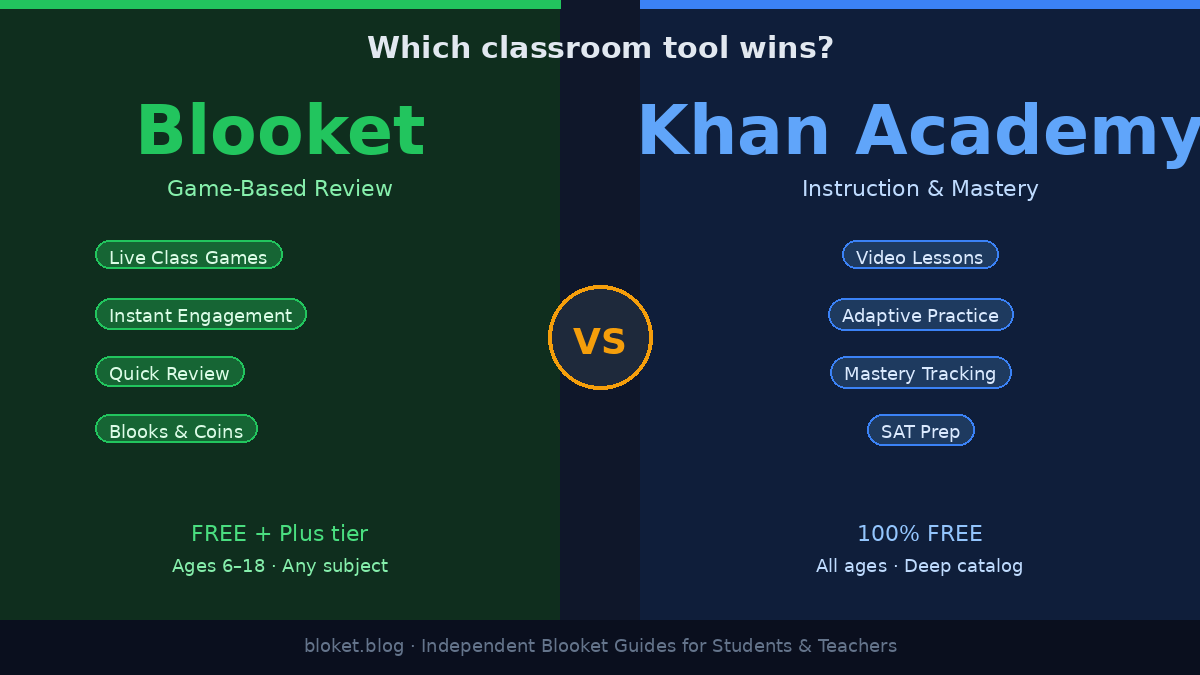
Blooket is a game-based review platform where teachers host live quiz-style games and students compete using collectible characters called blooks. Khan Academy is a free instructional platform offering expert-built video lessons, adaptive practice exercises, and full courses across dozens of subjects. One reinforces knowledge students already have. The other builds knowledge from scratch.
That single distinction shapes every comparison that follows.
Blooket: competitive review in a game shell
Blooket gives teachers access to a large library of community-created question sets — or lets them build their own — and wraps those questions inside multiplayer game modes. Students answer questions to earn in-game currency, collect blooks, or sabotage opponents depending on the mode. The competitive loop keeps classroom energy high, particularly with students in the middle grades.
The platform’s strength is reinforcement. A teacher can open a Tower Defense game, load a vocabulary set from last week’s lesson, and within minutes have 30 students actively retrieving information they need to retain. The results dashboard updates in real time, showing which questions tripped students up so the teacher can address gaps immediately after the game ends.
Blooket runs in any browser with no app download required, and most students learn the mechanics in under two minutes. The free plan covers everything most classrooms need for daily gameplay. Blooket Plus is a paid subscription tier that adds features like detailed post-game reports, extra game customization, and priority hosting during high-traffic periods.
Khan Academy: structured instruction for real learning
Khan Academy delivers full, self-contained courses built by subject-matter experts. A student can open a math unit they have never touched before, watch a clear instructional video, then work through scaffolded exercises that adapt based on their performance — all without a teacher present. That independence is the platform’s defining feature.
The subject catalog spans mathematics from foundational counting through multivariable calculus, chemistry, physics, biology, history, grammar, coding, economics, SAT preparation, and more. Each subject runs on a Mastery model: students must demonstrate understanding above a set threshold before the platform marks a skill complete and advances them to the next concept. Getting the answer right once is not enough.
For teachers, Khan Academy for Schools provides a dedicated dashboard where they can assign specific exercises or entire units, track individual student progress over time, and identify exactly which skills each student has or has not mastered before a test. That data arrives continuously, not just after a single session.
How the learning experience compares
Blooket and Khan Academy feel nothing alike to a student using them. One resembles a multiplayer mobile game with classmates; the other resembles working through a well-designed textbook — just a dramatically more interactive one. Understanding that difference is the fastest way to see which platform belongs in which moment.
Engagement and motivation
Blooket wins on immediate, visible energy. The competitive game mechanics — leaderboards shifting in real time, random coin rewards, blook steals, tower collapses — trigger engagement that keeps students focused without any external pressure from the teacher. A student who would tune out during a worksheet review will often stay fully locked in for a 15-minute Blooket session because the game itself is the reward.
Khan Academy motivates differently. Students earn energy points, build streaks, and watch skill mastery bars fill in as they progress. That system works well for self-directed learners who find intrinsic satisfaction in measured improvement, but it does not generate the same collective excitement as multiplayer competition. In a room of younger students, Khan Academy typically requires more teacher prompting to sustain momentum, whereas Blooket tends to sustain itself.
Depth of learning
Khan Academy goes significantly deeper at the concept level. When a student gets a problem wrong, the platform does not simply mark it incorrect and move on. It surfaces worked examples, offers hints that gradually reveal the solving strategy, and presents similar problems until the student demonstrates the skill. The video lessons are clear, short, and build on each other in a deliberate sequence that mirrors how a skilled teacher would explain a topic.
Blooket stops at the question. If a student answers incorrectly, they face an in-game consequence — losing coins, missing a power-up — but the platform provides no explanation of why the answer was wrong and no re-teaching of the underlying concept. For review of material students already learned, that is fine. For a student who missed a concept the first time, Blooket cannot close that gap.
Subject coverage and content quality
Khan Academy’s curriculum is fixed and carefully maintained. Its mathematics content is particularly exceptional, spanning every grade level with full alignment to major curriculum standards. Science, history, and language arts units are robust, though math remains the platform’s undisputed strength. The content is created by a dedicated team, which means consistency and accuracy across every lesson.
Blooket’s subject reach depends almost entirely on what teachers and the community have created. Any subject, from AP Chemistry to ancient Greek mythology to Grade 3 spelling, can become a Blooket game as long as someone has built a question set for it. The Blooket question library is large and searchable, but quality varies by set. Teachers should preview sets before using them with a class.
Which platform works better for teachers
Both platforms are functional without spending money, but they slot into different parts of the teaching cycle. Using both strategically is more efficient than trying to make one do everything.
Classroom management and live sessions
Blooket is designed for synchronous, live classroom use. The teacher opens a game, shares a six-digit code, and a full class joins from their devices in under a minute. Games run anywhere from five to twenty-five minutes, making Blooket a natural fit for warmup activities, energy resets in the middle of a long period, or end-of-class comprehension checks before students leave.
Khan Academy works far better asynchronously. Teachers assign units or individual exercises, students complete them independently — during a study hall, at home, or during silent work time — and the teacher reviews the accumulated data later. Trying to run Khan Academy as a live group activity is possible but feels forced compared to how the platform is built.
Progress tracking and reporting
Khan Academy’s teacher data tools are meaningfully more detailed. The dashboard shows which specific skills each student has mastered, how many attempts they made before succeeding, where they are currently stuck, and how each individual compares to the rest of the class. A teacher can see, before a unit test, exactly which students have not yet mastered long division — and assign them more targeted practice with two clicks.
Blooket’s reports show per-question accuracy and per-student accuracy for a specific game session. That information is genuinely useful for identifying which questions confused the most students, so the teacher knows what to address in the next lesson. But those reports do not build a longitudinal picture of each student’s skill growth over time. Blooket Plus improves the reporting, but even the premium tier operates on a session-by-session basis rather than tracking mastery across weeks or months.
Setup time and day-to-day ease
Blooket is faster to set up for a single classroom session. Finding an existing question set, selecting a game mode, and opening the lobby takes under three minutes. Building a custom set from scratch takes longer but is straightforward, and teachers can copy and edit public sets freely.
Khan Academy requires more initial configuration — creating a teacher account, setting up a class roster, and aligning assignments to curriculum scope and sequence. Once that structure is in place, assigning new content takes seconds and the platform handles all pacing and progress tracking automatically. The upfront investment pays off for teachers who want ongoing independent student practice without building new resources each week.
Cost and access
Khan Academy is completely free for students, teachers, and schools, supported by donations and philanthropic grants. Every feature — the full course library, teacher dashboard, student progress tracking, and SAT prep content — is available at no cost.
Blooket’s free plan allows unlimited daily gameplay with no cap on the number of students in a game. Blooket Plus adds reporting depth, additional game customization, and hosting priority, but the free tier is more than sufficient for regular classroom use.
Which platform works better for students
A student’s experience on each platform shifts significantly depending on whether they are in a room with 25 peers or sitting alone at home with a homework assignment.
In-class group use
Blooket delivers something Khan Academy cannot replicate in a live class setting: shared competitive energy. When students are neck-and-neck on a leaderboard, reacting to stolen gold coins, or cheering as a tower falls, the learning is embedded in a social experience that makes the time feel worth showing up for. That dynamic matters for classroom culture, attendance, and the tone teachers set around subject matter that students might otherwise find dry.
Khan Academy in a classroom context works best as structured independent silent work, with each student advancing through their own assigned tasks. That model has genuine value — differentiated pacing, individual accountability, reduced noise — but it is not a group experience in any meaningful sense, and it does not replicate the energy Blooket generates.
Independent study and homework
Khan Academy is significantly stronger as a homework and self-study tool. A student who did not fully grasp a concept during class can work through the relevant Khan Academy unit independently, get stepped hints when stuck, watch the explanatory video as many times as needed, and demonstrate mastery before moving on. The platform genuinely teaches. A student can make real academic progress on Khan Academy without any teacher present.
Blooket has solo game modes, but playing alone removes most of what makes Blooket engaging. Without the competitive social layer, it becomes a flashcard app with a visual skin. A student can get quiz repetitions, but they cannot develop understanding of material they never grasped in the first place. Blooket alone at home is limited; Khan Academy alone at home is powerful.
Standardized test preparation
Khan Academy holds a clear advantage for exam prep. Its College Board partnership for SAT preparation is the most prominent example — the platform delivers official practice questions built directly from real test data, adaptive diagnostics, and full-length practice tests. Students who use it consistently before the SAT typically show measurable score improvement.
For other standardized exams, Khan Academy’s subject depth across math and science covers most test content thoroughly. Blooket contributes here in a supporting role: teachers can build question sets around test-format content to give students high-speed retrieval practice under mild competitive pressure, which trains the pace-of-recall skills that standardized testing demands.
Blooket vs Khan Academy side by side
| Feature | Blooket | Khan Academy |
|---|---|---|
| Primary purpose | Review and reinforcement | Instruction and mastery |
| Content source | Teacher and community-created | Expert-built curriculum |
| Learning depth | Surface recall and retrieval | Conceptual understanding |
| Best setting | Live classroom, group play | Homework, independent work |
| Subject flexibility | Any subject (teacher-built sets) | Fixed catalog, very deep |
| In-class energy | Very high | Moderate |
| Progress tracking | Session-based accuracy | Longitudinal mastery data |
| Standardized test prep | Limited (teacher-built sets) | Strong, especially SAT |
| Free access | Yes (Plus tier is paid) | Yes, completely free |
| Works without a teacher | Limited | Yes, fully self-contained |
When to use each platform — and why many teachers use both
The most effective EdTech strategy is not picking one platform and defending it. Blooket and Khan Academy serve different instructional moments, and using each one at the right time produces better outcomes than forcing either tool to do a job it was not designed for.
Reach for Blooket when…
Use Blooket any time you need to check retention quickly and maintain group energy while doing it. End-of-week vocabulary reviews, warmup quizzes before introducing a new unit, mid-unit retrieval practice for formulas or historical dates — these are natural Blooket moments. It is also effective for differentiated review: a teacher can run two different question sets with the same game mode simultaneously, letting students at different levels review material appropriate to where they are.
Blooket also works well before a high-stakes assessment. Running a class-wide game the day before a test surfaces exactly which questions students are still missing, and the game format keeps the review session from feeling like last-minute panic cramming.
Reach for Khan Academy when…
Use Khan Academy when students need to encounter material for the first time, revisit a concept they never fully understood, or build a skill over multiple days or weeks. It is the right tool for intervention: a student who is three grade levels behind in math can work through Khan Academy independently, catch up on foundational skills without embarrassment, and move at whatever speed their current understanding allows.
Khan Academy also fits naturally into flipped classroom models, where students watch a video and complete an initial exercise at home, then arrive to class ready to apply the concept through discussion or problem-solving rather than passive listening.
Why using both makes sense
These platforms complement each other cleanly across a full unit cycle. A teacher might assign a Khan Academy unit on fractions at the start of the week. Midweek, after checking the dashboard to see which students are progressing and which are stuck, the teacher runs a targeted Blooket review to reinforce the skills students already absorbed. The end-of-game accuracy data shows lingering gaps. The teacher then assigns specific Khan Academy exercises for those skills before the unit assessment.
Neither platform replaces the teacher. Both reduce the time teachers spend building repetitive practice materials from scratch, so that planning energy goes toward the parts of teaching that require human judgment — facilitating discussion, explaining concepts in the moment, and responding to what students bring into the room each day.
FAQs
Is Blooket better than Khan Academy? Neither platform is objectively better — they are designed for different educational jobs. Blooket excels at live classroom review, group engagement, and fast comprehension checks. Khan Academy is stronger for teaching new concepts, self-directed study, and tracking skill development over time. The better choice depends entirely on what a teacher or student needs at a specific moment.
Can Blooket replace Khan Academy? No. Blooket tests recall of material students already know but does not include instructional video, concept explanations, or adaptive exercises. A student who never understood a concept will not learn it from Blooket — they will simply get it wrong and move on. Khan Academy can function as a standalone learning tool; Blooket cannot.
Is Khan Academy completely free for schools? Yes. Khan Academy’s full platform — the entire course library, teacher dashboard, student progress tracking, and SAT prep content — is free for students, teachers, and schools. The platform accepts voluntary donations to sustain operations, but no features are locked behind a paywall.
Which platform is better for younger students? Blooket tends to engage younger students more immediately. The game mechanics, blook characters, and competitive multiplayer format are highly appealing to students roughly in grades 2 through 7. Khan Academy works well for younger learners too, especially in math, but requires more self-direction to sustain. For a lively group classroom experience with younger students, Blooket is typically the stronger day-to-day tool.
Does Blooket teach new content or just review it? Blooket reviews content — it does not teach it. Teachers write the questions, students answer them, and the game tracks accuracy. If a student does not know the answer, Blooket marks it wrong and the game continues. There are no explanatory videos, worked examples, or concept hints. Use Blooket for retrieval practice; use Khan Academy when students need to actually learn something new.
Can teachers use both platforms in the same class? Absolutely, and many do. A common approach is to use Khan Academy for instruction and homework and Blooket for in-class review. The two platforms fit naturally into different phases of a unit cycle without creating extra teacher work or confusing students about which tool to open.
Which platform provides better data for teachers? Khan Academy provides more comprehensive, longitudinal tracking. It shows mastery levels per skill, time spent, attempt counts, hints used, and skill gaps — all tied to individual students and updated continuously. Blooket’s data is snapshot-focused: it tells a teacher how students performed in a single game session, which is useful but does not replace the growth-tracking data Khan Academy delivers.
Does Blooket work for high school students? Yes, though engagement varies. High school students playing Blooket in a class setting with their peers often enjoy it just as much as younger students. The competitive format and blook collecting have broad appeal. For older students doing independent study or exam preparation, Khan Academy’s content depth and SAT partnership make it far more useful than Blooket for self-directed work.
Conclusion
Blooket and Khan Academy both belong in a thoughtful digital classroom — just at different points in the teaching cycle. Blooket handles live review, group energy, and quick comprehension checks better than almost any tool available. Khan Academy handles instruction, independent study, and long-term mastery tracking in ways Blooket was never designed to.
If you only have bandwidth to try one platform, let the teaching moment guide the choice: open Khan Academy when students need to learn something, open Blooket when they need to review something they have already covered. If you have time to build both into your practice, use Khan Academy for the learning phase and Blooket for reinforcement — and let the data from each inform how you teach the next lesson.
The free tier of both platforms is worth exploring in the next class period. Run one Khan Academy assignment and one Blooket game, watch how students respond to each, and the role each tool plays in your classroom will be obvious within a week.
Curious about what truly works in your specific situation? Access our detailed case studies and learn from real-world successes.