Blooket vs Prodigy: Which Is Better for Your Classroom
Both Blooket and Prodigy have earned devoted followings among teachers and students, and both get described as “game-based learning.” That label covers very different things. Blooket is a flexible question game engine that works across any subject — a fast, competitive tool teachers control completely. Prodigy is a math and English RPG with built-in curriculum that runs largely on autopilot once a grade level is set.
Picking one over the other, or knowing when to use both, depends on what you’re teaching, who your students are, and what engagement looks like in your classroom. This guide compares every major factor — gameplay, subject coverage, pricing, grade fit, and real classroom use — so teachers and students can make a confident call.
What Blooket and Prodigy actually are
Blooket and Prodigy are both free-to-start, browser-based platforms that frame learning as gameplay. Beyond that surface similarity, they are built on very different ideas about how educational games should work.
Blooket: a flexible question game platform
Blooket is built around question sets. A teacher creates or copies a set of multiple-choice or true/false questions on any topic, then launches a game mode where students compete by answering correctly. The platform offers around a dozen distinct game modes, each with its own mechanics — from stealing coins in Gold Quest to surviving elimination rounds in Battle Royale.
The flexibility is the whole point. Because teachers supply the content, Blooket works for history, science, vocabulary, math, foreign languages, or anything else that fits a question-and-answer format. Students join with a six-digit code and play in real time, usually from a phone or laptop, with no personal account required.
Blooket also has a solo play option for homework or independent review, plus a public question library teachers can search, borrow, and edit.
Prodigy: a curriculum-aligned math and English RPG
Prodigy puts students inside a fantasy world where wizard characters battle monsters by answering questions. Teachers do not create question sets here. Instead, a teacher sets a grade level and the system delivers questions tied to that grade’s math or English standards automatically.
Prodigy Math covers grades 1 through 8, from basic number operations through early algebra. Prodigy English targets reading and language skills for grades 1 through 6. Both games share the same RPG world and the same character progression system, so students working in either subject see one continuous adventure.
The RPG design is what separates Prodigy from other practice platforms. Students earn gear, hatch pets, and explore new areas as they answer questions, which creates longer, more self-directed sessions than a typical timed quiz game.
How the gameplay actually works in each
The mechanics of each platform shape not just how students experience it, but how much ongoing management teachers need to do.
Blooket game modes: fast, varied, and competitive
Blooket’s game modes each translate correct answers into different in-game outcomes.
- Gold Quest: Answering correctly lets a player open a treasure chest for coins, but a wrong answer gives coins to an opponent. The unpredictability drives tension that students genuinely enjoy.
- Tower of Doom: Students attack opponents’ towers by answering questions. Sustained accuracy matters more than luck here.
- Battle Royale: Players are eliminated as rounds progress. The last one standing wins, which creates very high engagement and a lot of noise.
- Factory: Correct answers speed up a factory that generates blooks — Blooket’s collectible characters. Quieter and better suited to individual review sessions.
- Fishing Frenzy, Cafe, Deceptive Dinos, and others: Blooket adds new modes regularly, and each one reframes the same question-answer loop in a fresh setting.
A full class game typically runs 5 to 20 minutes, and teachers control the time limit. The pace holds attention during a short review block without letting the game drift away from the content.
Prodigy’s RPG loop: longer, self-directed, and immersive
Prodigy’s core loop works on a different rhythm. A student character walks the map and encounters an enemy. A battle opens. To cast a spell, the student answers a curriculum question. Answer correctly and the spell fires; answer incorrectly and the enemy attacks instead.
Between battles, students explore the world, collect gear, and interact with characters in the story. The game tracks progress through a long campaign that can span an entire school year. A single session naturally runs 20 to 40 minutes, and many students log in at home without any prompting.
Teachers access a separate dashboard where they can assign specific skill areas, view progress reports, and identify which questions students are struggling with. The data is detailed enough to inform instruction and share with parents.
The tradeoff is customization. Teachers can target skills within a grade level but cannot write their own questions or adjust the difficulty beyond grade assignment. What the curriculum includes is what students practice.
Subject coverage and grade-level fit
This is where the two platforms diverge most clearly, and where the decision often makes itself.
What Blooket covers
Blooket has no built-in curriculum. It is purely a game engine, which means it covers every subject and every grade level, as long as a question set exists for it. The public question library contains sets for elementary math, high school chemistry, SAT vocabulary, AP history, world geography, Spanish verb conjugation, and almost anything a teacher might search for.
For teachers who want full control over what students practice, Blooket wins without contest. A 10th-grade English teacher can run a Blooket session on Shakespearean terminology within minutes of deciding to do it.
The limitation is reporting depth. Teachers see which questions students answered correctly during a session, but the data does not automatically map to specific learning standards unless the teacher structures question sets that way deliberately.
What Prodigy covers
Prodigy Math covers major math standards for grades 1 through 8: number operations, fractions, geometry, measurement, and early algebra. Prodigy English covers phonics, vocabulary, reading comprehension, and grammar for grades 1 through 6.
That is a meaningful boundary. A high school teacher, a middle school social studies teacher, or a science teacher cannot use Prodigy for their content. The platform exists specifically for elementary and middle school math and English.
Within those subjects, though, Prodigy’s coverage is thorough and standards-linked. Progress reports show skill mastery by standard, which feeds directly into parent conferences, intervention planning, and any school documentation that requires evidence of curriculum alignment.
Which grade range fits best?
| Grade range | Better fit |
|---|---|
| Grades 1–3 | Prodigy for math and English; Blooket for simple review in other subjects |
| Grades 4–6 | Both work well; Prodigy for math/English, Blooket for everything else |
| Grades 7–8 | Blooket for most subjects; Prodigy Math still works for foundational math skills |
| Grades 9–12 | Blooket only (Prodigy does not serve secondary grades) |
| College or adult learning | Blooket only |
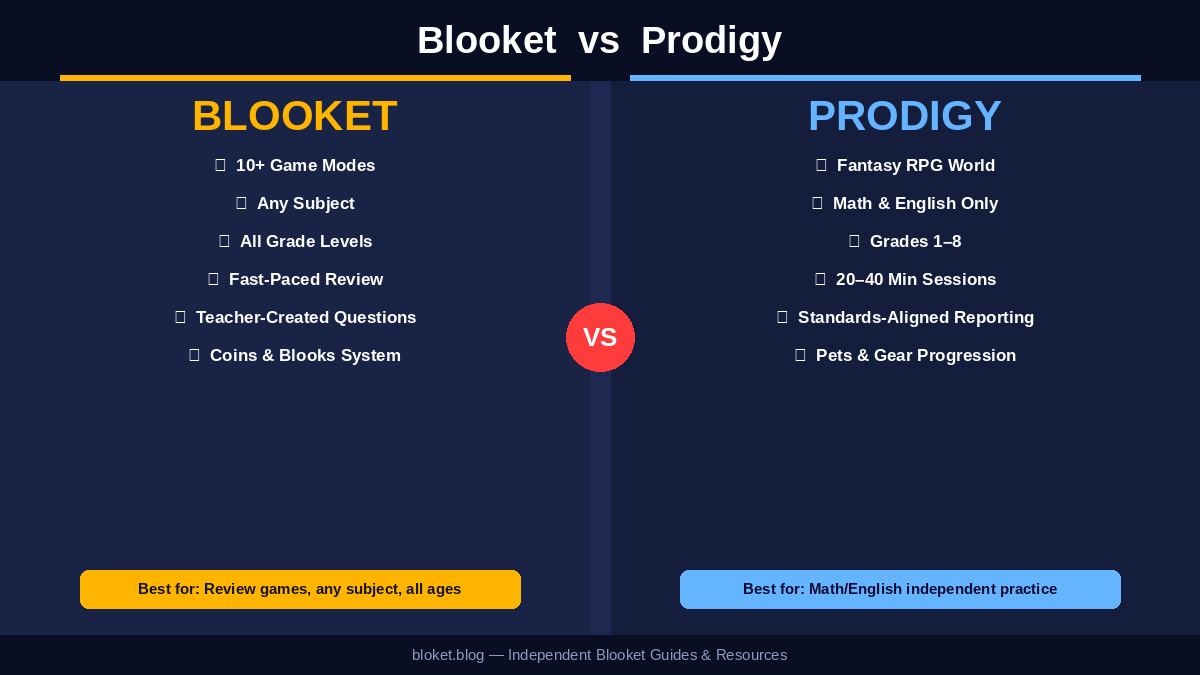
Blooket vs Prodigy: a direct comparison
Here is how the two platforms compare across the factors teachers and students care about most.
| Feature | Blooket | Prodigy |
|---|---|---|
| Subject coverage | Any subject | Math and English only |
| Grade range | All grades | Grades 1–8 |
| Content creation | Teacher-created or shared question sets | Built-in, standards-aligned curriculum |
| Gameplay style | Fast, competitive mini-games (5–20 min) | Long-form RPG (20–40+ min) |
| Game variety | 10+ distinct modes | Single RPG world with ongoing progression |
| Customization | High — teacher controls all questions | Low — teacher selects grade and skill only |
| Student motivation | Blooks, coins, leaderboards, mode variety | Gear, pets, world exploration, story |
| Progress reporting | Basic — per-game accuracy data | Detailed — skill mastery mapped to standards |
| Teacher setup time | Low to moderate — requires finding or creating a question set | Very low — set grade level and done |
| Free tier | Functional for most classroom use | Functional for most classroom use |
| Paid upgrade | Blooket Plus (teacher subscription) | Prodigy Premium (parent/student subscription) |
| Homework or independent use | Yes — solo game modes available | Yes — students frequently play voluntarily at home |
| COPPA compliance | Yes | Yes |
| Platform access | Browser, iOS, Android | Browser, iOS, Android |
Pricing: what the free tiers include and what upgrades add
Blooket’s pricing model
Blooket’s free plan gives teachers full access to the core experience: creating question sets, hosting live games, running all game modes, and reviewing basic game reports. For most classroom use, the free plan covers everything essential.
Blooket Plus is a paid teacher subscription that adds features like more detailed analytics, the ability to assign question sets as homework, early access to new game modes, and additional customization settings. Students never pay for Blooket. They join games with a code and play entirely for free, regardless of whether their teacher has Plus.
Prodigy’s pricing model
Prodigy’s teacher account is free and remains free. Teachers can assign skills, view progress reports, and manage classes without a subscription. The core academic experience for students is also free.
Prodigy Premium is a subscription sold to parents and students, not to teachers or schools. It unlocks cosmetic and gameplay extras for individual students — additional pets, gear, and in-game items — but does not change the academic content or questions. A student with Premium and a student without Premium see the same math problems.
This matters in a classroom setting. Premium students do not receive an academic advantage, so the experience stays level for everyone. A teacher’s classroom does not depend on parents spending money for the tool to work well.
There is a separate Prodigy School or District plan that gives teachers additional reporting tools and management features, though the free teacher dashboard is sufficient for most individual classrooms.
Which pricing model is more teacher-friendly?
Both platforms deliver what teachers need at no cost. Blooket’s free tier is arguably more generous on the gameplay side — all game modes are available without paying. Prodigy’s free teacher tools are genuinely useful, particularly the standards-linked skill reporting.
The case for Blooket Plus is strongest when a teacher needs detailed per-student data across multiple game sessions or wants to assign question sets as structured homework. Those features meaningfully extend what the free tier can do.
What teachers actually prefer and when
After looking at both platforms across different classroom contexts, the preference almost always comes down to the type of teaching moment rather than a verdict that one platform is categorically better.
When Blooket is the stronger choice
Blooket performs best as a review tool across any subject. When a class has just finished a unit and needs a focused 15-minute review before an assessment, Blooket is quick to launch (assuming the question set exists) and students get genuinely competitive. The rotation of different game modes keeps it from feeling repetitive over a school year.
Teachers in subjects Prodigy does not cover — science, social studies, foreign languages, high school electives — have no real alternative that matches Blooket’s engagement level. For them, Blooket fills a gap that nothing else covers as effectively.
Blooket also lands better with older students. High schoolers who would dismiss Prodigy’s RPG aesthetic often get fully absorbed in a Tower of Doom or Battle Royale session. The competitive mechanics work regardless of age.
When Prodigy is the stronger choice
Prodigy works best for sustained independent practice in math and English, especially when a teacher wants students working productively without hosting a live game every time. Students log in, pick up their progress, and practice while the teacher takes attendance, runs small groups, or circulates for other instruction.
The standards-linked reporting is a real asset for elementary teachers who document skill mastery, share progress data with parents, or plan differentiated instruction based on what individuals are struggling with. The data Prodigy generates is actionable in ways that Blooket’s basic reports are not.
For grades 1 through 5 in particular, Prodigy’s engagement during independent practice time tends to be high and self-sustaining. Students ask for free time to play it. That level of voluntary practice engagement is difficult to manufacture with a simpler drill program.
Can you use both in the same classroom?
Many teachers do, and the setup is straightforward. Prodigy runs during independent math centers, morning routine time, or early finisher blocks while the teacher works with small groups. Blooket appears at the end of a unit as a whole-class review game. Both serve distinct purposes without overlap, and running both does not require significant extra planning once each is set up.
FAQs
Is Blooket or Prodigy better for elementary school? Both work well in elementary classrooms. Prodigy suits grades 1 through 6 for math and English practice, especially during independent work time. Blooket works for any subject and energizes review sessions. Many elementary teachers use both: Prodigy for ongoing daily practice, Blooket for end-of-unit review games.
Is Prodigy actually educational or just a game? Prodigy is genuinely educational. The math and English questions are tied to real curriculum standards, and teachers can target specific skills based on what their class is learning. The game design is built around the questions — students cannot progress without answering correctly — so the learning is built in, not optional. The fantasy setting is the delivery mechanism, not a distraction from the content.
Can students play Blooket without a teacher? Yes. Blooket has a solo play option where students can practice any public question set independently at any time. They earn coins and unlock blooks even without a class game running. Teachers can also assign specific question sets as homework, though some homework assignment features require Blooket Plus.
Does Prodigy Premium give students an academic advantage? No. Prodigy Premium is a cosmetic upgrade sold to parents that gives students extra gear, pets, and visual items inside the game. Premium students see the same questions and practice the same curriculum as non-Premium students. Teachers do not need to worry about Premium creating an unequal learning experience in class.
Which platform is safer for student privacy? Both Blooket and Prodigy are COPPA-compliant, meeting U.S. federal standards for collecting data from children under 13. Both also maintain GDPR-compliant practices for international users. Students join Blooket with a game code and username only — no email address required. Prodigy requires a student account but does not require a parent email for classroom accounts created through a teacher dashboard.
Does Blooket work for high school? Yes. Blooket is widely used in high school classrooms across every subject. The competitive game modes appeal to older students, and teacher-created question sets make it possible to cover any curriculum content. High school is one of Blooket’s strongest use cases precisely because platforms like Prodigy do not extend to that grade range.
Which is easier to set up for a first-time teacher? Prodigy has a lower setup barrier — set a grade level, create a class, and students can start playing within minutes. Blooket requires at least one question set before students can play, which means finding a suitable public set or creating one. Both platforms have clear onboarding, but Prodigy gets students into gameplay faster on day one.
What subjects can I use Blooket for? Any subject that works with multiple-choice or true/false questions is fair game. History, science, math, vocabulary, grammar, foreign languages, test prep, geography, and more are all represented in the public question library. Teachers can also create custom sets for any topic not already in the library, including proprietary classroom material or school-specific content.
Conclusion
Blooket and Prodigy solve different classroom problems. Blooket is a review and engagement engine that works across every subject and grade, with teachers in full control of the content. Prodigy is a curriculum-embedded RPG for math and English in grades 1 through 8, built for sustained independent practice with detailed standards-linked reporting.
If you teach a subject or grade that Prodigy does not cover, Blooket is the clear answer. If you teach elementary math or English and want a platform students will practice on outside class time without needing to be told, Prodigy is worth setting up today.
Create a free account on whichever fits your immediate need, run one session with your students, and watch how they respond. The right tool is usually the one your class actually asks to play again.
Hungry for a completely fresh and unexplored viewpoint? Our recommended content delivers precisely what you are after.