Best Blooket sets for test prep that actually work
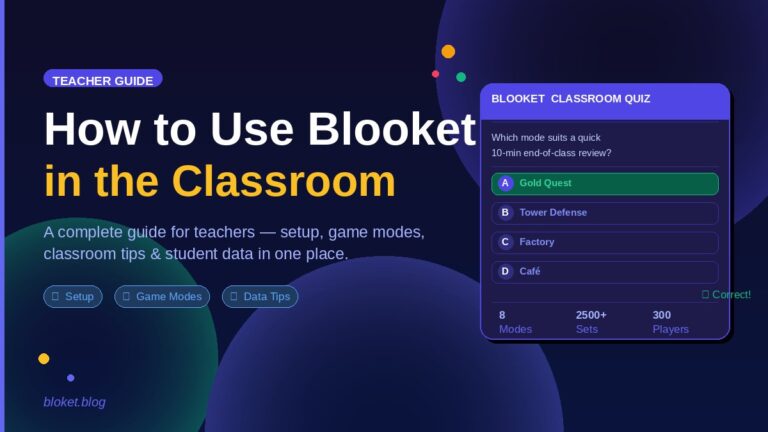
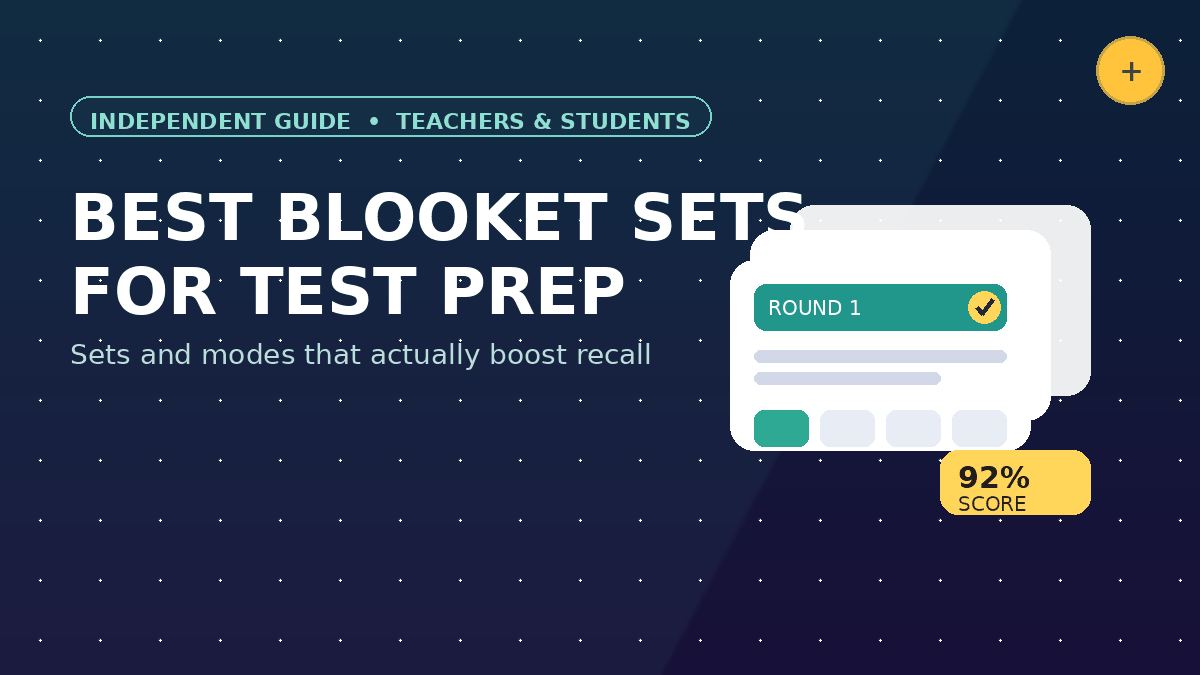
The best Blooket sets for test prep pair accurate, curriculum-matched questions with calmer game modes such as Café, Factory, or Tower Defense, since these formats reward correct answers more than luck or speed. Loud, chaotic modes like Battle Royale are fun for a Friday review game, but they pull attention away from the actual content. After running review sessions across math, vocabulary, and science classes, the pattern is consistent: the set and the mode matter more than how flashy the game looks.
This guide is written for teachers and students who want review time to translate into exam results, not just classroom noise. It covers what separates a strong test-prep set from a weak one, how to build or choose one in a few clear steps, which modes hold up under exam pressure, and the mistakes that quietly waste a review period.
What makes a Blooket set actually good for test prep?
A strong test-prep set uses questions written at the same difficulty and phrasing style as the real exam, keeps the question count tight enough to finish in one sitting, and avoids modes that reward speed-clicking over thinking. Anything less turns into entertainment with a quiz attached.
Question format has to match the exam, not the game
Students transfer skills better when the practice question looks like the real one. If the exam uses short-answer math problems, a Blooket set full of one-word vocabulary matches will not prepare anyone for that format.
In my own trials, classes that practiced with word-problem-style questions scored noticeably steadier on word-problem sections than classes that drilled isolated facts in the same subject. The set has to mirror the test, not just the topic.
Set length should match attention span, not the syllabus
A set covering an entire unit in one sitting sounds efficient, but most students lose focus somewhere between question 25 and question 35 in a live game. Shorter, focused sets beaten into multiple short sessions outperform one long marathon set almost every time.
A practical range that holds up across age groups: 20 to 30 questions for a single review session, with larger sets split by sub-topic rather than crammed into one block.
Answer choices need real distractors, not obvious filler
Multiple-choice answers only test recall if the wrong options are plausible. A question with one correct answer and three silly throwaway choices teaches students to guess by elimination instead of by knowledge.
Good test-prep sets use wrong answers that reflect common student mistakes, such as a sign error in math or a near-synonym in vocabulary. That single change does more for retention than picking a flashier game mode.
How difficulty should be layered inside one set
A set that jumps straight to the hardest material loses struggling students within the first few questions, while a set that stays easy the whole way through wastes time for students who already know the basics. Layering difficulty keeps both groups engaged longer.
A structure that has worked well across several subjects is roughly 40 percent easier recall questions, 40 percent medium application questions, and 20 percent harder questions that combine two or more concepts. That mix gives every student a fair number of early wins while still pushing the stronger students.
Question timers play into this too. Easier recall questions can run on a shorter timer, often somewhere around 20 to 30 seconds, while multi-step or application questions need closer to 45 to 60 seconds so students have room to actually work through the problem instead of guessing under pressure.
How to choose or build a Blooket set for test prep
Building a test-prep set takes four steps: gather or write exam-accurate questions, pick a calm review mode, set the timing and difficulty, and run a quick test round before using it with the full class.
- Start with the question bank, not the game mode. Pull questions directly from past quizzes, textbook review sections, or a question set you write yourself, so the content matches what students will actually see on the exam — our step-by-step guide to creating a Blooket quiz covers building one from scratch.
- Match the mode to the goal of the session. Choose a steady, lower-chaos mode such as Café, Factory, or Tower Defense for content review, and save fast-paced modes like Battle Royale or Racing for a lighter, end-of-unit recap. If the same set will be reused across a week of short reviews, rotating between two calm modes keeps the format from feeling stale without adding the distraction of a high-chaos mode.
- Set timing and difficulty deliberately. Give enough time per question that a student who knows the material can finish without rushing, and avoid timers so short that the game becomes a reflex test instead of a knowledge test. Most live games also let the host adjust how many total questions appear per round, which is worth lowering for a focused 15 to 20 minute session rather than letting a long set run the entire class period.
- Run the set yourself before class. Play through it solo or with a colleague first, since this catches typos, unclear wording, and questions that are accidentally too easy or impossible.
Following these four steps in order matters more than which specific mode gets picked last, because a well-built question bank still works even in a mediocre mode, while a great mode cannot fix bad questions.
Which Blooket sets and modes work best for test prep
The strongest test-prep results come from subject-matched question sets run through calm, low-distraction modes, while high-energy modes work better for confidence-building recaps closer to the actual test date. The table below breaks down how different modes behave during review.
Best modes for focused review sessions
Modes built around steady, individual progress let students think through each question without racing a clock or another player. These work best for first-pass review, when accuracy matters more than excitement.
| Mode style | Pace | Best used for | What to watch for |
|---|---|---|---|
| Calm, individual progress (such as Café, Factory) | Slow to medium | First-pass review of new or difficult material | Can feel repetitive in very long sessions |
| Strategy and resource-building (such as Tower Defense, Gold Quest) | Medium | Mid-unit review once basics are solid | Strategy choices can distract from the questions if overused |
| Head-to-head or elimination (such as Battle Royale) | Fast | Light recap close to test day, confidence building | Speed pressure can hurt students who think slowly but accurately |
| Racing or reaction-based modes | Fast | Quick vocabulary or fact recall, warm-ups | Rewards speed over reasoning, weak fit for multi-step problems |
Matching sets to subject area
Math and science review benefit most from sets with worked, multi-step questions and calmer modes, since rushing tends to produce careless errors. Our roundups of the best Blooket sets for math class and the best Blooket sets for science class cover vetted options for each. Vocabulary and language-arts review can handle faster modes, since recognition tasks are less sensitive to a few seconds of pressure.
History and social studies sit in between: factual recall questions work in faster modes, while questions asking students to connect causes and effects need the slower formats.
Sample test-prep set structure by subject
Seeing an actual breakdown makes the difficulty-layering idea above easier to apply. For a 25-question math review on a single unit, a workable split is 10 straightforward calculation questions, 10 word problems applying the same skill, and 5 questions mixing two skills from earlier in the unit.
For a 25-question vocabulary or language-arts set, a similar split works well as 10 definition-matching questions, 10 context-based usage questions, and 5 questions asking students to spot the correctly used word in a full sentence. Our guide to the best Blooket sets for English class covers vocabulary and grammar sets by skill. The context and sentence-level questions take longer, so they fit better in a calmer mode rather than a racing format.
Science sets benefit from grouping by sub-topic rather than mixing everything together, since a 30-question set covering three separate topics tends to feel scattered. Three shorter 10-question sets, one per sub-topic, give a clearer signal in the post-game report about exactly where the gaps are.
When Blooket Plus features are worth using for test prep
Blooket Plus is a paid subscription that adds extra modes, customization options, and reporting features on top of the free version. For test prep specifically, the most useful part is typically the extra reporting detail, since it shows which questions a class missed most often.
That data matters more for test prep than any single mode, because it points directly at the topics that need a second pass before the real exam. A free-tier set with a good question bank and a calm mode will still outperform a Plus-only set built around weak questions, so the subscription is a helpful add-on rather than a requirement for finding the best Blooket sets for test prep.
Where Plus genuinely helps is consistency. A teacher running review sessions across several classes can compare reports side by side and spot whether one class is struggling with the same two or three concepts as another, which shapes how the next lesson gets planned.
Common mistakes that turn Blooket test prep into a waste of time
The biggest mistakes are not about the game itself, they are about treating a review session like entertainment instead of a diagnostic tool. Each one below is easy to fix once it is named.
Mistake 1: Filling the set with easy questions
A set full of easy questions produces a satisfying scoreboard and very little useful information. Students leave the session feeling confident about material they have not actually mastered.
A better mix leans on questions students have gotten wrong before, pulled from quizzes, homework, or a previous Blooket report, rather than questions picked because they are quick to answer.
Mistake 2: Ignoring the post-game report
Every live Blooket game generates a report showing which questions were missed most often and by whom. Skipping that report after the session means losing the most useful part of the entire exercise.
In practice, spending five minutes scanning the report after class points directly at which two or three concepts need a short follow-up before moving on.
Mistake 3: Using high-chaos modes the day before a major exam
Fast, elimination-style modes raise energy and excitement, which is great for engagement but not ideal right before a high-stakes test. Students can leave the session associating the material with stress and speed pressure instead of confidence.
Calmer modes in the final session or two before an exam tend to leave students feeling more settled, since the focus stays on getting questions right rather than getting them right fastest.
Mistake 4: Reusing the exact same set every time
Repeating an identical set trains pattern recognition of question order and answer position rather than real recall. Students start guessing based on where an answer usually sits rather than what it actually says.
Shuffling question order, swapping in fresh distractor answers, or rotating between two or three versions of a set keeps the practice meaningful through multiple review sessions.
Mistake 5: Letting blook rewards become the main focus
Blooket awards in-game currency and collectible blooks ranked across rarity tiers such as common, rare, epic, legendary, and chroma, which is part of what makes the game appealing in the first place. When a review session turns into a hunt for a rare blook, students start chasing coins instead of thinking through the question in front of them.
This shows up most clearly in modes built around earning and spending currency, where a student can rush through questions just to afford an in-game upgrade. Keeping coin rewards modest and choosing modes where currency is a side effect rather than the main goal keeps the session focused on the actual content.
FAQs
What is the best Blooket mode for test prep?
Calmer, individual-progress modes such as Café or Factory work best for serious review, since they let students focus on each question without racing a timer or another player. Faster modes are better saved for light recap sessions closer to the test date.
How many questions should a test-prep Blooket set have?
Most students stay focused for 20 to 30 questions in a single session. Longer units are better split into two or three shorter sets by sub-topic rather than combined into one long set.
Can Blooket replace traditional test prep methods?
Blooket works best as one part of a review routine, alongside practice tests, worked examples, and direct feedback, rather than as a complete replacement for those methods. Its biggest strength is turning low-stakes practice into something students want to repeat.
Is Blooket Plus necessary for effective test prep?
No, the free version covers question creation, live hosting, and several game modes, which is enough for most review needs. Blooket Plus mainly adds extra modes and more detailed reporting, which helps but is not required.
Should answer choices be randomized for test prep sets?
Yes, randomized answer order prevents students from memorizing a position instead of the actual content. Most set-builder tools handle this automatically once it is turned on.
How do I know if a Blooket set is actually helping with test prep?
Compare the post-game report across two or three sessions on the same topic and watch whether the same questions keep getting missed. If the miss rate drops on a second pass, the set and mode combination is working.
Are timed questions a problem for test prep?
Short timers can hurt students who think carefully but slowly, even when they know the material. A moderate timer that allows full thinking time without letting the round drag is the better balance for review sessions.
What is the biggest difference between a fun Blooket session and a useful one?
A fun session optimizes for excitement and a satisfying scoreboard, while a useful test-prep session optimizes for accurate, exam-matched questions and a report worth reviewing afterward. The two are not mutually exclusive, but the second one only happens with intentional setup.
Conclusion
The best Blooket sets for test prep come down to three things working together: exam-accurate questions, a mode that matches the goal of the session, and a few minutes spent reading the report afterward. None of those require Blooket Plus or a perfectly polished set, just a deliberate setup before hitting start.
Treat each session as a small diagnostic rather than a one-off game, and the same set can keep paying off across multiple review periods as long as the questions and answer order get refreshed between uses. The pattern that shows up in the post-game report, more than any single mode or feature, is what actually points toward better exam results.
The next review session is the easiest place to test this. Pick one calm mode, build a tight 20 to 25 question set from real exam-style material, and check the report once the game ends to see exactly where the next study session should focus.
Stay in the loop with hot picks—our weekly roundup of must-know ideas.