Best Blooket sets for science class: a teacher’s guide
Finding a reliable Blooket set for science class takes longer than it should. Thousands of public sets exist on the platform, and quality varies enormously — some contain factual errors, others recycle a dozen vocabulary words and call it a review. The best Blooket sets for science class are accurate, appropriately sized, and matched to the concepts students actually need to master.
This guide covers the strongest set categories across biology, chemistry, physics, earth science, and general science. Each section explains what to look for, what to avoid, and how to get the most learning out of every game session.
Why Blooket works well for science review
Blooket wraps retrieval practice inside competitive game mechanics, and retrieval practice is one of the most evidence-backed study strategies available. Students answer questions to earn in-game currency, steal from opponents, and compete in real time — keeping focus high without any extra student setup.
How game mechanics reinforce science concepts
Science carries a heavy vocabulary load. Students need to know terms, definitions, processes, and relationships between concepts — and recall them quickly under pressure. Blooket’s rapid-fire question format suits this perfectly. A 20-question set on cell organelles can cycle through a class of 30 students two or three times inside a 15-minute review block.
The modes themselves serve different learning goals. Gold Quest rewards fast recall, which suits vocabulary-heavy content like element names or body system functions. Tower Defense requires sustained attention across far more questions, making it the better pick for longer concept reviews before an exam.
What Blooket gives teachers that other tools don’t
After every hosted game, teachers receive a breakdown showing which questions had the lowest correct-answer rates across the class. In my experience running dozens of science review sessions, this post-game report is the most underused feature on the platform. It turns a 15-minute game into a diagnostic tool — showing exactly which concepts to revisit the next day.
How to find and evaluate science Blooket sets
The Discover page at blooket.com/discover is the best starting point. Search by topic, apply a grade-level filter, and sort by play count or favorites. High play counts signal popularity, but not accuracy — always preview a set before using it with students.
Step 1: Search with specific terms
Broad searches like “science” return thousands of results. Narrow your search immediately: “cell organelles 7th grade,” “periodic table high school,” or “Newton’s laws quiz” surfaces far more relevant sets than a single-word search. Subject plus grade level plus subtopic is the most effective formula.
Step 2: Check the question count
A set with fewer than 15 questions will loop too quickly in fast game modes like Gold Quest, meaning students see repeated questions within one session. The optimal range for a standard review is 20 to 30 questions. Sets with 50 or more questions rarely get fully played in a single class period, so the back half of the content goes unused.
Step 3: Preview every question before using it
This is the step most teachers skip — and where problems start. Science errors in a game can quietly embed misconceptions that take weeks to correct. Spend three minutes reading every question and answer before using any public set. Pay extra attention to chemistry equations and genetics problems, as these categories carry the most errors in community-created content.
Step 4: Check for question variety
Strong sets mix definition questions (“What is the powerhouse of the cell?”), process questions (“What occurs during the S phase of the cell cycle?”), and application questions (“A student mixes an acid and a base — what type of reaction results?”). Sets that only drill definitions bore students by round two and build surface recall, not genuine understanding.
Best Blooket sets by science subject
The strongest sets on Blooket’s Discover page cluster around a few high-demand topics. Here is a breakdown by subject, with notes on what works and what to avoid in each category.
Biology sets
Biology is the most-represented science subject on Blooket, which means both the best and worst sets live here.
Cell biology and organelles
Cell organelle sets are among the most-played science content on the platform. The best ones test function alongside name — “What does the mitochondria do?” rather than just “What is the mitochondria?” Look for sets that include both plant and animal cell differences, since that distinction appears on most middle and high school assessments. Our guide to Blooket for high school teachers covers running science review with older students.
When I ran a cell organelle set with a mixed 7th-grade class in Tower Defense mode, students who had struggled with the worksheet version of the lesson began self-correcting each other mid-game. The competitive format was pushing them to verify answers rather than guess — something a passive worksheet never produced.
Genetics and heredity
Genetics sets work best when they focus on one concept: dominant and recessive alleles, Punnett squares, or codominance — each separately. Sets that try to cover all of genetics in 20 questions stay too shallow to be useful. For Punnett square practice specifically, look for sets that describe cross scenarios clearly; text-only questions on this topic can be ambiguous without a diagram.
Ecosystems and food webs
Ecology sets vary more in quality than any other biology category. The best ones test relationships between organisms rather than vocabulary alone. “Which organism is the primary consumer in this food chain?” is far more instructionally valuable than “Define producer.” Aim for sets with 25 or more questions covering food chains, energy pyramids, and biome characteristics — enough variety to sustain a full game.
Human body systems
Body system sets are among the highest-play content on Discover. The most effective ones focus on one system per set rather than cramming all systems into a single quiz. A 20-question set on the respiratory system reinforces that content far better than a 40-question scramble across multiple systems. Search specifically — “digestive system Blooket” or “circulatory system Blooket” — to find the focused versions worth using.
Chemistry sets
Chemistry presents a unique challenge: many concepts require calculation or diagram interpretation, which doesn’t fit naturally into a multiple-choice click format. The strongest chemistry sets on Discover focus on conceptual understanding and factual recall rather than arithmetic.
Elements and the periodic table
Periodic table sets are the most-played chemistry content on Blooket. The best ones test element symbol, atomic number, and periodic group rather than name-to-symbol matching alone. A student who can identify that chlorine sits in Group 17 and explain what that implies about its reactivity has a stronger foundation than one who has only memorized symbols.
Chemical reactions and bonding
Chemical bonding sets work well when they test reasoning behind bond types, not just names. “Why does sodium form a +1 ion?” requires electron configuration thinking; “What is an ionic bond?” does not. Reaction type sets — synthesis, decomposition, single replacement, double replacement — suit the quiz format well and are widely available on Discover.
Always verify any reaction equation in a chemistry set against a reliable source before running it with students. Incorrect equations appear more often in community chemistry sets than in any other science category.
States of matter
States of matter sets suit middle school best. High school teachers will find most too surface-level unless the set includes phase change graphs and specific heat concepts. Searching “matter high school Blooket” helps filter out elementary-level content before you spend time previewing.
Physics sets
Physics is the smallest category in Blooket’s science library, but strong sets exist. The key constraint is the same as chemistry: calculations don’t translate naturally to a timed click format. Stick to sets that test conceptual understanding.
Forces and motion
Newton’s Laws sets are the most common physics content available on Discover. The best ones include scenario-based questions — “A 1,000 kg car accelerates at 3 m/s². What net force is acting on it?” — rather than purely definitional ones. Scenario questions require students to apply the law rather than just recall a sentence.
Energy types and transfer
Energy sets covering kinetic energy, potential energy, thermal energy, and their conversions are widely available and generally reliable. Look for sets that use real-world examples — roller coasters, lightbulbs, compressed springs — because concrete anchors help students transfer concepts to actual test contexts.
Waves and electromagnetic spectrum
Wave property sets covering frequency, wavelength, amplitude, and wave speed are useful for middle and early high school. Sets that include electromagnetic spectrum ordering by frequency or wavelength are particularly popular before standardized assessments and tend to have fewer factual errors than other physics categories.
Earth science sets
Earth science is well-covered on Blooket at the middle school level. The strongest sets combine factual recall with process understanding rather than treating every concept as a vocabulary term.
Rock cycle and minerals
Rock cycle sets engage students because the content has a natural process structure: igneous to sedimentary to metamorphic and back. The best ones test the process (“What happens when magma cools slowly underground?”) alongside vocabulary. Mineral identification sets with 20 or more questions are consistently popular for dedicated earth science units.
Weather and atmosphere
Weather sets typically cover cloud types, weather instruments, and atmospheric layers — all high-frequency assessment topics. The strongest versions pair instrument names with specific function (“A barometer measures what?”) rather than listing names alone. Atmosphere layer sets should include altitude ranges alongside layer names for meaningful depth.
Plate tectonics
Plate tectonics sets cover boundary types, associated landforms, and events like earthquakes and volcanic activity. These are available at several difficulty levels. Searching by grade band avoids content that’s too elementary or too advanced for your class.
Game mode comparison for science review
Different Blooket modes serve different instructional goals. This table maps common science review needs to the mode that fits each one best.
| Review goal | Best mode | Typical session length |
|---|---|---|
| Quick vocabulary drill | Gold Quest | 5–10 minutes |
| Full exam review | Tower Defense | 20–30 minutes |
| Reinforcing a process or sequence | Factory | 10–15 minutes |
| Speed practice before timed tests | Racing | 5–10 minutes |
| Cooperative team review | Tower Defense (team) | 20–25 minutes |
Gold Quest suits fast-paced vocabulary review at the start or end of class. Students answer rapidly, earn gold, and steal from classmates — which creates a pressure that mimics a real quiz far better than silent study. Tower Defense slows the pace and rewards sustained attention, making it the better fit when material is complex or when students need time to reason through each question. For exam season specifically, our guide to the best Blooket sets for test prep covers the calmer modes that hold up under pressure.
Factory mode suits content with a clear sequence: the steps of the scientific method, the order of the electromagnetic spectrum, or the stages of mitosis. Students who answer correctly keep their virtual factories running, giving teachers a live visual signal of who is confident and who is not.
Common mistakes to avoid with science Blooket sets
Skipping the preview step
A set with 500 plays and an accurate-sounding title can still contain errors. One wrong answer embedded in a game can introduce a misconception that takes real instructional time to undo. Three minutes of previewing every question is a small investment for the certainty it provides.
Choosing sets that are too long or too short
Sets with fewer than 15 questions loop too quickly in Gold Quest and Classic modes — students see repeated questions inside a single session. Sets with 50 or more questions rarely get fully played in one class period. The 20 to 30 question range suits most review sessions.
Running the same game mode every session
Using Gold Quest every time trains students to treat it as background noise. Rotating modes across the week keeps sessions genuinely competitive and serves different learning goals. A class that sees Factory for sequence review, Tower Defense for exam prep, and Racing for speed drills gets more varied and more effective retrieval practice over a term.
Using sets that cover too many topics at once
A single set labeled “all of biology” often covers a dozen subtopics at low depth. Students leave able to answer a few trivia-level questions but without the conceptual depth needed for an actual assessment. Focused single-topic sets in the 20 to 25 question range build stronger, more durable retention.
FAQs
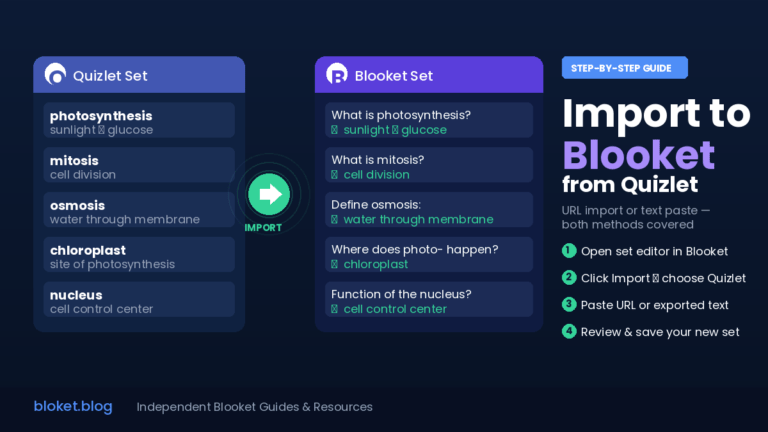
Can I create my own Blooket set for science class? Yes, and it is often the best option. Log in, go to Create Set, and add questions manually or import from a spreadsheet — our step-by-step guide to creating a Blooket quiz covers question types, timers, and answer choices in detail. A custom set guarantees accuracy, aligns to your exact curriculum vocabulary, and can be updated anytime a question needs correcting.
Are there Blooket sets aligned to NGSS or other national science standards? Some creators tag sets with standards references in the title or description, but the Discover page has no official standards-filtering tool. Searching “NGSS” or “biology EOC” surfaces relevant sets, but verifying alignment against your specific standards document is still your responsibility.
How many questions should a science Blooket set have? The optimal range for a 15 to 20 minute review session is 20 to 25 questions. Fewer than 15 questions repeats too quickly in fast game modes; more than 35 questions typically don’t get fully played in one class period.
Can I copy and edit a public science set to fix errors? Yes. Blooket lets you copy any public set and edit questions freely. This is usually faster than building from scratch — copy a high-play set, correct any errors you find, adjust difficulty to match your class level, and save it to your personal library.
Is Blooket Plus worth it for science teachers? Blooket Plus is a paid subscription that adds extra game modes, more detailed student performance reports, and additional customization. For science teachers who run two or more sessions per week, the individual student performance data makes it easier to pinpoint specific knowledge gaps. Whether the subscription cost suits your budget is a separate decision.
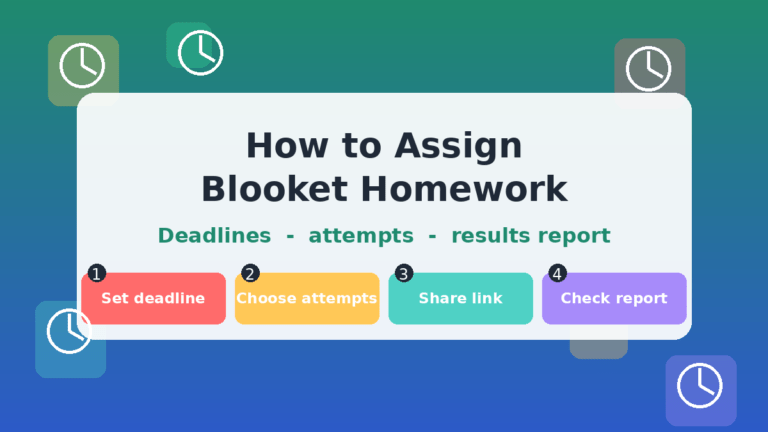
Can students use science Blooket sets independently at home? Yes. Teachers can assign sets as solo practice, letting students play without a live host. This works well for vocabulary review before a quiz or as supplemental work after a lesson students found difficult.
How do I know if a public science set is accurate enough to use? Preview every question yourself and cross-check against your textbook or a reliable source. High play counts signal engagement, not accuracy. Pay extra attention to chemistry equations and genetics scenarios — these produce the most errors in community-created content.
Conclusion
The best Blooket sets for science class are accurate, appropriately sized, and matched to what students actually need to review before an assessment. Biology and earth science have the deepest libraries on Discover; chemistry and physics require more careful vetting but strong options exist. Rotate game modes across sessions to keep engagement genuine and serve different learning goals, and use the post-game report to guide re-teaching the next day.
Start at blooket.com/discover, search your specific topic plus grade level, preview the top three results, and pick the set with the cleanest question list. If nothing passes the preview check, copying and editing the best available set takes under ten minutes — and guarantees the content students see is actually correct.
Never waste a click again—our editor’s choice badge means instant quality.