New Blooket Game Modes List: Complete Guide to Every Mode
Blooket launched with a small set of modes and has kept adding new ones ever since. The problem is that the platform does not make it obvious which modes are recent additions and which have been there from the start. Players and teachers often discover an unfamiliar mode on the host screen and find themselves unsure whether they missed something or whether it genuinely just arrived.
This guide is a complete new Blooket game modes list: every mode on the platform, how each one plays, which are the newer arrivals, and how to decide which works for your situation, whether you are a student chasing coins or a teacher planning a review session.
What are the new Blooket game modes?
The newer Blooket game modes include Crazy Kingdom, Pirate Treasure Hunt, Monster Brawl, Blook Rush, Fishing Frenzy, Café, and Factory. These were added after the original set of Classic, Tower Defense, Gold Quest, Battle Royale, and Racing. Each newer mode layers a different secondary mechanic on top of answering questions correctly, which changes how sessions feel in practice.
How Blooket releases new modes
Blooket adds game modes gradually, often starting them as features available to Plus subscribers before opening them to all players. When a mode first appears, it sometimes launches with limited question-set compatibility and gains full functionality over time as the team refines it.
The platform’s mode library has grown from five modes at launch to more than a dozen distinct options. Most modes are accessible to anyone with a free account, though a small number sit behind the Plus subscription tier.
Why new modes matter for teachers and students
The original five modes cover core needs well, but they do not address every classroom situation. A long review session, a class with wide ability gaps, or a group that has burned through Classic and Gold Quest all benefit from modes introduced after launch. Knowing which newer modes exist, and what they actually do differently, is the practical value of keeping this list current.
Complete Blooket game modes list
Every mode in Blooket builds a secondary game layer on top of the core quiz mechanic. Correct answers always produce coins, resources, or advancement. The difference between modes is what you do with those rewards and how that shapes the competitive experience.
| Mode | Category | Luck Factor | Best Session Length |
|---|---|---|---|
| Classic | Leaderboard | Low | 5–20 min |
| Tower Defense | Strategy | Low | 15–30 min |
| Tower Defense 2 | Team strategy | Low | 15–30 min |
| Gold Quest | Steal/collect | High | 10–20 min |
| Battle Royale | Elimination | Medium | 5–10 min |
| Racing | Speed | Low | 5–15 min |
| Café | Resource-build | Low | 10–25 min |
| Factory | Resource-build | Low | 10–25 min |
| Fishing Frenzy | Collection | High | 10–20 min |
| Blook Rush | Auto-battle | Medium | 10–20 min |
| Crazy Kingdom | Strategy-build | Medium | 15–30 min |
| Pirate Treasure Hunt | Map/exploration | Medium | 15–25 min |
| Monster Brawl | Combat rounds | Medium | 10–20 min |
The original five modes
These modes shipped with Blooket and remain among the most used across classrooms and student sessions worldwide.
Classic: Students answer questions to earn coins, and a live leaderboard updates after each answer. No secondary mechanics exist beyond the quiz itself. Classic is the fastest mode to set up and the most predictable in outcome.
Tower Defense: Correct answers earn coins that players spend placing and upgrading towers to defend against waves of enemy blooks. The strategy layer extends sessions naturally and rewards students who answer correctly and allocate resources wisely.
Gold Quest: Every correct answer earns gold, but periodic steal events allow players to take gold from others. The theft mechanic introduces social tension that a plain leaderboard cannot create. High luck factor makes final standings harder to predict than Classic.
Battle Royale: Incorrect answers raise a player’s elimination risk progressively. The last student standing wins. Sessions end fast, which makes this a high-pressure warm-up mode rather than a sustained review tool.
Racing: Correct answers advance a character along a track. The first to the finish wins. This is the fastest-paced mode in the original set and works well when session time is limited.
Modes added after launch
These are the additions that most players and teachers mean when they search for a new Blooket game modes list.
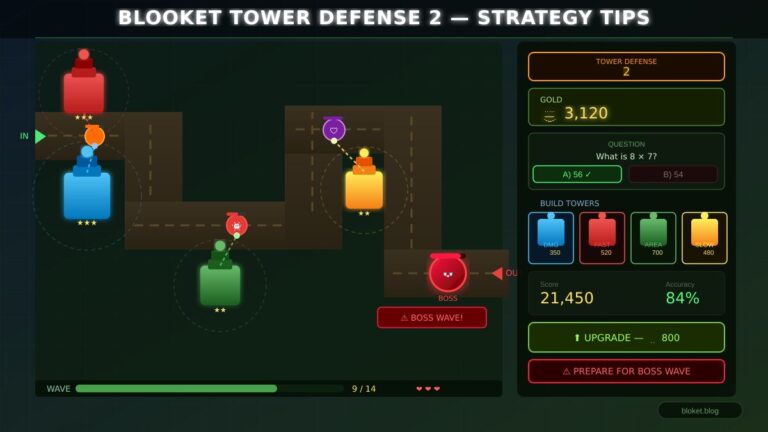
Tower Defense 2: A rebuilt take on the original Tower Defense with different tower types, updated enemy blooks, and a team-based format — see our Tower Defense 2 tips for full coverage. Two groups defend their own bases while trying to break through the opponent’s defenses. Team coordination adds a social dimension missing from the solo Tower Defense mode.
Café: Players run a virtual café by answering questions to earn currency, then spending that currency on upgrades that serve more customers per round — see our Cafe mode walkthrough for the full strategy. The mode is entirely self-paced and individual, making it one of the most forgiving in the library for classes with wide ability gaps.
Factory: Similar pacing to Café but centered on blook production rather than restaurant management — our Factory mode guide covers upgrade timing in detail. Correct answers feed a production line, and the player who produces the most blooks wins. Factory suits the same settings as Café and the two are interchangeable for most use cases.
Fishing Frenzy: Each correct answer casts a fishing line — read our Fishing Frenzy tips for rarity tier strategy. The catch is random, ranging from common low-value blooks to rare high-value ones. The randomness keeps the leaderboard fluid throughout the session because a single high-value late catch can change standings significantly.
Blook Rush: Correct answers generate coins that students spend at a rotating shop to buy battle blooks — our Blook Rush guide breaks down the buying priority. Those blooks fight other players’ blooks automatically. Students with better answer streaks acquire stronger blooks faster, but auto-battle outcomes add enough unpredictability to prevent the leaderboard from locking early.
Crazy Kingdom: Players answer questions to collect resources and manage kingdom decisions. Between quiz questions, students approve or deny citizen requests, and each decision consumes resources earned through correct answers. The dual mechanic of answering and deciding makes this the most cognitively layered mode in the newer set.
Pirate Treasure Hunt: A grid-based map replaces the standard leaderboard. Correct answers move a player’s pirate to adjacent tiles. Treasure tiles award points, and trap tiles penalize movement. The spatial element makes results less about raw speed and more about where on the map players navigate.
Monster Brawl: Correct answers charge a player’s monster with stats that influence combat rounds — see our Monster Brawl strategy for stat priorities. Monsters fight each other automatically between quiz phases. The answer-then-battle rhythm gives sessions a natural pace that keeps attention across multiple rounds.
New Blooket game modes explained in detail
The newer modes each introduce mechanics that the original five do not have. Understanding those mechanics in practice is what helps you pick the right session rather than just the most familiar one.
Crazy Kingdom
Crazy Kingdom is the most strategically layered of the newer modes. After each correct answer, a citizen request appears asking the player to approve or deny something that affects kingdom resources. The answer powers the resources, but the decision shapes how those resources get distributed.
In classroom sessions, Crazy Kingdom works best with students who already have some Blooket experience. First-time players can find the dual mechanic confusing for the first three to four rounds. Once students understand the loop, engagement holds across a full 25-minute session better than most other modes because something is always happening.
What makes Crazy Kingdom different
Most Blooket modes have a passive waiting phase between questions. In Crazy Kingdom, that gap is filled with decision-making. This eliminates the attention drop that typically hits in the middle third of a long session and gives faster answerers something to do between prompts rather than sitting on the leaderboard watching others catch up.
Pirate Treasure Hunt
Pirate Treasure Hunt replaces the performance ranking with a navigational experience. Players move across a grid by answering questions, and the tile they land on determines their reward. High-value treasure tiles, low-value tiles, and trap tiles all appear on the same map, and players do not know what a tile holds until they land on it.
The exploration mechanic reduces the visibility of who is winning versus losing. In Classic or Gold Quest, every student can see exactly where they rank at all times. In Pirate Treasure Hunt, students see their position on the map but cannot easily calculate who is ahead by how much. That ambiguity lowers the competitive pressure in a useful way for classes where visible leaderboards create anxiety.
Best use for Pirate Treasure Hunt
This mode works particularly well for the first Blooket session with a new class or group. The map element feels different enough from a standard quiz game that it breaks initial resistance from students who think of quiz tools as boring, and the unclear ranking reduces the social risk for students who worry about performing publicly.
Monster Brawl
Monster Brawl structures gameplay around alternating quiz phases and combat rounds. During quiz phases, correct answers charge a monster’s attack, defense, and speed stats. When a combat round triggers, monsters fight other players’ monsters automatically based on accumulated stats.
The combat animations serve a practical purpose beyond entertainment. They give students a defined break between answering phases, which resets concentration without killing session momentum. Sessions that sustain 20 minutes without a natural pause tend to lose engagement in the final portion. Monster Brawl builds that reset into the mode’s own structure.
Monster Brawl in longer sessions
When I observed Monster Brawl sessions running past 15 minutes, students who had fallen behind on the leaderboard after early combat rounds stayed more engaged than comparable students in Classic or Gold Quest. The regular reset of combat rounds creates the perception that the game is not yet decided, which keeps participation rates higher for students who would otherwise mentally check out once the top three positions seemed locked.
Blook Rush
Blook Rush makes every correct answer feel immediately consequential. Coins appear on screen the moment an answer lands, the shop refreshes with new blooks regularly, and each purchase decision forces a quick calculation about whether to buy a cheap blook now or save for a stronger one later.
The auto-battle system means the mode rewards both quiz accuracy and purchasing judgment. A student who answers every question correctly but spends coins on mismatched blooks can lose battles to a student who answered slightly fewer questions but bought strategically.
Why Blook Rush works for motivated students
Blook Rush suits students already engaged with Blooket’s blook collection system. The shop-and-battle loop makes correct answers feel like they have immediate, tangible consequences, which tends to increase answer rates compared to modes where rewards feel abstract or delayed.
Fishing Frenzy
Fishing Frenzy is the luck-heaviest mode in the newer set, deliberately. The range of possible catches is wide, and the distribution of catch values is random enough that leaderboard positions shift throughout the session rather than stabilizing midway through.
That variance is the mode’s most practical feature in a classroom setting. It prevents a dominant student from establishing an insurmountable lead early, which protects the motivation of students who answer fewer questions correctly. Knowing that a single high-value catch can change standings keeps everyone answering even when they feel behind.
Fishing Frenzy for ability-diverse classes
When tested across a group where the strongest students answered three times as many questions correctly as the weakest, Fishing Frenzy produced a final leaderboard where the gap between first and last place was smaller than in Classic using the same question set. The randomness compressed the outcome range in a way that felt fair to students rather than arbitrary.
How to choose a new mode for your situation
Choosing based on familiarity rather than mechanics leads to sessions that underdeliver. These criteria match the newer modes to specific goals.
For long review sessions (20+ minutes)
Crazy Kingdom and Monster Brawl both sustain engagement better than most original modes across longer sessions. The decision rounds in Crazy Kingdom and the combat phases in Monster Brawl fill natural attention gaps that Classic and Racing cannot.
For short, focused warm-ups (10 minutes or less)
Blook Rush and Monster Brawl both run efficient short sessions because the shop phase and combat round each create a defined start-and-end structure. Factory and Crazy Kingdom need more time to develop their mechanics and feel incomplete in under 10 minutes.
For mixed-ability classes
Café and Fishing Frenzy reduce the visibility and impact of performance gaps. Café is entirely self-paced and contains no elimination, stealing, or automatic battles. Fishing Frenzy’s randomness compresses the leaderboard over time. Both prevent early dominance from discouraging lower performers.
For student-driven solo review
Factory and Café both function as self-study tools because they do not require other players to create pacing or tension. A student using Blooket alone gets a complete, functional experience from either mode without the hollowness of competitive modes played solo.
How to access every game mode in Blooket
Hosting a session in any newer mode follows the same process as hosting any Blooket game. The only variation is whether a mode requires a Plus subscription.
- Log in to your Blooket account and open your dashboard.
- Select a question set you want to use for the session.
- Click “Host” on the question set.
- On the mode selection screen, scroll through all available options.
- Select the mode you want. A lock icon indicates the mode requires Blooket Plus.
- Adjust the time limit and any available settings, then start the game.
Free account vs Blooket Plus modes
Most game modes in Blooket are accessible on a free account. Blooket Plus, the platform’s paid subscription tier, makes additional modes available and sometimes gives Plus subscribers access to newer modes before they open to everyone. The lock icon on the mode selection screen is the definitive indicator of what your account can access, since the set of Plus-exclusive modes can shift as Blooket adjusts its tiers.
How students join any mode
Students never need a Blooket account or subscription to join and play. The host generates a game code, and students enter that code at blooket.com/play. Whatever mode the host selected is the mode students play, regardless of their own account status. This makes every newer mode equally accessible to students in a teacher-hosted session.
FAQs
What is the newest game mode in Blooket?
Blooket adds modes on a rolling basis without always announcing them prominently. Crazy Kingdom, Pirate Treasure Hunt, and Monster Brawl are among the more recently added options. The mode selection screen on the host dashboard always reflects what is available on your account at the time of hosting.
How many game modes does Blooket have in total?
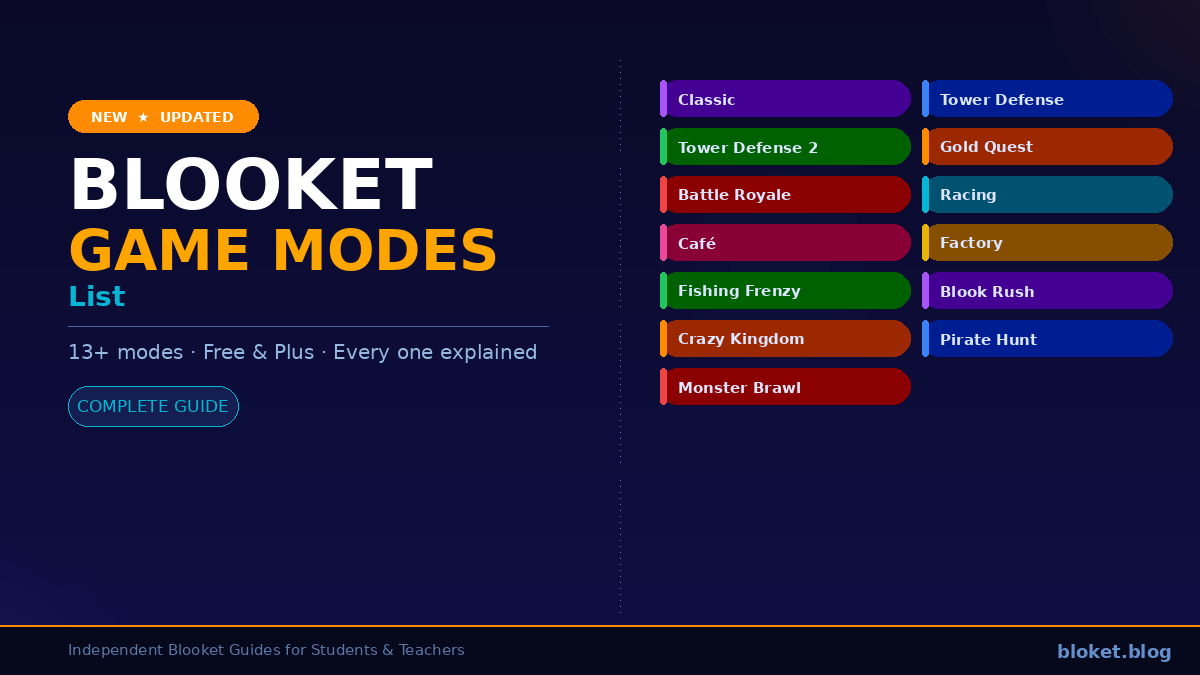
Blooket has more than a dozen distinct game modes across free and Plus tiers. The list accessible to free accounts includes Classic, Tower Defense, Tower Defense 2, Gold Quest, Battle Royale, Racing, Café, Factory, Fishing Frenzy, Blook Rush, Crazy Kingdom, Pirate Treasure Hunt, and Monster Brawl. The exact count changes as new modes are added.
Are new Blooket modes free or do they require Plus?
Some newer modes are free; others require a Blooket Plus subscription. New modes sometimes launch as Plus-only before becoming available to free accounts. The lock icon on the mode selection screen is the most reliable way to check, since Blooket adjusts which modes need a subscription over time.
Can students play newer modes without a Blooket account?
Yes. Students only need the game code from the host. They can join and play any mode, including newer ones, without creating a Blooket account. Account creation is only needed to host sessions and to track personal coin or blook progress between sessions.
Is Café a replacement for Factory in Blooket?
Café and Factory coexist as separate modes. Café introduced a restaurant management theme alongside the already existing Factory mode rather than replacing it. Both involve self-paced resource building through correct answers, but their in-game activities and visual themes differ. Either works for the same classroom contexts.
Which newer Blooket mode is best for a first-time class session?
Pirate Treasure Hunt is the strongest choice for a first session with a new group. The map element feels clearly different from a standard quiz, which breaks initial resistance, and the unclear ranking reduces the social risk for students who worry about public performance comparisons.
Do new Blooket modes require more questions in a set?
Most modes work with any question set of 10 or more questions. Some modes with multiple game phases, like Crazy Kingdom and Monster Brawl, work better with 15 to 20 questions to avoid cycling through the same prompts repeatedly. The host dashboard will alert you if a selected question set is too short for a specific mode.
Conclusion
The new Blooket game modes list now covers more than a dozen options, with Crazy Kingdom, Pirate Treasure Hunt, Monster Brawl, Blook Rush, Fishing Frenzy, Café, and Factory representing the most significant additions since the original five. Each newer mode introduces a mechanic the originals do not have, giving teachers and students more ways to match a session to a specific goal or class dynamic.
Pick the mode that fits your session length and group energy (see our complete Blooket game modes ranked list for direct comparisons). If you have not tried Crazy Kingdom or Monster Brawl, either is a strong first step into the newer additions. Check the mode selection screen for lock icons, use the guide above to match mechanics to your goal, and run a short test round before committing a new mode to a full class period.
Great minds never stop learning—check out our most-read posts and expand your world of knowledge today.