All Blooket game modes ranked: the complete guide
What actually separates a great Blooket mode from a forgettable one?
The best Blooket modes do three things at once. They make answering questions feel like a natural part of the game rather than a chore bolted onto it. They keep every player involved from start to finish- not just the ones already winning. And they scale without breaking, whether there are five players or fifty.
A mode that only rewards the fastest typist, or that eliminates slower players in the first two minutes and leaves them with nothing to do, fails two of those three tests. Plenty of modes fall into that trap.
The four criteria behind this ranking
Engagement floor: How much does the mode hold the attention of a player who is not leading the leaderboard? Some modes punish slower students so visibly and so early that they mentally check out. That is a design flaw, not a player problem.
Learning reinforcement: Does the game loop push players toward answering more questions, or does the strategy allow coasting? A mode where smart play means answering as little as possible is a poor learning tool, regardless of how fun it feels.
Coin and reward potential: Blooket’s reward system keeps players returning. Modes that convert effort into meaningful coin gains feel worthwhile; modes that return almost nothing for a full session feel hollow, and players notice.
Classroom and solo fit: Some modes shine in a 30-student class. Others work best for a solo study grind or a small group of four. Knowing which is which saves a session from going sideways.
These four criteria shape every position in the ranking below. Nothing is ranked on theme or visual appeal alone.
All Blooket game modes ranked
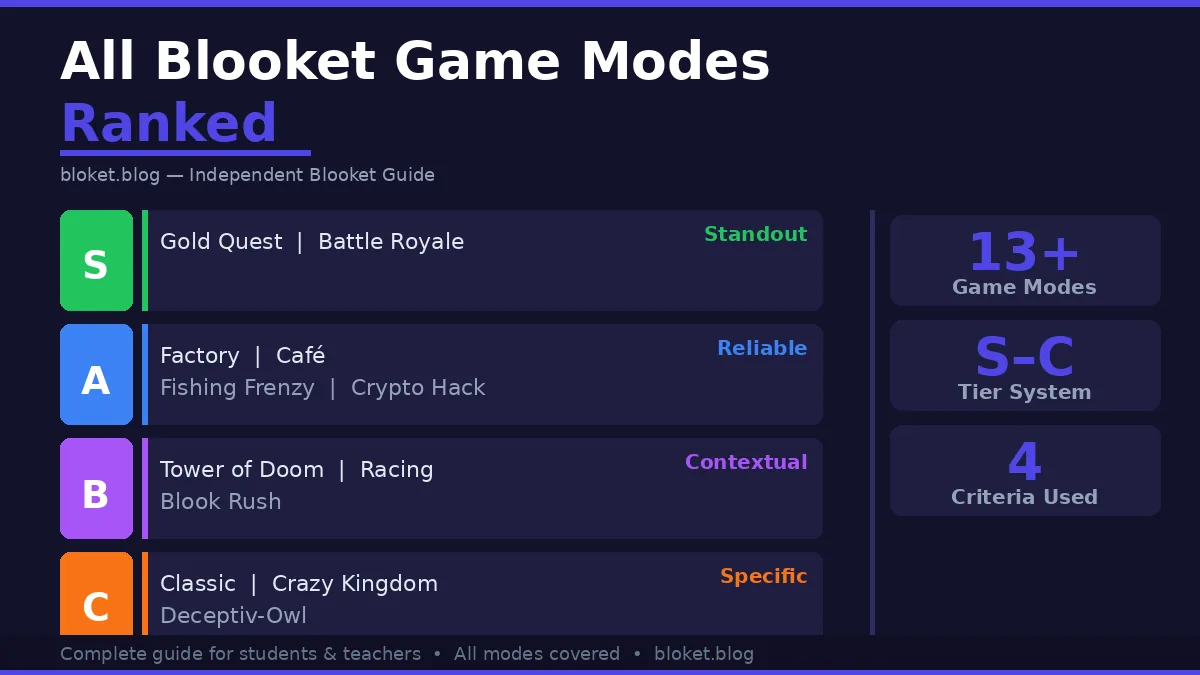
The ranking runs from the modes that deliver consistently across all four criteria down to the ones that require a specific context to work well. Every mode here is worth knowing; the tier placement is about versatility and reliability, not quality in isolation.
S Tier: The standout modes
These modes score well on every criterion. They handle most group sizes, keep every player invested from first question to last, and make answering feel like the purpose rather than a side effect.
Gold Quest
Gold Quest is the most consistently exciting mode Blooket offers. Players answer correctly to spin a wheel that can earn gold, steal from a rival, or trigger a random outcome. That steal mechanic changes everything: even a player in last place stays glued to the leaderboard because a single fortunate spin can flip the standings completely.
The mode also reinforces answering volume better than almost any other. More correct answers mean more spins; more spins mean more chances to win or take from others. There is real incentive to keep answering accurately, not just quickly.
Gold Quest works at any group size, resolves fast enough for a short class period, and generates the kind of spontaneous reactions- gasps, groans, laughter- that signal genuine engagement. When I tested it with groups ranging from eight players to over thirty, the energy was consistent every time. It earns the top position without serious competition.
Best for: Classes of 10 to 40 players, competitive study groups, any subject.
Battle Royale
Battle Royale creates the most visible energy of any Blooket mode. Players answer questions to survive elimination rounds, and watching classmates get knocked out produces real stakes that players feel immediately. The pace is fast, every answer matters, and the mode handles large groups with less chaos than most alternatives.
The one honest weakness: players eliminated early have nothing to do while the session continues. In a classroom, that means a plan for those players- a short parallel task, a note-taking activity, or a quick rejoin option if the platform supports it. Hosts who ignore that gap end up with a third of the class disengaged. Hosts who solve it get one of the highest-energy sessions Blooket produces.
Best for: Large classes, end-of-unit reviews, any session where maximum group energy is the goal.
A Tier: Reliable modes with one trade-off
These modes are excellent. Each one falls just short of S Tier because of a single condition or gap that affects versatility, not quality.
Factory
Factory is the best mode for sustained, individual-effort sessions. Players answer questions to produce items in their factory, and the loop is satisfying in its clarity: correct answer, item produced, factory grows. There is no volatility- a player who answers steadily and accurately will nearly always outperform a distracted one. That makes it the strongest mode for learning reinforcement, even if it trades some excitement to get there.
The trade-off is social energy. Factory has no steal mechanic, no elimination drama, no moment where the leaderboard flips unexpectedly. The room gets quieter. For a study group that wants to focus, that is a feature. For a class that came in looking for excitement, it reads flat. Used in the right context- smaller groups, individual grind sessions, situations where fairness matters more than chaos- Factory is exceptional.
Best for: Individual study sessions, smaller groups, settings where steady effort should be rewarded over luck.
Café
Café wraps answering questions inside a restaurant management loop. Players serve customers by answering correctly and earn currency to upgrade their Café. The theming is the most cohesive of any Blooket mode- the game logic and the visual narrative actually match each other- and there is a satisfying progression arc that builds over a full session.
The drop from S Tier comes from pace. Café runs slower than Gold Quest or Battle Royale. Players who fall behind in early rounds struggle to catch up, and the mode needs at least 15 minutes to feel complete. Given that time, it is one of the most satisfying experiences in Blooket. Cramming it into a five-minute warm-up wastes what makes it good.
Best for: Longer sessions, groups who respond to progression systems, younger audiences who connect with the theme.
Fishing Frenzy
Fishing Frenzy surprises people. Players answer correctly to cast a line and catch items of varying rarity, and the rarity system creates a low-stakes thrill that generates genuine reactions when something rare surfaces. Catching a rare blook mid-session gets an audible response in a room. That alone distinguishes it from most modes.
The limitation is that Fishing Frenzy is more about collection than competition. The leaderboard matters less than what you catch, which reduces the urgency to answer quickly. For blook collection goals, casual review sessions, or groups that respond badly to head-to-head competition, it is an excellent call.
Best for: Casual review sessions, blook collection goals, younger or more relaxed groups.
Crypto Hack
Crypto Hack gives each player a server to defend and opponents’ servers to attack. Correct answers power hacks and fund upgrades, and players choose which opponent to target- a strategic layer that most Blooket modes simply do not have. The mode feels more like a game with questions in it than a quiz with a skin over it.
It sits in A Tier rather than S Tier because the mechanics take time to click. First-time players often spend the early minutes confused rather than engaged. A 60-second orientation before starting pays off immediately, and experienced players get a genuinely rich experience. The strategic depth is the best Blooket offers.
Best for: Groups who have played Blooket before, STEM-themed sessions, medium-sized groups.
B Tier: Solid modes for the right context
These modes are not worse than the tiers above- they are more specific. Each is the right call in a clearly defined situation and the wrong call outside it. Use them intentionally.
Tower of Doom
Tower of Doom shifts the dynamic entirely: players share a castle and answer questions cooperatively to defend it against enemy waves. No one is eliminated. No one is stealing from anyone. The whole group succeeds or fails together.
That cooperation changes the learning atmosphere in ways competition cannot. Students who shut down under head-to-head pressure often engage clearly in Tower of Doom because there is no visible personal loss. Teachers running classes with low competitive tolerance, high anxiety, or a specific need for group cohesion will find this mode uniquely effective. Use it when that is the goal; do not use it as a default just because it is easy to set up.
Best for: Cooperative learning goals, classes that need lower-stakes engagement, post-exam recovery sessions.
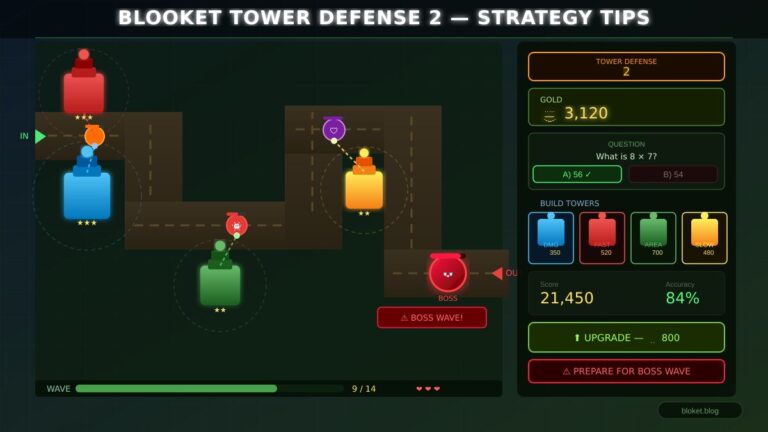
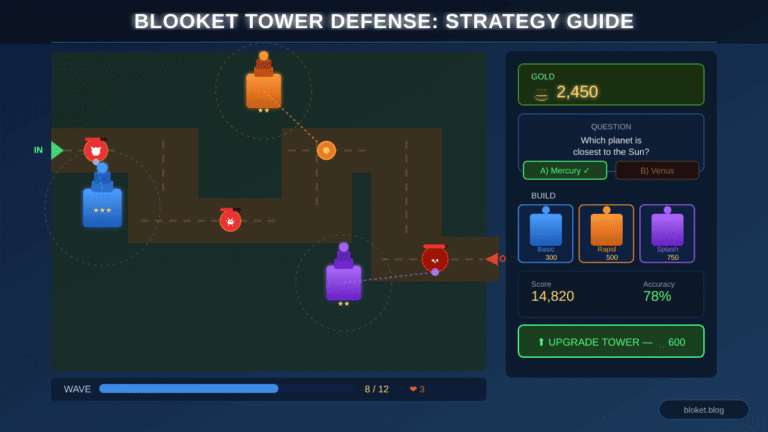
Tower Defense
Tower Defense shares mechanics with Tower of Doom but plays independently rather than cooperatively. Players place blooks as defensive towers, and correct answers generate resources to strengthen them. The strategic layer is more involved than most modes, and the experience rewards sustained focus.
That requirement for attention is the mode’s trade-off. Distracted players fall behind visibly and fast. Focused players get one of the richer solo-play experiences in Blooket. This mode suits individual grind sessions and students who enjoy managing systems.
Best for: Solo grind sessions, students who enjoy strategy, smaller groups with strong focus.
Blook Rush
Blook Rush sends waves of enemy blooks toward a player’s base, and correct answers generate defenders to stop them. It moves faster than Tower Defense and has a satisfying arcade quality. Players stay alert because the pace does not let them drift.
The ceiling is lower than it feels at first. Blook Rush refreshes well as a change of pace after repeated sessions of higher-tier modes, but as a primary choice it becomes repetitive faster than the alternatives. It works best when the host recognizes exactly that role for it.
Best for: Variety sessions, solo practice, players who want faster-paced defense gameplay.
Racing
Racing is the most mechanically transparent mode: answer correctly to advance your blook toward a finish line, first to cross wins. There is no strategy, no steal mechanic, no resource management. The rules communicate themselves in seconds.
That simplicity is the ceiling as much as the floor. The same player tends to win consistently, there is nothing to discover after the first session, and the mode ends quickly. For a five-minute warm-up or a first introduction to Blooket, it is perfect. As a main event, it runs thin.
Best for: Quick warm-ups, introducing Blooket to new players, very young students.
C Tier: Functional but limited
These modes work. Most groups will get more engagement from something higher on this list, but each has a narrow scenario where it is the correct pick.
Classic
Classic is the original mode: answer questions, earn points, highest score wins. It is the most direct expression of who knows the material, which sounds like an advantage until you watch a class run it. The gap between fast and slow students becomes visible immediately, and less confident players disengage early when the outcome feels settled.
Classic earns its place in one scenario: pure speed drills where the goal is fluency under pressure, and social dynamics are less of a concern. For most other purposes, higher-tier modes deliver equal learning value with meaningfully more engagement.
Best for: Speed drills, assessment simulation, very quick sessions where a leaderboard is the point.
Crazy Kingdom
Crazy Kingdom puts players in charge of a kingdom and layers resource-management decisions between each question. The concept is more creative than its placement suggests, and the art and theming are among the best in Blooket. The problem is pace: the decision layer adds time between questions, and sessions can drag in ways that undercut the engagement.
With a group that genuinely enjoys narrative or kingdom-building mechanics, Crazy Kingdom delivers a memorable session. With a general group expecting the pace of Gold Quest, it lands flat.
Best for: Narrative-oriented groups, longer sessions, hosts who have specifically set up the mode intentionally.
Deceptiv-Owl
Deceptiv-Owl is the most socially complex mode Blooket offers. After answering, players declare whether they were confident or bluffing, and opponents try to read them. Done well, it generates real conversation about why answers are correct- something no other mode does. The bluffing mechanic is genuinely clever.
The barrier is just as real as the upside. The mode needs a warm-up round to explain, performs poorly with large groups where the social reading gets lost in the noise, and does not work at all for solo play. In a small, discussion-oriented group- a debate class, a close-knit study group of five or six- it can be the best session in the room. Anywhere else, start something higher on this list.
Best for: Small groups of under 10, discussion-based classes, players who know each other well.
Which mode fits your classroom session?
For most classroom sessions, Gold Quest or Battle Royale carry the room without needing any special conditions. They handle large groups, require no setup explanation, and create visible energy that keeps the whole class pointed at the screen.
Matching mode to session goal
| Session goal | Recommended mode |
| High energy, whole-class review | Battle Royale |
| Competitive but lower volatility | Gold Quest |
| Individual accountability | Factory |
| Cooperative engagement | Tower of Doom |
| Quick warm-up under 5 minutes | Racing or Classic |
| Longer, immersive session | Café or Fishing Frenzy |
| Small group with discussion | Deceptiv-Owl |
| Strategy-focused review | Crypto Hack or Tower Defense |
Group size and mode fit
Modes with a steal mechanic- Gold Quest and Crypto Hack- get more interesting as group size grows because there are more targets and more leaderboard movement. Modes based on individual progression- Factory and Café- work equally well at any size, since players are essentially running parallel solo games. Elimination modes need at least 10 players to feel meaningful; a five-person Battle Royale ends in under three minutes, which defeats the purpose.
Session length and mode selection
Café, Tower Defense, and Crazy Kingdom are built for longer sessions- 15 minutes or more. Forcing them into a five-minute slot means the mode never gets going. Gold Quest, Battle Royale, and Racing all resolve quickly and work well in tight time windows. Match the mode to the time you actually have, not the time you wish you had.
How to earn the most coins for your effort
Coin earnings in Blooket depend primarily on the number of questions answered correctly and total session length- not the mode itself. That said, some modes create conditions that lead to more total answers per session.
High answer-volume modes
Factory and Classic produce the highest answers per minute because the game loop is direct: answer, advance, repeat. There is no strategic layer, no decision-making between questions, no pause. A 10-minute Factory session will typically yield more total correct answers than a 10-minute Gold Quest session, even though Gold Quest feels faster.
Long-session modes
Café and Tower Defense naturally extend session duration, which means more total answers and more coins over time. A 20-minute Café run will generally produce more coins than a 10-minute Gold Quest run, even accounting for the difference in per-minute pace.
How Blooket Plus affects earnings
Blooket Plus is a paid subscription that raises the coin ceiling and may offer features that affect how certain modes reward players. Free accounts still earn meaningfully- the difference between free and Plus is in ceiling, not in whether rewards exist. If coin accumulation is a serious goal, checking your account tier is worth the minute.
Mistakes players and teachers make when picking a mode
Defaulting to Classic every session
Classic is not a bad mode. It is the most overused one. Hosts who run Classic every session lose the engagement premium that other modes generate- premium that costs nothing extra to access. Rotating between even three modes (Gold Quest, Factory, Café) keeps sessions from feeling predictable without adding any preparation time.
Running Battle Royale with a small group
Elimination modes need population. An eight-player Battle Royale ends in minutes, and eliminated players have nothing to do for most of what follows. The mode is designed for energy in numbers. Save it for larger groups.
Skipping the cooperative modes entirely
Tower of Doom and Tower Defense see consistent underuse relative to how well they work in specific conditions. Classes that resist competition- because of anxiety, mixed ability levels, or just the culture of that particular group- respond to cooperative modes in ways that head-to-head competition cannot reach. These modes solve a real problem. They just need to be deployed for it.
Starting complex modes without any orientation
Crypto Hack and Deceptiv-Owl have mechanics that are not legible from gameplay alone. Starting without explanation produces two to five minutes of confused questions and missed answers. A brief verbal walkthrough- under 90 seconds- before the game begins recovers that time instantly and changes the whole session.
FAQs
What is the best Blooket game mode overall?
Gold Quest holds the top position for overall versatility. It works at any group size, creates consistent energy through its steal mechanic, and keeps every player engaged from the first spin to the last. Battle Royale is the stronger choice specifically for large groups where elimination drama is the goal.
Which Blooket mode gives the most coins?
No single mode guarantees the highest coin return- total earnings depend on how many questions are answered correctly and how long the session runs. Factory and Classic drive the highest answers-per-minute, which typically produces more coins in a fixed time window. Longer sessions in Café or Tower Defense can catch up by extending total play time.
Can teachers use every Blooket mode in a classroom?
Yes. Every mode is designed to function as a classroom tool, and the host controls session settings throughout. The practical decision is matching mode to goal: Battle Royale for whole-class energy, Factory for individual accountability, Tower of Doom when cooperation matters more than competition.
How many game modes does Blooket have?
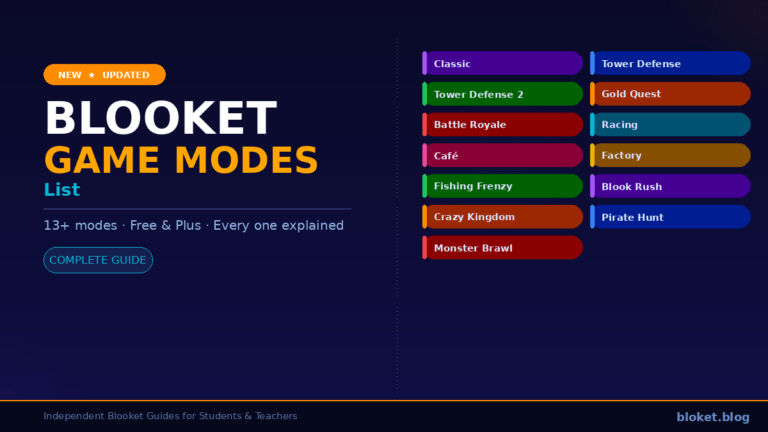
Blooket adds and refines modes over time, so the exact count can shift after updates. The platform has consistently maintained more than ten distinct modes, covering individual progression, cooperative defense, competitive elimination, and social bluffing mechanics.
Which Blooket mode works best with young students?
Café and Fishing Frenzy work well with younger players because the themes are approachable and the mechanics are not punishing. Racing is also strong with younger groups- the visual feedback is immediate and obvious, and the rules explain themselves through play.
Is Deceptiv-Owl worth using?
Yes, in the right setting. It is the only Blooket mode that generates discussion about answer confidence rather than just answer speed, which gives it real value for critical thinking practice. Keep the group small, give players time to learn the bluffing mechanic, and do not rush the session.
What is the most strategically complex Blooket mode?
Crypto Hack. Players simultaneously manage their own server’s defenses, choose which opponents to target, and allocate resources across multiple fronts. A player with equivalent knowledge but better strategic decisions will consistently outperform a less deliberate opponent.
Does the question set affect which mode to choose?
It can. Fast modes like Battle Royale and Gold Quest pair best with material that players know at least moderately well- the pace rewards fluency. Slower modes like Café and Tower Defense give players time to work through harder or newer content without the pressure of a real-time leaderboard.
Conclusion
Every Blooket game mode has a reason to exist, but not every mode fits every session. Gold Quest and Battle Royale earn their top positions because they create engagement consistently, work across group sizes, and make answering questions feel like the point. Factory and Café reward sustained effort over a full session. The cooperative and niche modes- Tower of Doom, Deceptiv-Owl, Crazy Kingdom- are genuinely excellent when the session calls for them specifically.
The practical step from here: identify one mode from this guide that you have never tried and run it in your next session. The modes at the top of the ranking are there because they work reliably. The only way to confirm that is to test one yourself.
Take charge of your growth—explore actionable strategies and proven methods that deliver real results.