Blooket Cafe Mode Walkthrough: Complete Strategy Guide
Most players lose Cafe Mode because they spend coins on the wrong items, ignore the customer queue, or try to do both things at once without a system. This guide covers every mechanic, every buying decision, and every strategy pattern that separates top scorers from the rest. Whether you are a student competing for first place or a teacher setting up a review session, this walkthrough gives you a clear framework from start to finish.
What is Blooket Cafe Mode?
Cafe Mode is a Blooket game mode where you manage a virtual cafe, answer quiz questions to earn coins, and use those coins to stock menu items that customers order. The player with the highest coin total when the timer ends wins.
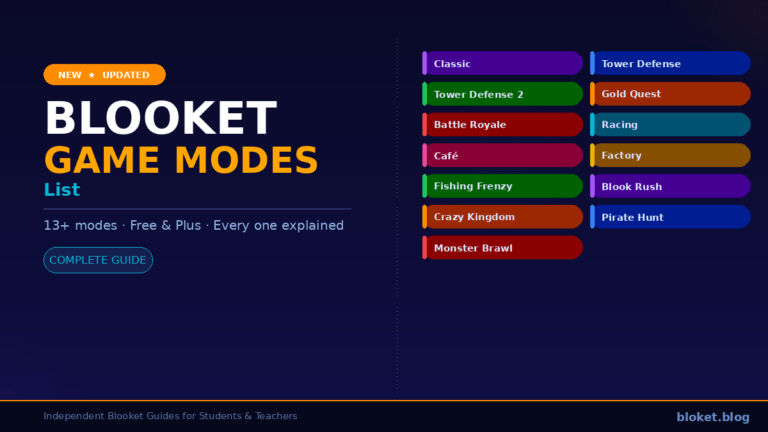
The mode blends quiz speed with resource management — similar to our Factory mode guide which uses the same loop. Unlike Gold Quest, which has a heavy luck element, or Tower Defense, which focuses on wave strategy, Cafe Mode rewards players who answer quickly AND make smart purchasing decisions. Both skills matter equally, which is what makes it one of the more strategically deep modes Blooket offers.
How the scoring works
Every correct answer earns you in-game coins. You spend those coins in the shop to buy food and drink items for your menu. When customers arrive and place orders, you click the matching item to serve them. Serving customers correctly earns you more coins on top of what questions give you. The feedback loop is: answer questions → earn coins → buy stock → serve customers → earn more coins.
Who can play it
Cafe Mode is available in hosted class games and in solo play through any standard Blooket account. A free account is all that is needed to play. Teachers launch it from the host dashboard; students join through the standard game PIN system. No paid subscription is required to access the mode.
How Blooket Cafe Mode works: a step-by-step breakdown
The interface has four active areas: the question panel, the customer queue, the shop, and your coin balance. Understanding what each one does before the timer starts saves you from scrambling in the first 30 seconds.
Step 1: Read the starting screen before customers arrive
When the host launches Cafe Mode, you land inside your cafe before the first customer wave begins. Use those opening seconds to glance at your starting coin balance and check what, if anything, is already in your menu. Do not open the shop yet.
Step 2: Answer questions immediately to build your coin base
Your first priority is answering 2–3 questions quickly. Each correct answer deposits coins directly into your balance. Building that initial coin total gives you real buying power when you open the shop for the first time. Players who open the shop on the very first second and spend before answering usually fall behind early because they have too little stock and too few coins to recover.
Step 3: Visit the shop and buy starting inventory
Open the shop after your first round of answers. Buy at least one or two lower-cost items immediately so you are ready to serve the first customers. Lower-tier items cost less and earn less per serve, but having them available from the start means you collect coins during the early customer wave instead of watching orders walk out the door.
Step 4: Serve customers as they arrive
Customers walk into your cafe and show what they want. Click the matching menu item to serve them. A correct serve earns coins and a tip bonus. A missed order earns nothing. You do not get penalized beyond the lost revenue, but in a competitive game those missed orders accumulate into a real gap on the leaderboard.
Step 5: Alternate between answering and serving
The core rhythm of Cafe Mode is: answer a question, check the customer queue, serve any pending orders, answer another question, restock if balance allows. Neither task should be completely paused for the other. Treating the game as pure quiz play or pure serving both lead to the same outcome: falling behind.
Step 6: Upgrade your menu as your balance grows
Once you have a working base of low-tier items and a growing coin total, start buying mid-tier and eventually high-tier items. Higher-value items earn significantly more per serve. The transition point is when your coin balance is high enough that buying a more expensive item does not leave you unable to restock basics.
Step 7: Monitor the leaderboard and adjust
The live leaderboard shows your rank throughout the game. Check it periodically, not constantly. If you are trailing by a large margin in the first half of the game, the fastest fix is answering questions more accurately and faster, not changing your shop strategy. Coin income from questions is the primary driver of early-game position.
Menu items in Cafe Mode: what to buy and when
The shop in Cafe Mode has items across multiple price tiers. Each tier has a different cost and a different earn rate per serve. Getting the buy order right is where most of the strategic depth in this mode lives.
Low-tier items: buy these first, always
Low-tier items are affordable from the first minute of the game. They earn a modest amount per serve, but their value is availability. You can stock several of them immediately, which means customers start earning you coins from the very start. Never skip this tier entirely, even as your balance grows, because customers order across all tiers and an empty low-tier slot means missed orders.
Mid-tier items: the profit engine
Mid-tier items cost more than the starting options but earn noticeably more per order. Once you have 3–4 low-tier items stocked, shift your buying focus here. These are the items that drive sustained coin growth through the middle section of the game, when customer flow is highest and your answering pace is consistent.
High-tier items: high reward, high risk
The most expensive items in the shop yield the largest per-serve returns. The risk is straightforward: they are expensive to buy and take time to pay back the investment. Players who rush to buy high-tier items before building a stable lower inventory frequently miss orders in other tiers and end up with less overall than if they had waited.
When to make the move to high-tier
A reliable rule: buy your first high-tier item only when your coin balance would still leave you able to restock two other items after the purchase. If buying the high-tier item drains you to near zero, wait one or two more questions.
Balancing your overall menu
The strongest menus in Cafe Mode have variety across at least two tiers. A menu stacked entirely in one category will miss orders constantly because customers request items from across the range. Broad coverage early, deeper investment in higher tiers later, is the menu strategy that holds up across session lengths from 5 minutes to 15.
| Menu tier | When to buy | Coins per serve | Risk level |
|---|---|---|---|
| Low-tier | Immediately at game start | Low | Very low |
| Mid-tier | After 3–4 low items stocked | Moderate | Low |
| High-tier | Once balance supports it comfortably | High | Moderate |
Strategies that consistently produce top scores
Answer first, shop second
This is the single most impactful habit to build. Answering questions before shopping gives you more to spend and reduces the number of trips to the store you need to make. Every second in the shop is a second not answering questions and not serving customers.
Never let your customer queue go cold
Customers do not wait indefinitely. If you are grinding questions while a customer stands in your cafe with a visible order, that order is at risk of being lost. After every answered question, glance at your queue. One second of attention is all it takes.
Stock before the mid-game rush
In most Cafe Mode sessions, customer flow picks up noticeably after the first minute or two. Use the slower early period to stock as broadly as possible. Players who are still buying basic items during the busiest period of the game are always playing catch-up.
Use leaderboard data to change behavior
If the leaderboard shows you are 2nd or 3rd by a small margin, maintain your current rhythm. If you are significantly behind, the answer is almost always to answer more questions faster, not to spend more. Coins come from correct answers. More coins means more buying power means more serving capacity.
Do not panic-spend when behind
A common reaction to seeing a gap on the leaderboard is to immediately open the shop and buy the most expensive item available. This almost never works. It leaves you coin-poor and unable to serve orders for the next 30 seconds while you rebuild balance. Answer more, spend the same.
Common Cafe Mode mistakes and how to fix them
Buying only expensive items early
High-tier items look attractive because of their per-serve value. But spending all starting coins on one expensive item means no low-tier stock and a string of missed early orders. Fix: always buy at least two low-tier items before spending on anything expensive.
Ignoring the customer queue entirely
Some players get locked into question-answering mode and barely look at their cafe. Every unanswered order is direct coin loss. Fix: make it a habit to glance at the queue after every single question.
Forgetting to restock
Stock runs out. If a popular item hits zero and you do not refill it, every customer who wants that item is a missed serve. Fix: open the shop briefly after every 3–4 questions to check inventory levels.
Answering slowly on familiar content
On questions covering content you know well, hesitation is the same as giving away coins. Fix: click confidently on familiar material. Reserve extra thinking time only for genuinely difficult questions.
Hoarding coins without spending
Some players accumulate large balances without buying items and then lose simply because they never built serving capacity. Coins sitting in your balance earn nothing. Fix: spend consistently and keep your menu stocked across tiers.
Cafe Mode in the classroom: a teacher’s guide
When this mode works best
Cafe Mode is a strong choice for individual review sessions where you want every student actively engaged rather than waiting on teammates — see why it features in our best modes for small classes list. The resource management layer keeps faster students occupied between questions and gives students who answer more slowly a path to staying competitive through smarter buying decisions.
Choosing the right question set
A set of 20–40 questions works well for most Cafe Mode sessions. Fewer than 20 and the rotation becomes repetitive in a longer session. More than 50 and many questions appear rarely or not at all. Build sets from factual recall content: vocabulary, definitions, formulas, historical facts, and science terms all work well because they can be answered quickly, which matches the pace the mode rewards.
Setting the timer
For warm-ups and quick knowledge checks, sessions of 5–8 minutes work well. For end-of-unit reviews where deeper engagement is the goal, 10–15 minutes is more appropriate. For younger students or classes newer to Blooket, keeping sessions under 10 minutes tends to maintain attention better through the full game.
What to watch during the session
Watch which students answer questions slowly on content they should know. This often signals recall gaps rather than engagement gaps. Also note students who are performing well on the leaderboard, as they are usually the best people to call on during the debrief.
Running a debrief
After the session, the final scoreboard shows coin totals. Ask the class what top scorers did differently. Students often figure out the answer: they answered faster and kept their menu stocked. That debrief conversation reinforces both the quiz content and a useful lesson about resource decisions under time pressure.
FAQs
Can you play Blooket Cafe Mode without a teacher or host?
Yes. Solo play is available through your Blooket dashboard. You can launch Cafe Mode yourself using any question set. The mechanics are identical, though there is no live competition without other players. Solo play is a useful way to learn the mode before a competitive class session.
Does answering faster earn more coins in Cafe Mode?
In the standard version of Cafe Mode, a correct answer earns coins regardless of response speed. Some hosts enable speed-bonus settings, which reward faster correct answers with additional coins. Check with your host or look at the pre-game settings screen to confirm what rules are active in your session.
What happens if a customer leaves without being served?
The customer exits and you receive no coins for that order. There is no penalty beyond the lost revenue. In a tight game, however, a string of missed orders creates a meaningful gap. The fix is keeping your menu stocked and checking the queue regularly.
How many players can join a Cafe Mode game?
Blooket supports up to 60 players in a hosted game. Cafe Mode runs normally at any size within that range. Individual mechanics do not change based on class size, though larger groups make the leaderboard more competitive.
Is Cafe Mode free to use?
The core Cafe Mode is accessible to all Blooket users with a free account. Blooket Plus is a paid subscription that unlocks additional platform features, but playing Cafe Mode in a hosted game or in solo play does not require it.
Can teachers review individual student performance after the game?
Yes. The host dashboard provides post-game analytics showing correct and incorrect answers per student. This data is available after the session ends and is useful for identifying which questions tripped up most of the class.
What question types work best in Cafe Mode?
Standard multiple-choice with four options is the default Blooket format and suits Cafe Mode well. True/false sets tend to feel too simple for older students in a competitive session. Content that benefits from rapid recall, like vocabulary, equations, and factual definitions, fits the mode’s fast-answer rhythm best.
Is Cafe Mode good for students who get test anxiety?
The cafe management layer gives students something to focus on beyond the questions themselves, which some students find reduces the pressure of a pure quiz format. The competitive element is still present through the leaderboard, but the complexity of the mode can make the quiz component feel less high-stakes for students who typically freeze under direct question pressure.
Conclusion
Cafe Mode is a game of two parallel tasks: answering questions accurately and managing a small economy under time pressure. The players and students who score highest are not always the fastest at quizzes — they are the ones who stock the right items early, keep their menu varied, serve customers without gaps, and adjust their pace based on leaderboard feedback. Build that system from the first second of the game and the strategy takes care of itself — Cafe also ranks among the easiest Blooket modes to win once your routine is dialed in.
For another relaxed earning mode, read our Fishing Frenzy tips. Load a question set, start a session, and put these steps into practice.
Make every minute count—our focused reading guides help you learn faster and smarter than ever before.