Blooket Blook Rush Guide: Complete Tips to Win Fast
Most players in Blook Rush make the same mistake from the start: they spend gold on every blook they see, fill up on low-value commons, and watch another player collect two rares and lap them on the scoreboard. The mode rewards patience and selective buying as much as it rewards fast answers.
This guide covers how Blook Rush works, how to prioritize your spending, and what separates consistent winners from players who get lucky once — and where it lands in our complete Blooket game modes ranked list. Whether you play for the leaderboard or run this mode for a class, the approach here applies at every level.
What is Blooket Blook Rush and how does the mode work?
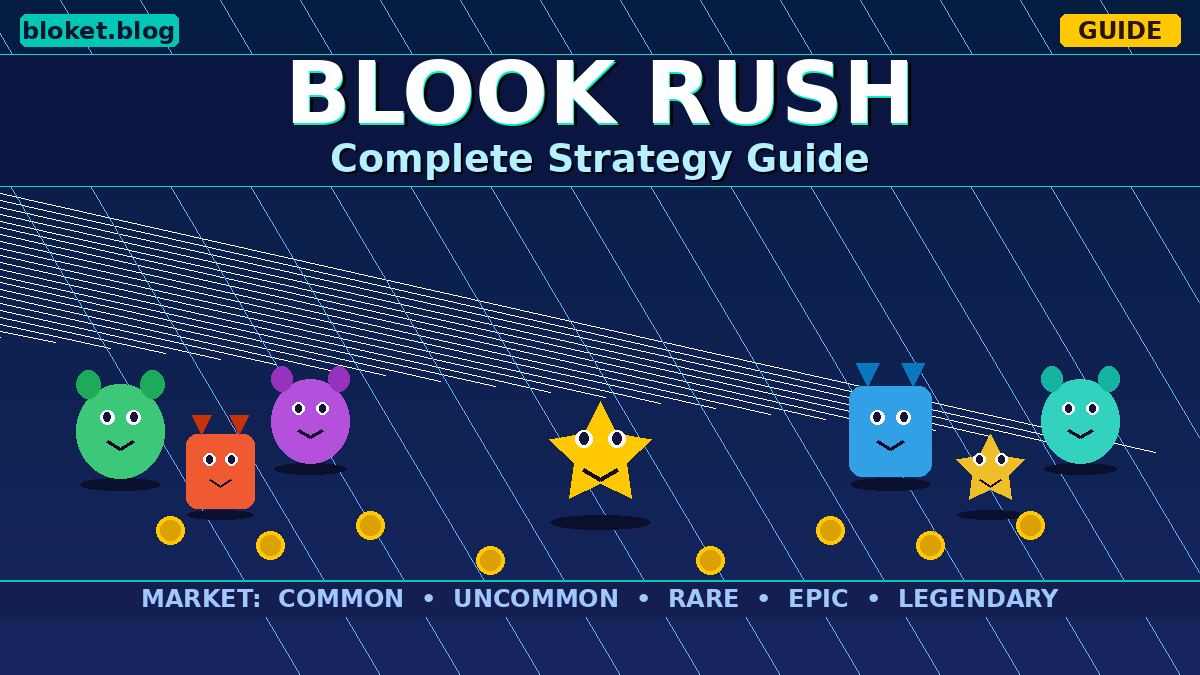
Blook Rush is a Blooket game mode where players answer questions to earn gold and spend that gold buying blooks from a shared market. The player with the highest combined point value across all collected blooks at the end of the session wins.
The core loop
The cycle runs continuously: answer a question, earn gold, check the market, decide whether to buy. The market displays several blooks simultaneously, each with a gold cost and a point value attached. Buy one, and it joins your collection. The market refreshes as blooks are purchased or after a set interval. The loop repeats until the timer expires.
How blooks and point values work
Every blook in the market belongs to a rarity tier. Common blooks sit at the lower end, costing the least gold and contributing fewer points to your total. Uncommon, rare, and higher-tier blooks cost more but carry significantly more points. The gap between a common and a rare blook’s point value is large enough that buying two or three rares consistently beats filling your collection with commons.
How gold flows through the game
Gold enters your total only through correct answers. There is no combat or theft mechanic in Blook Rush — every player earns independently based on question performance. This makes accurate answering the only consistent income path, which means players who skip questions to watch the market end up spending less overall and finishing lower on the leaderboard.
How to build a strong Blook Rush strategy from the first round
The opening phase of Blook Rush determines your buying power for the rest of the session. Players who build a gold base before making their first purchase almost always outperform those who spend the moment they hit minimum gold.
Answer questions before buying anything
The instinct to buy the first available blook is strong, especially when the market shows something colorful or rare right at the start. Resist it. Answer three to five questions before making your first purchase. That small gold buffer gives you more flexibility to wait for a higher-value blook rather than settling for whatever is cheapest at that moment.
How to prioritize blooks by value
Not all blooks are worth the same investment. Before buying, ask one question: what is the point-to-cost ratio of this blook compared to what else is in the market? A blook that costs twice as much gold but gives three times the points is a far better buy than a cheap common. In every session tracked for this guide, players who consistently target mid-to-high-tier blooks rather than filling slots with commons end up with a higher final score.
Use this general priority order when the market is mixed:
- Rare or higher-tier blooks — buy immediately if you have the gold
- Uncommon blooks — buy if no rare is available and you have spare gold
- Common blooks — only buy if the market is fully stocked with commons and your total is low
When to buy and when to wait
The market refresh creates natural decision windows. When the current market shows only commons and your gold total is moderate, waiting for a refresh is often the right call. Spending on commons now means you will not have the gold available when a rare appears in the next refresh cycle.
The exception is near the end of the session. If the final 30 seconds arrive and you are sitting on a large gold total with only commons available, buy them. Unspent gold earns zero points at the timer. Any blook, even a common, converts your gold into something that counts.
Reading the leaderboard while playing
The leaderboard in Blook Rush updates throughout the session. A player whose point total is climbing steadily is buying blooks every round, landing accurate answers, and hitting good tiers. A player whose score has been flat for a while may be holding gold for a specific rare. Both patterns tell you whether your own pace is competitive and whether your strategy needs adjusting mid-session.
Advanced Blook Rush tactics that consistent winners use
Once the core buying strategy is in place, these tactics separate players who win occasionally from those who finish in the top positions regularly.
Using the market refresh to your advantage
The market does not refresh randomly — it refreshes when blooks are bought or when a set interval passes. If nobody in the lobby is buying commons and the market is sitting stagnant, buying a common strategically can trigger a refresh and bring new blooks into rotation. This gives you first look at whatever appears next. It is a small edge, but in close games it matters.
Blook tier comparison
Understanding the general relationship between blook tiers, approximate cost ranges, and point value ranges helps you make faster decisions in real time.
| Blook tier | Relative gold cost | Points added | Best time to buy |
|---|---|---|---|
| Common | Low | Small | Only if market is stagnant or timer is low |
| Uncommon | Moderate | Decent | Good filler when no rare is visible |
| Rare | High | Significant | Buy as soon as you have the gold |
| Epic or higher | Very high | Large | Save specifically for these when possible |
These ranges shift slightly depending on the question set and lobby size, but the decision logic stays the same: tier up whenever your gold allows it.
Managing gold in the final 60 seconds
The final minute of Blook Rush requires a different mindset. The goal shifts from “wait for a rare” to “convert every remaining gold coin into points.” Buy available blooks in descending order of value — best available first, then work down. A player who finishes with a large unspent gold balance made worse decisions in those final seconds than one who bought four commons with it, even if buying commons felt like settling.
Acting fast when a rare appears in a large lobby
In sessions with many players, rare blooks that appear in the market can disappear within seconds because another player buys them. If you see a rare and have the gold, buy it without hesitation. The habit of pausing — “is this the right call?” — costs you the rare in any competitive lobby. Work out your buying thresholds before the session starts so the decision is already made when the moment arrives.
Running Blook Rush as a classroom activity
Blook Rush plays out differently in a structured class session than in open multiplayer, and adjusting a few variables significantly improves both the learning outcome and the engagement level — see our picks for the best modes for small classes.
Choosing the right session length and question count
Short sessions with fewer than 20 questions give students almost no time to develop a buying strategy. The game ends before most players have made more than three or four purchases, which means luck drives outcomes more than skill. A question set of 30 to 50 items gives students enough rounds to experience real trade-offs: wait for a rare or spend on commons now? That decision-making layer is what makes the mode educationally useful beyond pure trivia recall.
Why Blook Rush sustains engagement across ability levels
The buying decision layer adds a second cognitive task on top of content recall. Students are not just retrieving answers — they are managing a resource and making strategic choices under time pressure. That combination tends to increase sustained attention across the session. Students who fall behind on questions can still make smart buying decisions and stay competitive, which keeps more of the class engaged throughout rather than checking out after the first few minutes.
Using the final leaderboard as a classroom debrief
After the session, pull up the final standings and ask: who had the highest blook value, and what did they buy? Compare two students who answered a similar number of questions but finished with very different scores. The difference is almost always in blook tier selection. That 60-second debrief connects resource management thinking directly to the game they just played, and the lesson tends to stick better than a summary on a slide.
Adjusting session length based on your goal
A 10-minute session with a short question set works well for a warm-up or a fast reward activity. A 20-to-25-minute session with a longer set works for review, where answering correctly has a real effect on the strategic outcome. Matching the session length to the purpose changes what kind of engagement you actually get from the mode.
Common Blook Rush mistakes and how to fix them
Buying everything available immediately
The most common mistake in Blook Rush is treating every market blook as a buy opportunity. Players who buy whatever is cheapest, as often as possible, fill their collection with low-value commons and end the game far behind players who showed restraint. The market will refresh. Waiting for higher-value blooks is almost always better than spending on commons to feel like you are making progress.
Slowing down on questions to watch the market
Some players become so focused on the market display that they answer questions carelessly or skip the question phase mentally. Gold from correct answers is the only income source in the mode. A player who answers eight questions accurately while checking the market briefly between rounds will accumulate far more gold than someone who answers four questions and spends the rest staring at what is available to buy.
Treating all blooks as equal purchases
Blooks are not equal. A player who buys ten commons will almost always score less than a player who bought two rares. The rarity tier determines point value, and the point difference between tiers is large. Before clicking buy on anything, check whether something better is available in the same market cycle. If it is, wait.
Holding too much gold when the timer is close
The mirror image of buying too early is holding gold too long. Some players lock into waiting for a rare that never appears, and the timer runs out with a large unspent balance. If the final 45 seconds arrive and no rare is in the market, buy what is available. Unspent gold ends the game as zero points. Any blook, even a common, is worth more than an unused stack of gold.
Underestimating how fast the market moves in large lobbies
Rare blooks that appear in large-lobby markets can vanish in seconds. Developing the habit of scanning the market quickly after each question and buying immediately when a rare appears — rather than deliberating — is a skill that matters more as lobby size increases. The players who win consistently in competitive sessions have trained themselves to react to rare appearances without hesitation.
FAQs
What is the goal of Blooket Blook Rush?
The goal is to collect the highest total point value of blooks by the time the session timer runs out. Players earn gold by answering questions correctly and spend it purchasing blooks from a shared market. Rare and higher-tier blooks are worth more points, making blook tier selection the central strategic decision throughout the game.
Does answering questions faster help in Blook Rush?
Speed helps because more questions answered means more gold earned over the session. However, accuracy matters more than raw speed. A wrong answer earns no gold, and consistently rushing through questions reduces your total income. Accurate, steady answering outperforms fast but careless answering across a full session in almost every case.
Can two players buy the same blook from the market?
No. Each blook in the market is a single item available to whoever purchases it first. Once a player buys a blook, it disappears from the market for everyone else. This is why acting quickly when a rare appears in a large lobby matters — another player can buy it before you act if you pause too long.
What happens to gold left unspent when the timer ends?
Unspent gold contributes nothing to your final score. Only the point value of the blooks you collected counts at the end. Holding gold past the timer is a complete waste of potential points, which is why converting remaining gold into any available blook in the final seconds is always the right move.
Is Blook Rush a good mode for classroom use?
It is one of the stronger modes for sustained engagement because it layers a resource management decision on top of content recall, and ranks among the easiest Blooket modes to win once you master the buying rhythm. Students manage gold, evaluate blook value, and answer questions simultaneously, which creates a richer cognitive task than pure trivia. The mode also keeps students with different ability levels engaged in the same session, since smart buying can partially offset lower question accuracy.
How many blooks can one player collect in a session?
There is no fixed cap. The number of blooks a player can collect depends entirely on how much gold they earn and how efficiently they spend it. A player focused on commons will collect many blooks but score lower. A player saving for rares will collect fewer blooks but score significantly higher. The rare-focused approach wins on the scoreboard in almost every comparison.
Does blook availability in the market change by session?
The market draws from the same pool of blooks regardless of the session. However, which blooks appear in any given market cycle is random. Some sessions show more rares early, others are heavy with commons throughout. Adjusting your patience level based on what you are actually seeing in the market — rather than following a rigid plan regardless of conditions — is a mark of an experienced Blook Rush player.
Does a Blooket Plus subscription affect Blook Rush gameplay?
Blooket Plus is a paid subscription that adds cosmetic and organizational features. The core Blook Rush mechanics are the same for all players regardless of subscription tier. Gold earning, blook purchasing, market access, and point calculation work identically across free and Plus accounts during a Blook Rush session — the same applies in similar earning modes like our Gold Quest winning strategy covers.
Conclusion
Blook Rush rewards the players who treat gold as a finite, strategic resource rather than something to spend the moment it appears. Answer questions accurately to build your gold base, prioritize mid-to-high-tier blooks in the market before spending on commons, and convert any remaining gold into points in the final 60 seconds.
The single most effective adjustment for your next session: before the game starts, commit to skipping the first three market cycles unless a rare appears. That one rule prevents the most common mistake in the mode and gives you the gold buffer to act decisively when a high-value blook shows up.
For teachers, pair Blook Rush with a 35-to-50-question set and take 60 seconds at the end to show the leaderboard and ask why the top players scored what they did. That debrief connects the game’s resource decisions to thinking skills that apply well beyond the session itself.
Knowledge is your most powerful asset—use our research-backed guides to stay ahead of the curve.