
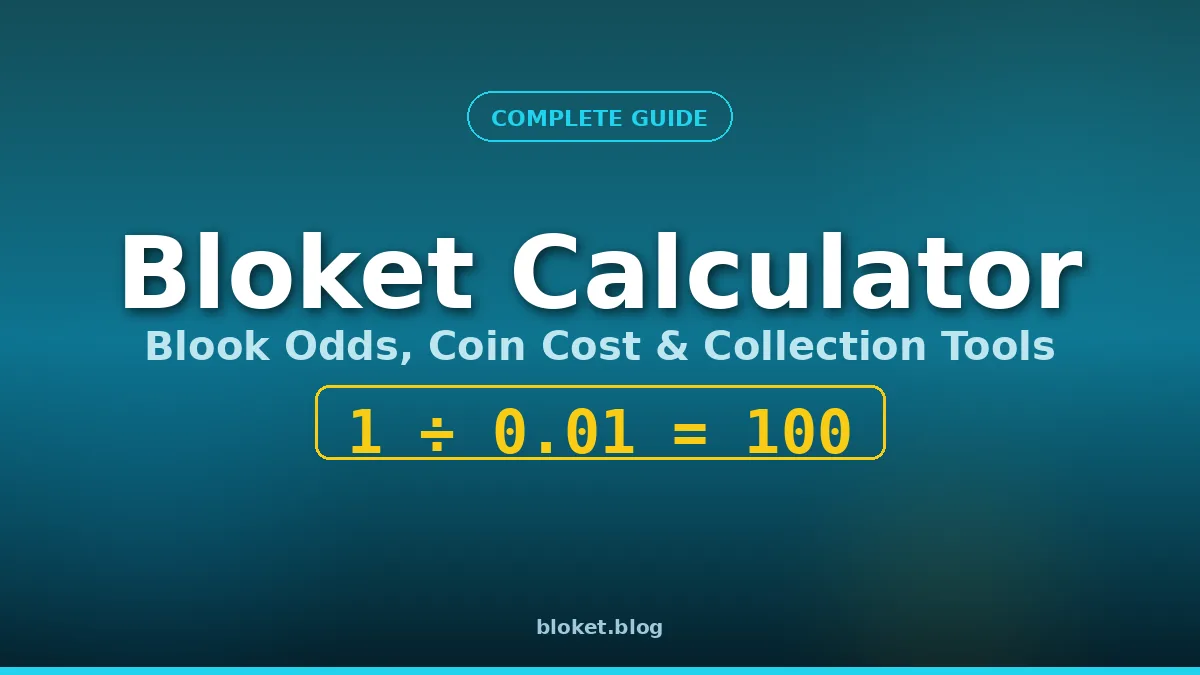
A Bloket calculator is any tool that helps a player estimate blook drop odds, coin costs, or collection progress on the Blooket learning platform. Some are simple probability tables. Others are full web apps that model expected coin spending across many boxes. All of them try to answer one question: what will it actually cost to get the blook you want?
This guide covers the main types of Bloket calculators, how to use them well, when they help and when they mislead, and how to work out the same numbers by hand if no calculator is available. It also covers the sketchier corners of this space, where “calculators” turn out to be login-stealing sites in disguise.
Nothing here needs a paid tool. The best Bloket calculations are simple enough to run on any basic math tool, and the community-made calculators that exist are free.
What a Bloket calculator actually is
A Bloket calculator is a community-built tool, not an official Blooket feature. Blooket does not publish a calculator on its own site. The tools that exist are made by players and teachers who wanted a faster way to answer common questions about coins, blook odds, and collection progress.
The most common types calculate expected coin cost to pull a specific blook, expected number of boxes needed to complete a rarity tier, and total blook count against total collection size. Some also handle Blooket Plus subscription cost against play time value.
Why players use Bloket calculators
Blook boxes have published drop odds. A player looking at a Space Box with a two percent chance for legendary tier can do the math to know that pulling a specific legendary blook takes many hundreds of tries.
Reading raw odds without doing the math leads to bad decisions. A player who thinks a five percent chance means five boxes will guarantee a pull is going to be disappointed. A calculator turns confusing percentages into concrete expected costs, which changes how players spend their coins.
Teachers sometimes use calculators too, though usually for a different reason. Some teachers use blook collection progress as a classroom motivation tool, and a calculator helps set realistic milestones.
The community-made nature of these tools
Every Bloket calculator worth using is made by a Blooket player or a group of players. They are hobby projects, not commercial products, and their accuracy depends on how carefully the maker gathered the underlying odds.
The trade-off is that community calculators can go out of date when Blooket changes box contents or adjusts odds. A calculator that was accurate for months might slip out of sync after a platform update. Cross-checking any calculator’s numbers against the current in-game odds is smart practice.
Types of Bloket calculators explained
The Bloket calculator space breaks into a few distinct types, each answering a different question. Picking the right type for the question at hand saves time.
The categories below cover the tools most players and teachers actually use.
Blook drop rate calculators
These are the most popular type. A drop rate calculator takes a box name and a target blook, and returns the expected number of boxes needed to pull that specific blook.
The math is straightforward. A blook with a one percent drop rate has an expected pull of one hundred boxes. A blook with a 0.1 percent drop rate has an expected pull of one thousand boxes. Multiply by the box cost in coins and the total expected coin spend appears.
The number is an expectation, not a guarantee. Actual pulls follow a distribution, so a player might get the target blook in ten boxes or still not have it after a thousand. The expected value gives a useful average, not a promise.
Coin cost and value calculators
Coin cost calculators start from the coin balance and estimate what a player can afford. Some also model coin income from playing modes, which helps players plan a saving strategy.
The more useful calculators let a player enter their weekly play hours and estimate coin income based on the modes they play most. This turns “how long until I can afford this box” into a concrete number.
The trade-off is that coin payouts vary between modes and even between rounds within one mode. Any income estimate is an average, and actual coin flow will move faster or slower depending on which modes get played.
Collection progress calculators
Collection progress calculators focus on the total blook count against the total collection size. They help players see how close they are to completing a rarity tier or the whole collection.
The tool is most useful for players chasing full-tier completions. Seeing that a legendary tier is at eighteen of twenty gives a specific target to aim for. Seeing that a common tier is at eighty of one hundred motivates a few more common box pulls to finish it.
Some calculators show completion percentages weighted by rarity, which highlights how far from actual completion a collection really is. A collection at ninety percent completion by count might be at fifty percent by rarity-weighted value if all the missing blooks are rare tiers.
Blooket Plus cost calculators
Blooket Plus is a paid subscription that adds hosting and reporting features. Some calculators model the subscription cost against gameplay time to help teachers or heavy players decide whether the subscription pays off for them.
The calculation is not about coin math but about feature value. If a teacher hosts many games a week and the Plus features save time on each, the subscription can be worth its cost. If Plus features only get used occasionally, the free tier is fine.
These calculators lean into feature comparison rather than pure numbers. Different players get different value from Plus, and the calculator helps make that concrete.
Box comparison calculators
Box comparison calculators put two or more boxes side by side and show which one gives better expected value per coin spent. This is useful when a player has enough coins for a choice between a cheap box or saving up for a rarer one.
The math weighs each box’s cost against its odds of pulling something the player does not already own. A box full of blooks the player already owns has low expected value even if the odds look good on paper.
Some comparison calculators also factor in personal collection status, which changes the answer for different players. The same box has different value to a completionist chasing legendaries versus a casual player just filling common tiers.
Answer streak and score calculators
A smaller category of calculators focuses on game score rather than collection. These estimate expected score based on average accuracy and response time, and are more useful for players who track their competitive performance.
The math is more approximate than for coins, since scoring formulas vary between modes. Still, players who want to know whether their average score is competitive at a class level find these useful for benchmarking.
Teachers rarely use these because they already see actual scores in the class report. The calculators fill a gap that only exists for students playing outside a class report structure.
A comparison of calculator types
| Calculator type | Best for | Accuracy | Time to use |
|---|---|---|---|
| Blook drop rate | Chasing specific blooks | High if odds are current | Under a minute |
| Coin cost | Budgeting future spending | Medium (payout varies) | Two to three minutes |
| Collection progress | Completion goals | Very high | Under thirty seconds |
| Blooket Plus value | Deciding on subscription | Medium (personal value varies) | Five minutes |
Most players use drop rate and collection progress calculators the most. Coin cost calculators come third, and Blooket Plus calculators come up mostly when a subscription decision is on the table.
How to use a Bloket calculator effectively
Getting real value from a Bloket calculator takes a small amount of thought. The tool itself is easy. The interpretation of the results is where players either learn something useful or fool themselves.
The tips below apply to any calculator type and take almost no extra time to follow.
Cross-check the odds against the current in-game numbers
The first step with any calculator is a fast sanity check against Blooket’s own published odds. Every box shows its odds in-game on the box detail screen.
If the calculator’s numbers match the in-game numbers, the tool is likely accurate. If the numbers do not match, either the calculator is out of date or the odds have shifted. Trusting an out-of-date tool leads to bad spending decisions.
The check takes ten seconds and prevents hours of wasted play time chasing bad numbers.
Treat expected values as averages, not promises
An expected pull of one hundred boxes for a specific blook does not mean the blook will drop on box one hundred. It might drop on box five. It might not drop after five hundred.
The math is honest but the outcomes are random. Some players get lucky and pull rare blooks quickly. Others go long stretches without pulling anything rare.
Planning based on expected values is smart. Planning based on the assumption that expected values are exact is not. A player expecting a legendary pull after fifty boxes needs to budget coins for two hundred boxes to be safe.
Use calculators for decisions, not for entertainment
The calculators that help are the ones a player consults before making a spending decision. Should this box be bought now, or is a better one worth saving for. Should coins be spent grinding this mode, or a different one.
Running calculators just to see numbers move is a way to lose interest in the actual game. The point is to inform a specific choice, not to become part of the play.
Bookmark one calculator per type
Most players end up using two or three calculators regularly. Bookmarking these avoids the search-and-hope-it-works pattern that eats time on every future check.
The best calculators tend to stay updated and functional over time. Once a good one is found, using it consistently is better than switching to whatever ranks highest in search results this week.
Doing the calculations yourself without a tool
Every Bloket calculation can be done by hand or with a basic calculator app. Understanding the math is useful because it lets a player make decisions when no calculator is handy.
The methods below cover the calculations that come up most often.
Expected number of boxes for a specific blook
The math is one division. Divide one by the drop rate, expressed as a decimal, to get the expected number of boxes.
A drop rate of one percent is 0.01 as a decimal. One divided by 0.01 equals one hundred. So the expected number of boxes to pull a specific blook with a one percent drop rate is one hundred.
A drop rate of 0.5 percent is 0.005. One divided by 0.005 equals two hundred. Same math, different numbers.
Expected coin cost
Multiply the expected number of boxes by the coin cost of one box. A hundred boxes at fifty coins each is five thousand coins. A thousand boxes at two hundred coins each is two hundred thousand coins.
This is the number that stops most players from chasing specific rare blooks. Seeing that a target legendary requires spending a hundred thousand coins in expected value changes the way most people think about the pull.
Confidence range for actual pulls
Real pulls follow a distribution around the expected value. A rough rule of thumb for planning: budget for about three times the expected pull count to be reasonably safe.
If the expected pull is a hundred boxes, budget for around three hundred to have a realistic chance of pulling the target within the budget. This is not a guarantee but a much safer plan than budgeting for exactly one hundred.
Coin income per hour of play
Estimating coin income requires knowing average coin payout for the modes played most. Most modes pay between one hundred and five hundred coins per session, with longer modes tending toward the higher end.
Multiply the average per-session payout by the number of sessions played per hour. Café at fifteen minutes per session at three hundred coins average is around twelve hundred coins per hour. This is a rough estimate but useful for planning.
Time to complete a collection tier
Combining coin income with expected coin spend gives an estimate of how many hours of play a target requires. Divide expected coin cost by hourly coin income to get the play hours needed.
A hundred-thousand-coin target at twelve hundred coins per hour is about eighty-three hours of play. That is the reality check most players need to see before chasing a specific rare blook. Some choose to continue anyway, others find a smaller target that fits their available time.
The number is not a discouragement. It is honest information that helps a player pick goals that match how much they actually play.
Building a simple spreadsheet calculator
Any player comfortable with a basic spreadsheet can build a personal Bloket calculator in about ten minutes. The columns needed are blook name, drop rate, box cost, and expected coin cost.
Expected coin cost is a simple formula: box cost divided by drop rate. That is the whole formula. Adding a column for personal budget makes the sheet a personal decision tool that fits the specific player’s goals.
The advantage over a generic online calculator is that a personal sheet stays accurate as the player updates their own numbers. It also does not need any outside site to load.
Common Bloket calculator mistakes and myths
Calculator errors come from either the tool being wrong or the user misreading the result. Both are avoidable with a bit of care.
The list below covers the mistakes that come up most often.
Trusting an outdated calculator
Calculators built when Blooket first released a box may not reflect current odds. The tool still runs, the numbers still look plausible, and the results are wrong.
The fix is the sanity check against in-game odds mentioned earlier. Any calculator that does not match current numbers should not be trusted for a real spending decision.
Treating expected value as a target
An expected pull of a hundred boxes means the target is likely somewhere around a hundred, not exactly at a hundred. Players who plan for exactly the expected number often burn through their coins with nothing to show.
The three-times rule of thumb for budgeting is a much safer starting point. Any player serious about pulling a specific rare blook should plan for a larger budget than the expected value.
Using “calculators” that ask for a login
Some sites that advertise as Bloket calculators actually try to capture login credentials. A real calculator does not need a Blooket account to do the math. Any tool asking for a Blooket login or Google credential is not a calculator.
The safest calculators are the ones that ask for nothing more than a target blook or box name. No login, no personal information, no browser extension. Anything more than that is a red flag.
Ignoring the class or teacher context
Students calculating their expected coin spend to complete a collection sometimes forget that Blooket time in school is not for coin farming. Grinding coins in a class review session at the expense of learning is a losing move.
Calculators are best used to plan for solo play at home, not to justify off-task behavior in class. A student who spends class time coin farming misses the learning point of the session and often gets caught by the teacher anyway.
Overweighting rarity in decision-making
Chasing only the rarest blooks with every coin earned is a slow and often frustrating path. Most players enjoy the game more with a broader collection of common and uncommon blooks than a sparse collection with one legendary.
Calculators can accidentally push toward the rare-chase mindset by showing exact numbers that make the chase feel achievable. Balancing that with actual play enjoyment is a judgment call every player has to make.
Best practices for using Bloket calculators well
A few habits turn calculator use from a distraction into a useful decision tool. Most take almost no time to set up.
The habits below come from patterns visible in how experienced players use these tools.
Set a coin budget before consulting a calculator
Deciding the maximum coin spend on a specific pull before running the numbers changes the way the calculator gets used. Instead of asking “how many coins will I need,” the question becomes “does my budget cover a realistic pull attempt.”
If the budget does not cover the expected pull plus a safety margin, the pull is not worth attempting yet. Saving up more coins first is a smarter path than starting a pull that will run out of budget partway through.
Track actual pulls against expected pulls
Some players keep a small note of what they actually pulled from a box versus what the calculator said to expect. Over time this builds intuition for how random the pulls really are.
A player who has kept records for a while develops a healthier skepticism about expected values. Seeing that half the time a rare pull happened well before the expected value, and half the time well after, makes the math feel more honest.
Prefer calculators without ads or extensions
The best community calculators are minimal single-page tools with no ads, no login prompts, and no browser extension requests. Anything more elaborate is either monetization or something worse.
A page that renders a small form, calculates the result, and shows a number is a good sign. A page that asks for permissions, installs anything, or gates the result behind a survey is a bad sign.
Use the calculator to plan, then close it
Consulting a calculator once before a session and then closing it prevents the tool from becoming a distraction during play. Some players keep calculators open in a second tab and check them constantly, which pulls attention away from the actual game.
The calculator’s job is to inform a decision, not to be a running companion. Once the decision is made, the tool has served its purpose.
Share calculations with friends who play
Players who play with the same friend group sometimes share their calculations, which turns the tool into a small social feature. A shared budget target across a group of friends chasing the same blook adds accountability that solo play does not have.
The math itself does not change, but the framing does. Knowing a friend hit their target after two hundred pulls when the expected was a hundred and fifty gives more useful information than a solo experience of pulls.
Group chats around Blooket pulls also help distinguish honest pulls from lucky outliers, since more data points build a better picture than one player’s experience.
Avoid making calculators the whole game
Some players get so focused on optimizing their pulls that they stop enjoying the actual gameplay. The calculator becomes a spreadsheet exercise, and the fun of the surprise pull disappears.
Blooket is a learning game with a collection layer, not a probability puzzle with questions on top. Keeping the calculator use light preserves what makes the platform enjoyable in the first place.
Any player who notices themselves calculating pulls more than actually playing should step back from the tools for a while. Play a few sessions without checking any calculator and let the pulls surprise. Enjoyment usually returns.
Teach kids to check the math themselves
For teachers and parents watching students use calculators, the calculator itself is a small teaching moment. Blooket calculators use the same probability math that shows up in middle school statistics classes.
Walking a student through how expected value works, why an average is not a guarantee, and how a safety margin builds into a plan is a real math lesson wrapped in something the student cares about. The Blooket context makes the ideas stick better than a textbook example would.
This is one of the underused benefits of the whole Blooket calculator space. The tools exist for players, but the ideas behind them are lesson material that teachers can lean into.
FAQs
Is there an official Bloket calculator?
No. Blooket does not publish a calculator on its own site. Every Bloket calculator that exists is a community-made tool built by players or teachers. This is not a problem in itself, but it means quality varies and some calculators go out of date faster than others.
Are Bloket calculators safe to use?
Simple community calculators that ask for nothing but a box or blook name are safe. Sites that ask for a Blooket login, install browser extensions, or gate results behind surveys are not safe and should not be used. The presence of an account login prompt is the clearest red flag.
Do Bloket calculators actually work?
Yes, when they use current odds. The math itself is honest probability calculation. The trap is when a calculator has not been updated after Blooket changed its box contents or odds. Cross-checking the calculator’s numbers against in-game odds catches this in ten seconds.
Can a Bloket calculator guarantee I get a specific blook?
No. Calculators return expected values based on probability, not guarantees. A specific blook might drop on the first pull or after a thousand pulls. Planning with a safety margin above the expected value is a much smarter approach than assuming the expected value is a target.
Do teachers use Bloket calculators?
Some teachers use them to set collection milestones for students who are motivated by blook progress. Most teachers do not because their focus is on the review value of Blooket, not the collection game around it. Calculators are much more common on the student side than on the teacher side.
What is the best free Bloket calculator?
The best free calculator is the one that uses current odds, has no login prompts, and has a maker who updates it after Blooket changes boxes. Bookmarking one good calculator and sticking with it is smarter than searching for a new one every session. Look for tools that show the source of their odds openly.
Can I make my own Bloket calculator?
Yes. The math is simple probability calculation, which fits in a basic spreadsheet or a short script. Some players build personal calculators in a Google Sheet to track their own pulls against expectations. This can be more useful than any generic online tool because it fits the specific goals of the player.
Do I need a Bloket calculator to play well?
No. Calculators help with spending decisions on rare pulls but are not required for enjoying the game. Most players do fine without ever using one. The calculator’s value is in avoiding wasteful spending on unrealistic chases, not in playing the game itself.
Wrapping up Bloket calculators
Bloket calculators are useful tools for making spending decisions and setting collection goals. The best ones are simple, community-made, and updated regularly against in-game odds. The worst ones ask for logins and put accounts at risk.
The one action to take now: check the drop rate on the box currently being pulled the most, divide one by that rate to get the expected pull count, then multiply by the box cost. That single calculation replaces most calculator use.
For deeper looks at the specific boxes and their contents, the box and blook rarity guides on this site cover the details of what actually drops from each one.
Skip the filler and land on editor’s best—our seal means real quality.