How to Top Blooket Leaderboard: Proven Tips That Win
The Blooket leaderboard does not reward luck alone. Players who consistently finish first combine fast answering, smart mode knowledge, and a few tactics that most players never think about. This guide breaks down exactly how leaderboard scoring works, which strategies move the needle in each popular game mode, and the mistakes that silently drop you from first to fifth.
How does the Blooket leaderboard work?
The Blooket leaderboard ranks players by the points or resources they accumulate during a game, and the metric depends entirely on which game mode is being played. In Gold Quest, the leaderboard measures gold held at the end. In Battle Royale, it is survival order. In Classic, it is raw points earned per correct answer.
Understanding the scoring mechanic for your specific mode is the first step. A strategy that works in Gold Quest can actively hurt you in Battle Royale.
How scoring differs by mode
| Game mode | What the leaderboard measures | Key driver |
| Gold Quest | Gold held when game ends | Answering fast + smart stealing |
| Battle Royale | Survival order | 100% accuracy under time pressure |
| Classic | Total points accumulated | Speed × answer volume |
| Tower Defense | Waves survived / score | Answering correctly for resources |
| Factory | Production value | Steady correct answers |
| Café | Customer satisfaction / coins | Answer speed + order management |
| Racing | Finish position | Pure answer speed |
The leaderboard resets every game. There is no persistent cross-session ranking visible to other players in standard modes — what you see at the end screen is that session only.
What the end-screen ranking actually shows
After a game ends, Blooket displays the top players in order. The position you finish in depends on the final count of whichever metric that mode tracks. Ties are resolved internally by Blooket, often favoring the player who reached that score first. Speed is a tiebreaker even when it is not the stated scoring metric.
How to top the Blooket leaderboard in any mode
The clearest path to first place combines three things: answering quickly, answering accurately, and understanding how the specific mode rewards or punishes those two things. For a broader playbook that goes beyond ranking and focuses on closing out the match, this complete guide on how to win every Blooket game ties it all together.
Step 1: Use number keys instead of clicking
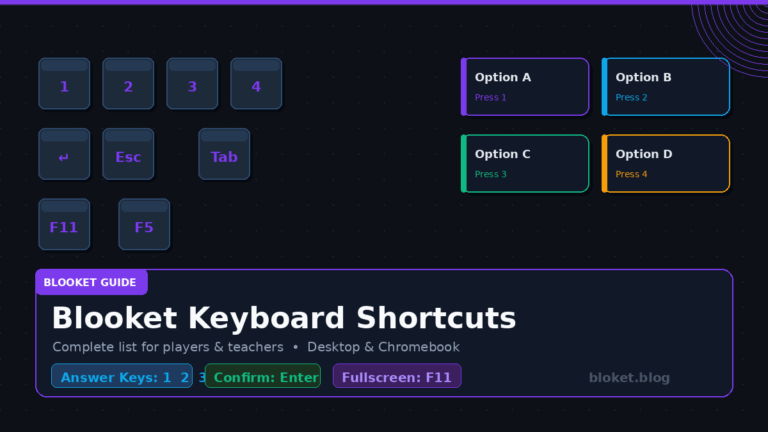
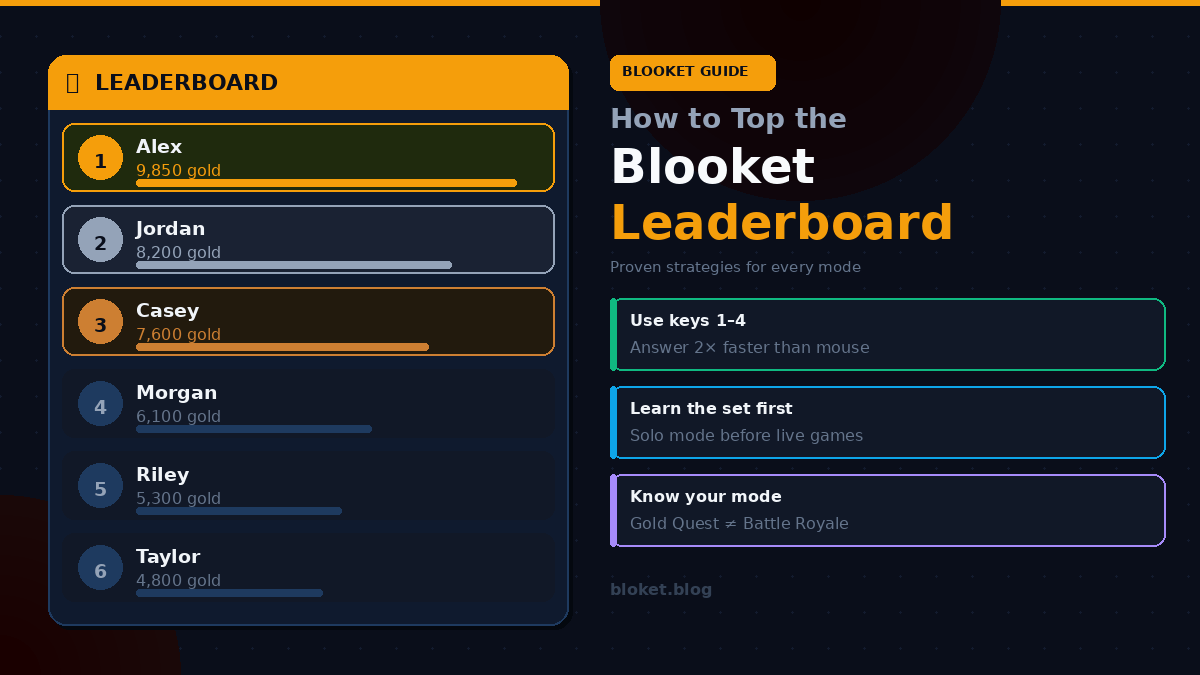
Press 1, 2, 3, or 4 to select the corresponding answer tile the moment it appears. The keys map to answer positions: 1 is top-left, 2 is top-right, 3 is bottom-left, 4 is bottom-right. This alone shaves a fraction of a second off every question, and across a 20-question game that adds up to several full extra seconds of lead time over mouse users. For the full set of keys that work in the lobby, host dashboard, and every game mode, see this complete Blooket keyboard shortcuts list.
Step 2: Read the question before the answers load
Blooket questions appear slightly before the answer tiles animate in. Use that half-second to process the question stem. By the time the tiles are fully visible, you have already narrowed your likely answer and are pressing the key rather than reading and clicking simultaneously.
Step 3: Prioritize accuracy in elimination modes
In Battle Royale, a wrong answer removes health — and players with full health can survive to win even if they answered fewer questions overall. One careless wrong answer early can end your run. Slow down by half a second on questions you are unsure of. The speed penalty for one careful answer is always smaller than the elimination penalty for one wrong one.
Step 4: Never skip questions in Classic and Racing
Classic and Racing modes reward volume. Every correct answer adds to your score. There is no benefit to pausing or hesitating strategically. The player who answers the most questions correctly in the shortest time wins. Keep the pace high and do not pause between questions.
Step 5: Learn the question set before a hosted game
If a teacher or host shares the question set name before the game, search it on Blooket and play it in Solo mode first. Recognizing questions during a live game means you are pressing keys before most players have finished reading. In hosted classroom games, this is the single biggest legal advantage available.
Mode-by-mode strategies to reach first place
Gold Quest
Gold Quest is the most strategically layered mode on the leaderboard. Answering correctly earns you coins, but the real mechanic is the chest system: after each correct answer, you pick a chest that either gives you gold, steals gold from a random player, or swaps gold totals with someone.
When to steal vs collect
Steal-type chests are most valuable when another player has significantly more gold than you do. If the game has five minutes left and you are in third place, a steal chest targeting the leader can flip the leaderboard instantly. Earlier in the game, collecting gold steadily is more reliable because the pool is smaller and steals return less.
Protecting your lead in Gold Quest
There is no direct defense against theft. The only protection is answering so quickly that you accumulate gold faster than others can steal it. If you are the leader with two minutes left, maintain pace rather than slowing down — the player in second is answering hard and hoping for steal chests.
Battle Royale
Battle Royale rewards the last player standing. The leaderboard is determined by elimination order, so the first player knocked out finishes last regardless of how many questions they answered correctly before their health hit zero.
Focus entirely on accuracy. Speed matters only as a secondary factor — a faster correct answer beats a slower correct answer, but a wrong answer at any speed is always worse than a slow right answer.
Classic mode
Classic is a straightforward race. Points are awarded per correct answer, and the player with the most points wins. There are no secondary mechanics like stealing or elimination health.
The fastest typists and keyboard users dominate Classic. If you have not switched from mouse clicking to number-key answering, Classic is the mode where that change produces the most immediate leaderboard improvement.
Tower Defense and Tower Defense 2
Correct answers generate resources that let you place and upgrade towers. Players who answer more accurately have stronger defenses and survive more waves, which translates to a higher end-of-game score.
The leaderboard in Tower Defense is less about pure answer speed and more about tower placement efficiency. A player who answers slightly slower but places towers optimally can outscore a faster player who ignores tower strategy. Between questions, make one deliberate upgrade or placement decision rather than clicking randomly.
Factory
Factory scores are driven by consistent answering. Each correct answer adds production value to your factory. There are no steal mechanics or elimination events. Steady, accurate answering throughout the full game beats burst-and-miss patterns.
If you get a question wrong, do not try to over-speed on the next one to compensate. The point loss from one wrong answer in Factory is small; the point loss from rushing and getting three wrong in a row is significant.
Mistakes that drop you down the leaderboard
Guessing on every question
Random guessing has a 25% success rate with four answer choices. Over a 20-question game, that produces roughly 5 correct answers. A player answering carefully and accurately will produce 15 to 18 correct answers in the same time. Guessing is only rational when you have genuinely no idea and the game has a long cooldown between questions — in most Blooket modes, reading the question takes less time than people assume.
Playing Gold Quest as a pure speed game
Many players treat Gold Quest like Classic: answer as fast as possible, collect gold, and hope for the best. Players who also manage chest selection strategically — targeting steal chests toward the current leader when they are behind — regularly outscore faster answerers who ignore the chest mechanic.
Ignoring the question set
Blooket question sets vary enormously in difficulty and topic. A student playing a question set matched to their knowledge will always outperform a faster player who does not know the subject. In self-hosted or choice games, selecting a set you are already comfortable with is a legitimate competitive decision.
Letting the UI distract you between questions
Gold Quest, Factory, and Café all have interactive elements between questions. Some players spend so long on the between-question interface that the next question loads before they are focused. Keep your post-answer interaction brief. One chest tap or one quick placement is enough — the next question is coming.
Assuming blook choice affects scoring
Blooks are cosmetic. The character you play as has no effect on answer speed, scoring, or any leaderboard mechanic. Spending time or coins chasing a specific blook for competitive reasons is a myth. Put that attention toward learning the question set instead.
FAQs
Does answering faster give you more points in all modes?
Speed gives bonus points in some modes (Classic, Racing) and acts as a tiebreaker in others. In Battle Royale, accuracy outweighs speed — a fast wrong answer is worse than a slightly slower right one. Check the specific mode’s scoring logic before assuming speed alone wins.
Can you see the leaderboard during the game?
In most modes, Blooket shows a mid-game leaderboard between questions or on a results screen. In Classic, the host can see live rankings on their dashboard. Players typically see a brief rank indicator rather than the full leaderboard until the game ends.
Does Blooket Plus help you rank higher on the leaderboard?
Blooket Plus is a paid subscription that unlocks additional blooks and features but does not change scoring, answer speed, or any leaderboard mechanic. A free-account player answering correctly and quickly will outscore a Plus subscriber who does not know the material.
Is there a global Blooket leaderboard across all games?
Blooket does not have a publicly visible global leaderboard that ranks players across all games. Rankings are per-session and displayed at the end of each individual game. Coins accumulate in your account but are not ranked against other players globally.
What is the fastest way to improve my leaderboard position as a new player?
Switch to keyboard number keys (1—4) for answer selection, play a few rounds of the specific question set in Solo mode before a live game, and focus on accuracy before speed. Those three changes produce the most immediate ranking improvement with no extra resources required.
Can the host manipulate the leaderboard?
Hosts control game settings like time limits per question and which mode is played, but they cannot directly adjust individual scores mid-game. The leaderboard reflects the game mechanics as designed by Blooket. Hosts can, however, end the game early, which freezes the leaderboard at whatever point scores were at.
Does the number of players in a game affect how hard it is to reach first place?
More players means more competition for steal chests in Gold Quest and more elimination competition in Battle Royale. In Classic and Racing, player count has no effect on your personal score — only on how many people finish ahead of you. Strategies remain the same regardless of lobby size.
Conclusion
Topping the Blooket leaderboard comes down to three controllable factors: answering correctly, answering quickly, and knowing how your specific mode actually scores. Switch to number key answering immediately. Learn the question set whenever you can. And in Gold Quest especially, pay attention to the chest mechanic — it is where most leaderboard positions are actually won and lost.
Pick one mode this week, learn its scoring system from the table above, and apply the matching strategy. For a deeper, mode-by-mode breakdown of what each mode actually rewards, this player guide on the best Blooket strategies by game mode is the right next step. First place is repeatable once you stop playing every mode the same way.
Explore trending topics and expert insights—your go-to guide for inspiration.