Blooket Factory Mode Guide: How to Play and Win
Factory Mode is one of Blooket’s most competitive game modes, and it rewards players who think as much as they answer. The basic loop is simple: answer questions correctly, earn gold, upgrade your factory, and protect what you’ve built. But winning consistently takes more than fast fingers.
This guide covers everything — how Factory Mode works mechanically, how to host it in a classroom, the best upgrade strategies, and the specific mistakes that cost most players the game. Whether you’re a student trying to dominate the leaderboard or a teacher planning a review session, this is the complete breakdown.
What is Blooket Factory Mode?
Factory Mode is a Blooket game mode where players earn gold by answering questions correctly, then invest that gold into building and upgrading factories that generate passive income. The player with the most gold when time expires wins. Factory Mode adds a resource-management layer that changes how smart players approach every question, much like our Cafe mode walkthrough does with customer management.
The steal mechanic is what sets Factory apart from every other Blooket mode. When a player answers incorrectly, a random opponent gets the chance to steal a percentage of their gold. That single feature makes every wrong answer costly in a way that compounds as the game progresses.
How the factory system works
Every player starts with a Level 1 factory that produces a small amount of gold automatically every few seconds. The factory runs in the background the entire game — you earn passive income even while reading the next question. To increase that output, you spend accumulated gold to upgrade your factory tier by tier.
Each upgrade level raises the gold-per-second rate meaningfully. The compounding effect is real: a player who upgrades early will outpace a player who delays, even if the delayed player answers more total questions. This is why upgrade timing is the central strategic decision in every Factory session.
The role of questions
Questions are your income source. Each correct answer deposits gold into your account. The more questions you answer correctly in a fixed time window, the more gold you have available to push upgrades. Speed matters, but accuracy matters more — a wrong answer doesn’t just miss a deposit, it opens a steal window for someone else.
The questions themselves come from whatever set the host loaded. Teachers can use any set they’ve created or found in the Blooket library. The mode works with any subject, which is a big part of why it shows up across grade levels and subjects.
How to play Blooket Factory Mode
The mechanics take about two minutes to understand in your first game. Mastering the pacing and decisions takes a few sessions.
Joining a game as a student
Your host shares a game code. Go to blooket.com, click “Join a Game,” enter the code, choose a blook, and wait for the host to start. No account is required to join as a guest. If you do have an account and are logged in, your stats and token rewards from the session carry over to your profile.
Hosting Factory Mode as a teacher or player
Log in to your Blooket account, navigate to your dashboard, and open a question set. Click “Host” and select Factory from the game mode list. Set your time limit — anywhere from 3 to 20 minutes works, depending on class time — then click Launch and share the code with players. The host sees a live view of all players and their gold totals throughout the game.
Answering questions and earning gold
Once the game starts, a multiple-choice question appears on your screen. Select the correct answer to earn a gold reward. The amount per correct answer is consistent regardless of difficulty. This means volume and accuracy together determine your income rate — you want as many correct answers per minute as possible.
Read each question fully. In the rush of competition, players often misread a question and click the wrong answer when they actually knew the right one. That’s a double loss: you miss the gold reward and you hand a steal opportunity to an opponent.
Upgrading your factory
Your current factory level and upgrade option appear on your screen alongside your gold balance. Tap or click to upgrade when you can afford it. There is no penalty for upgrading — all the gold goes directly into increasing your factory’s output rate.
The general upgrade sequence:
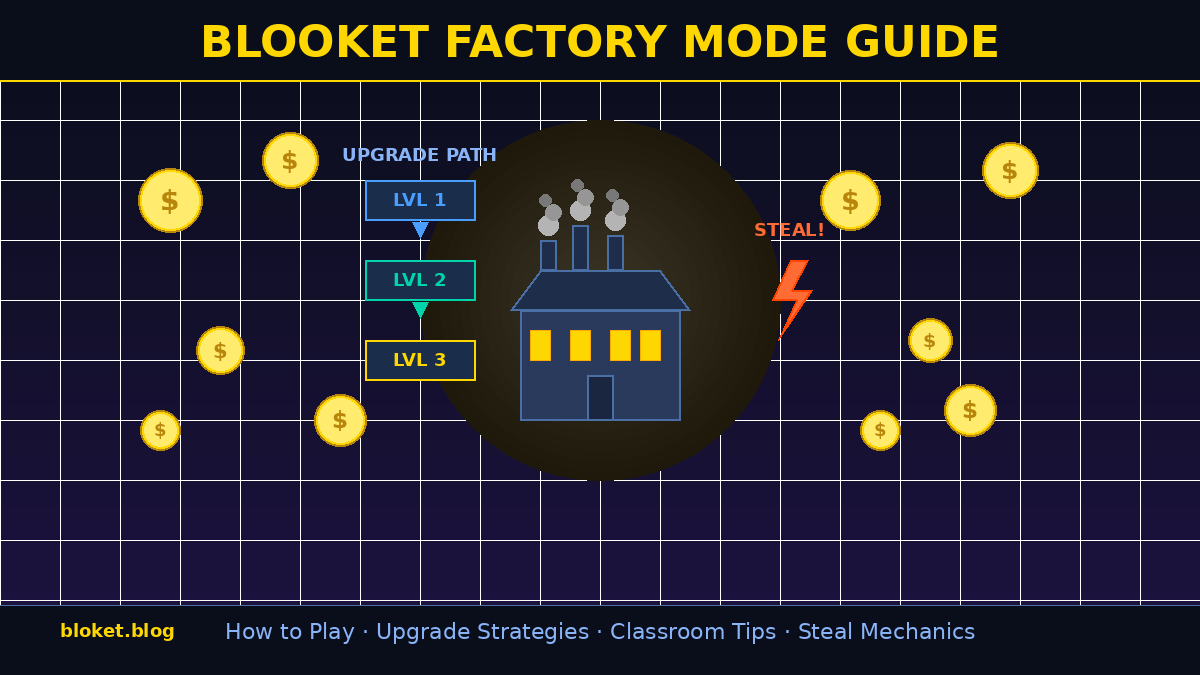
Level 1 to Level 2: Affordable within the first minute of most games. This is always the right first move.
Level 2 to Level 3: Costs noticeably more but delivers a significant passive income jump. Aim for this before the game’s midpoint.
Level 3 and beyond: Each tier costs more and produces more. Reach these levels if your answer rate is high enough to fund them.
The rule is simple: upgraded gold cannot be stolen. Gold sitting in your account can be. Every upgrade is a form of protection as much as an income investment.
The steal mechanic explained
Steals trigger automatically when another player answers incorrectly. Blooket selects a target at random and transfers a percentage of that target’s gold to the triggering player. You do not choose who you steal from, and you cannot prevent being chosen as a target except by having less gold to steal.
The percentage stolen scales with the target’s total. This means large balances become high-value targets. Players with the biggest gold totals can lose significant amounts in a single steal event. This mechanic keeps the game competitive even when someone builds a large early lead.
Winning strategies for Factory Mode
The randomness of steals flattens some of the skill gap, but consistent winners in Factory Mode share the same habits. These are the strategies that produce results across sessions, not just lucky games.
Upgrade in the first 90 seconds
The single most impactful move is your first upgrade. Make it as fast as possible. Passive income compounds over the full game length — an early Level 2 factory running for 10 minutes generates substantially more gold than a Level 2 factory that starts at the 4-minute mark. Every second your factory spends at a lower tier is income left on the table.
In my sessions testing this mode across different question sets, players who hit Level 2 before the 90-second mark consistently placed higher than those who waited to “save up” before upgrading.
Accuracy beats pure speed
Rushing through questions at 75% accuracy often produces worse outcomes than a careful 95% accuracy pace. Here’s the math: at 75% accuracy, one in four answers triggers a steal opportunity against you. At 95%, it’s one in twenty. The faster player who keeps answering incorrectly feeds gold to opponents far more often than the methodical player does.
The sweet spot is confident speed — answering as fast as you can while still reading each question fully before clicking. Half a second of attention on the question before clicking makes a measurable difference.
Tighten your accuracy as your balance grows
Early in the game, a wrong answer costs little because your balance is low. Late in the game, a wrong answer when you’re holding 8,000 gold can hand a large chunk to an opponent. The smartest players unconsciously slow down a fraction as their balance grows. Your accuracy should increase alongside your gold total.
Stop upgrading in the final two minutes
Late-game upgrades often don’t pay off. If a factory upgrade costs 3,000 gold and generates 60 gold per second at the new tier (a rough example), that investment needs 50 seconds just to break even — not accounting for what you’d generate at your existing tier anyway. In the final 2 minutes of a game, holding your gold is often more valuable than spending it on an upgrade that barely has time to return its cost.
Calculate informally: will this upgrade pay back before time runs out? If yes, buy it. If not, hold.
Don’t panic after a big steal
Being stolen from feels worse than it plays out strategically. Your factory is still running. Your answer rate hasn’t changed. Players who stay composed after a steal and keep answering accurately often close the gap within two or three minutes, because their factory is still at a higher level than opponents who never upgraded.
The worst response to a steal is to start answering carelessly out of frustration — that just triggers more steals.
Factory Mode in the classroom
Factory Mode is one of the stronger classroom game modes for review because it generates sustained engagement across the full session length, not just in quick bursts — for a similar idle-style mode, try our Cafe mode walkthrough.
What question sets work best
Sets with 20 to 50 questions work well for Factory Mode because they loop naturally during a 10-minute session, giving players repeated exposure to the same material. Short sets under 10 questions cycle too quickly and reduce variety. Long sets over 80 questions may mean some questions barely appear during a short session.
In terms of question style, straightforward recall questions suit Factory Mode best — vocabulary definitions, math facts, historical dates, biology terms, grammar rules. Questions that require multi-step reasoning slow players down in a way that undermines the rhythm of the mode. Save those question types for modes with more deliberate pacing, such as our Santa’s Workshop guide.
Managing the steal mechanic with students
The steal mechanic can frustrate students who feel they’re being punished for wrong answers rather than rewarded for right ones. A few classroom-tested approaches help:
Reframe steals as learning signals: When a student gets stolen from, point out that it flagged a question worth revisiting. It becomes a study cue rather than a punishment.
Use shorter sessions: A 5-minute Factory game keeps score gaps narrow. Nobody falls so far behind that catching up feels impossible.
Keep Factory in the practice zone: Use it for review, not for grades. Remove the grade pressure and the steal mechanic shifts from stressful to exciting.
Pairing Factory Mode with pre-test review
Running two or three short Factory sessions back-to-back the day before a test is a genuinely effective review structure. Each session is 5–7 minutes. Players encounter the same questions multiple times across sessions, which builds retrieval practice without feeling like repeated drilling. The competitive energy keeps attention levels higher than a standard review worksheet produces.
After the sessions, use the Blooket host report to identify which questions had the lowest accuracy across the class. Those are the ones to go over together before the test.
Reading the host dashboard during play
While students are playing, the host view shows everyone’s live gold total and question accuracy. Glancing at this during a session tells you which students are struggling with the material (low accuracy, low gold) versus which are cruising. That real-time signal is more useful than post-game data for in-the-moment teaching decisions.
Common mistakes in Factory Mode
Hoarding gold instead of upgrading
Holding large amounts of gold without investing is the most common error. Unspent gold is exposed to steals. Gold spent on an upgrade is locked in and working for you. Even a suboptimal upgrade at a slightly wrong moment is usually better than sitting on gold.
Over-investing late in the game
The opposite mistake is also common among experienced players who understand upgrading but don’t track time. Spending everything on a factory upgrade with 60 seconds left, when the passive income won’t cover the cost before the game ends, is a direct gold loss. Time awareness is part of the skill.
Ignoring easy questions
Some students stop reading questions carefully because they assume they know the answer. Confident misreads — clicking the wrong option on a question you actually knew — are surprisingly common and completely avoidable. Slow down by a half-second on each question. The accuracy gain is worth it.
Quitting mentally after a large steal
A steal that wipes out a significant portion of your gold feels terminal, but it rarely is. Factory Mode is long enough to recover. The players who win after being stolen from are the ones who immediately refocus on their answer accuracy and trust their upgraded factory to regenerate income. The ones who mentally quit feed additional steals through careless answering.
FAQs
Can you play Factory Mode without a Blooket account?
Yes. Students can join any hosted Factory game as a guest using just the game code — no account is needed to play. Teachers and anyone hosting a game do need a free or paid Blooket account to create and launch sessions.
How many players can join a Factory Mode game at once?
Blooket supports up to 60 players in a single hosted game session. Factory Mode handles larger groups well since each player operates independently — there are no paired matchups or queued turns to create bottlenecks.
Does Factory Mode work with any question set?
Yes, Factory Mode is compatible with any question set you create or find in the Blooket library. Sets in the 20–50 question range tend to produce the smoothest sessions because they loop often enough to keep the pace active throughout the game.
Can teachers see individual student performance after a Factory game?
Yes. Blooket generates a summary report after each hosted game that shows every player’s questions answered, accuracy percentage, and final gold total. This data is accessible from the host dashboard immediately after the session ends.
Is there any way to turn off stealing in Factory Mode?
Standard Factory Mode does not include an option to disable stealing — it is a core mechanic of the mode. Teachers who want lower-stakes competitive play can use shorter time limits to reduce the gap between players or use a different Blooket mode that doesn’t include stealing.
How is Factory Mode different from Tower Defense?
Tower Defense has players use earned resources to place defensive towers against waves of enemies, often with cooperative or competitive elements tied to surviving rounds. Factory Mode is purely player-vs-player gold accumulation — the only direct interaction between players is the steal mechanic. The underlying structure is different even though both involve earning and spending resources.
What is the best upgrade strategy for a short 5-minute game?
Push your first two upgrades within the first 90 seconds, then focus entirely on answer accuracy for the rest of the session. In a 5-minute game, reaching Level 3 quickly and maintaining high accuracy gives the best return before time runs out. Skip late upgrades in the final 90 seconds unless the math clearly works out.
Do blooks affect performance in Factory Mode?
No. Blooks are purely cosmetic in all Blooket game modes, including Factory. Your choice of blook has no effect on your gold earnings, upgrade costs, factory output, or steal probability. Pick whichever one you like.
Conclusion
Factory Mode rewards two skills equally: the discipline to answer questions accurately and the judgment to invest gold at the right time. Players who understand upgrade timing, manage their accuracy as their balance grows, and stay composed after steals consistently outperform those who just answer the fastest.
Run a Factory session with a question set you already use for review. Watch how the resource-management layer changes student focus compared to a straightforward quiz mode. The combination of passive income, strategic upgrades, and steal pressure produces a level of sustained engagement that is genuinely difficult to replicate with other review formats.
Set up your first Factory game today and see where your upgrade instincts land — it ranks among the easiest Blooket modes to win once you’ve got the upgrade timing down, and for another relaxed earning mode, try our Fishing Frenzy tips.
Inspiration is only a click away—browse our fresh perspectives and discover ideas worth exploring right now.