Blooket blook trading guide: how to buy, sell and win
Most Blooket players unlock duplicates and have no idea what to do with them. They either ignore the market entirely or sell rare blooks for a fraction of what they are worth. The Blooket blook trading system — the in-game market where players buy and sell blooks using tokens — is one of the most powerful tools in the game for building a collection, and almost nobody uses it well. This guide covers exactly how the market works, how to price and list blooks, how to spot a fair deal when buying, and which trading habits separate players who grow their collections efficiently from those who stall out.
How does Blooket blook trading work?
Blooket blook trading happens through the in-game market, where players list blooks they own for a token price and other players can purchase them directly. It is peer-to-peer exchange using tokens as currency. No real money changes hands in market transactions — only the in-game tokens you earn through playing and hosting.
What the market is and is not
The market is a listing board. You post a blook at a price you set; a buyer pays that price in tokens; the blook transfers to their account. Blooket does not set prices for you — the market is player-driven, which means prices shift based on supply, demand, and how recently a blook’s event window closed.
The market is not an auction. There is no bidding. The first buyer who wants your blook at your listed price takes it. This matters for your pricing strategy: list too high and no one buys; list too low and you leave tokens on the table — our guide on how to sell Blooket Blooks covers the in-game sell mechanics in detail.
What you need to start trading
You need a Blooket account and at least one duplicate blook to sell. A duplicate is any blook you own more than one copy of — your first copy stays in your collection, and additional copies are eligible to list. For buying, you need tokens in your balance. Tokens are earned by hosting games and by playing as a student in Blooket sessions.
Who has access to the market
The market is available to standard Blooket accounts. Blooket Plus is a paid subscription that adds features, but market access itself does not require a paid plan. Both free and Plus users can buy and sell blooks through the same marketplace.
How to sell blooks on the Blooket market
Selling a blook takes under two minutes once you understand the flow. The key decisions — which blook to list and at what price — take more thought than the mechanics themselves.
Step-by-step: listing a blook for sale
- Open your Blooket profile and navigate to the market section.
- Go to the sell tab within the market. This shows your eligible blooks — the ones you have duplicate copies of.
- Select the blook you want to list. Only duplicates appear here; your first copy of any blook is locked and will not show up.
- Set your token price. Before entering a number, check what other listings for the same blook are priced at. The market shows active listings you can compare against.
- Confirm the listing. Your blook is now visible to every other Blooket player browsing the market.
- Wait for a buyer. You do not need to stay online — listings persist until someone buys or you remove them.
- Collect your tokens. When a buyer purchases your listing, the tokens are added to your account automatically.
How to set a price that actually sells
The most common seller mistake is guessing. Before entering any price, spend sixty seconds checking active listings for that blook. If five other players are listing the same blook at 80 tokens, listing yours at 200 means it will sit unsold indefinitely.
Price just below the lowest active listing for common and uncommon blooks — buyers take the cheapest option first. For rarer blooks where fewer listings exist, you have more pricing power, but check recent sold data if the market gives you that information. A blook with no competition lets you price closer to its perceived scarcity value.
For limited edition blooks specifically, resist the urge to sell immediately after an event closes. In my testing across multiple seasonal events, the first wave of post-event listings floods supply and drives prices down. Holding duplicates for several weeks after an event typically yields noticeably more tokens per blook once the initial seller rush clears.
How to buy blooks from the Blooket market
Buying from the market lets you target specific blooks rather than relying on random box pulls. That makes it a more efficient path to completing a collection or filling post-event gaps.
Finding the blook you want
Browse or search the market by blook name or rarity tier. When you find the blook you want, you will see all active listings sorted by price. The cheapest listing appears first. Check how many listings exist — if only one or two sellers have it listed, the blook is scarce and the price reflects that.
Deciding whether a listing is worth buying
Compare the listing price against what it would cost to try pulling that blook from a box. If a blook is from a permanent box and the listing price is lower than the average token cost of pulling it randomly, buying the listing is the better deal. For limited edition blooks that are no longer available in any box, there is no box comparison — the market price is whatever sellers decide it is.
Avoid impulse purchases on high-rarity blooks unless you have verified the price is fair. A Chroma blook listed at double the going rate simply because no other seller has one active yet is a price you may regret once more listings appear. If the blook is from a recurring seasonal event, it will likely return; if it is from a one-off event, that rarity is real.
Timing your market purchases
The best time to buy a recently retired limited blook is in the two to three weeks after its event ends. Sellers who accumulated duplicates flood the market immediately post-event, and competition among sellers pushes prices down. The worst time to buy is several months later when only one or two sellers remain — those sellers know supply is thin and price accordingly.
How to value blooks before trading
Accurate valuation is what separates traders who consistently build their collections from those who waste tokens on poor deals. Rarity tier is the starting point, but it is only one variable.
Rarity tier and typical market behaviour
| Rarity tier | Market supply | Token value range | Notes |
| Common | Very high | Low | Rarely worth selling individually |
| Uncommon | High | Low–mid | Bulk value only |
| Rare | Moderate | Mid | Fair trading blook |
| Epic | Lower | Mid–high | Solid market target |
| Legendary | Low | High | Worth holding for timing |
| Chroma | Very low | High–premium | Most consistent market demand |
| Limited (any tier) | Capped post-event | Above tier average | Value rises over time |
| Mystical / Unique | Extremely low | Premium | Seldom listed; high variance |
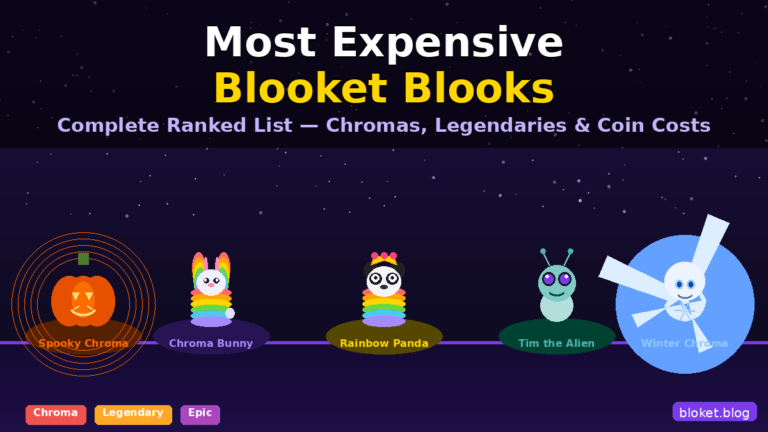
These ranges shift constantly based on player activity, how recently an event ran, and how many sellers are active at a given moment. Use the table as a framework, not a fixed price list. For the current top-end prices in the game, see our most expensive Blooket Blooks ranking.
What drives blook prices up or down
Supply drops: When a seasonal event ends and no new copies of an event blook can be created, supply is permanently capped. Every blook that gets sold and removed from a seller’s inventory tightens the remaining pool. Prices trend upward.
Demand spikes: When a blook goes viral within the Blooket player community — showing up frequently in high-attendance game sessions, or being featured in popular content — demand can spike faster than supply adjusts. This is more common for recognisable Chroma and Legendary blooks.
Permanent box availability: If a blook can be pulled from a permanent box any time, market prices are capped by the average token cost of pulling it. No rational buyer pays 500 tokens in the market for a blook they can realistically pull for 200 tokens through box openings.
Limited edition blooks in the market
Limited edition blooks follow a predictable price curve. Immediately after an event, prices are lowest because supply is highest. Over the following months, sellers exit and supply shrinks, pushing prices upward. The curve is not always smooth — a new seasonal event can briefly pull player attention away from the market, temporarily depressing prices even for unrelated blooks.
If you have a strong supply of a recently closed event’s blooks, stagger your listings. Selling all your duplicates at once adds to the supply glut and lowers the price everyone gets, including you.
Smart trading strategies for building your collection
Target specific blooks rather than random pulls
Box pulls are random. The market is specific. If you have a defined target — a particular Legendary or a limited blook you missed — going to the market is almost always more token-efficient than chasing it through random box openings, provided the market price is fair. Calculate what repeated pulls would cost on average and compare that to the listed price before deciding.
Use common and uncommon duplicates as a token pipeline
Every duplicate Common and Uncommon blook you hold has small but real token value — for non-trading paths to free pulls, see our guide on how to get free Blooket Blooks. Players who open many boxes accumulate dozens of these duplicates. Listing them in bulk for modest prices generates a steady flow of tokens without requiring any strategy — it is passive income from blooks that would otherwise sit unused.
Batch your listings. Rather than listing one duplicate at a time, list five or ten in a session. This is more time-efficient and ensures you are not missing token opportunities while your duplicates sit unlisted.
When to hold vs. when to sell
Hold any limited edition blook that falls below the Rare tier in terms of market volume — meaning few other copies are listed. The scarcity premium builds over time. Sell when you need tokens urgently for an active seasonal event and the opportunity cost of that token is high.
Sell permanent blooks quickly. A permanent blook’s market price does not appreciate over time the way a limited blook does — new copies are always one box opening away. There is no benefit to holding a permanent Rare for months hoping the price rises.
Building your collection through strategic buys and sells
The most efficient collectors I have observed treat trading as a cycle: sell excess Common and Uncommon duplicates to fund targeted purchases of specific Rares, Epics, and Legendaries — many of which top our rarest Blooket blooks ranked list. This avoids the trap of spending all tokens on random boxes hoping for the right pull.
Map out which blooks you want. Check whether they are available in the market and at what price. If the market price is reasonable, buy directly. If not, set a token target by selling duplicates and wait for prices to adjust.
Common trading mistakes that cost players tokens
Selling right after an event ends
Post-event, the market floods with duplicates from players who pulled multiple copies during the event window. Listing your limited blooks in this window means competing with every other seller at once. Prices drop. Waiting two to four weeks for the initial flood to clear typically results in higher prices per listing with far less competition.
Listing rare blooks without checking existing prices
Pricing a blook without checking the market first is guesswork. I have seen players list Legendaries for half the going rate simply because they did not check — and a buyer took it immediately at that price. Spend sixty seconds on research before every listing. It costs nothing and protects your tokens.
Overpaying for blooks available in permanent boxes
If a blook can be pulled from any active permanent box — like a Chroma blook from a year-round source — the market price should not exceed the reasonable token cost of pulling it yourself through box openings. Paying a premium in the market for a permanent blook because it looks rare is a mistake — you could open boxes and likely get it for less. The market is the right route for limited blooks and high-rarity targets, not for blooks accessible through regular pulls.
Ignoring the market entirely between seasonal events
The market is active year-round, not just after events. Limited blooks from past events are available any time through market listings. Players who only check the market during active events miss the window where post-event supply is highest and prices are lowest. A habit of browsing the market regularly — even in quiet periods between events — consistently turns up good deals.
Selling all duplicates immediately instead of staggering
Dumping every duplicate you own onto the market at once drives down the price of your own listings. If you have five duplicates of a limited Rare, listing all five at once adds to supply and invites price competition. List one or two, wait for them to sell, then list more. The same five blooks will earn more tokens across staggered listings than all at once.
FAQs
Can I trade blooks directly with a specific player, or only through the market?
Blooket’s trading system runs through the market — there is no direct player-to-player trade feature where you can send a blook to a specific person. Listings are public and any buyer can purchase them. If you want a friend to get your blook, list it at a price only they would pay at that moment and coordinate timing.
Do I lose my blook if no one buys my listing?
No. A listed blook stays in your inventory until it sells or you remove the listing. You can de-list at any time and the blook returns to your available collection. There is no time limit on listings.
Can I buy back a blook I sold by mistake?
Only if another copy appears in the market. Once you sell a blook, it leaves your account. If it was your only copy, you will need to find another listing in the market or wait for the relevant box or event to produce another copy. There is no undo function.
What is the minimum and maximum token price I can set for a listing?
Blooket sets floor and ceiling limits on market prices, though the exact figures can vary and are displayed when you create a listing. Always check the store interface for the current range — it prevents extreme mispricing in either direction.
Is market trading available to student accounts?
Market access can depend on account type and any school-level restrictions set by teachers or administrators. Standard personal accounts have market access by default. If you are on a school-managed account, check whether your administrator has restricted market features.
How do I earn tokens fast enough to be a serious market buyer?
Host Blooket game sessions with as many active players as possible — longer sessions with more participants generate more tokens per host. As a player, focus on sessions where the host runs extended games. Multiple sessions per day during active event periods is the fastest way to build a token balance.
Does Blooket take a fee from market transactions?
Blooket applies a market fee to transactions, meaning the seller receives slightly fewer tokens than the buyer pays. The exact fee percentage is shown when you confirm a listing. Factor this into your pricing so you net the token amount you are targeting, not just the listed price.
Can I list the same blook in the market and still use it in games?
Yes. Listing a blook for sale does not prevent you from using it as your active blook during game sessions. The listing only removes the blook from your account when a buyer completes the purchase.
Trade with a plan, not with leftover duplicates
Blooket blook trading rewards players who approach the market deliberately. The mechanics are simple; the strategy is where most players fall short. Check prices before you list, hold limited blooks through the post-event flood, stagger your sales, and use the market to target specific blooks rather than chasing them through random pulls.
Check your blook inventory today, identify any duplicates sitting unused, and list the ones you have no attachment to. Even a handful of Common duplicates selling for modest tokens adds up across a season — and a well-timed Legendary or Chroma sale can fund a full event box strategy on its own.
Stay informed and ahead of the game—our popular picks arm you with essential knowledge.