Best Blooket Game Mode for Small Class
Running Blooket with a small group exposes a problem most guides ignore. Modes built for 25 players fall flat with 8. Team games go lopsided, elimination rounds end in minutes, and one confident student can dominate the leaderboard before others warm up.
The good news: a handful of Blooket’s modes were practically designed for small settings. After running sessions across groups of 6 to 14 students, clear patterns emerged about which modes deliver consistent engagement and which ones flop before the first question set finishes.
This guide covers the best Blooket game mode for small class situations, explains exactly why player count changes the experience, and gives a ranked breakdown you can use before your next session.
Why class size changes everything in Blooket
The best Blooket game mode for small class settings depends on one thing most recommendations overlook: mechanics, not content. Blooket’s modes are built around player counts in ways the lobby screen never explains. A mode that thrives with 25 players can feel hollow with 8.
The minimum player problem
Several Blooket modes use randomized stealing, elimination, or team formation. Each of those mechanics requires enough players to work properly. Gold Quest, for example, gets its tension from the chance that another player will steal your gold. With 5 players, stealing rounds feel low-stakes because the pool of targets is tiny. With 10 to 14 players, the same mode becomes genuinely competitive.
Team modes carry a bigger structural risk. Tower Defense and Tower of Doom split students into two groups. A class of 8 means teams of 4 at best. One student who answers faster than average can carry their team completely, removing the need for anyone else to engage seriously.
Engagement math in small groups
In large classes, slower students can coast while faster ones carry the score. Small classes expose that dynamic completely. Every student’s answers count more, every leaderboard position is visible, and the gap between top and bottom performers becomes obvious to the entire room.
The best modes for small classes are ones that reward personal progress, reduce the penalty for falling behind, and keep every student actively answering rather than waiting on others. That filter alone eliminates half the available modes before a single question loads.
The best Blooket game modes for small classes
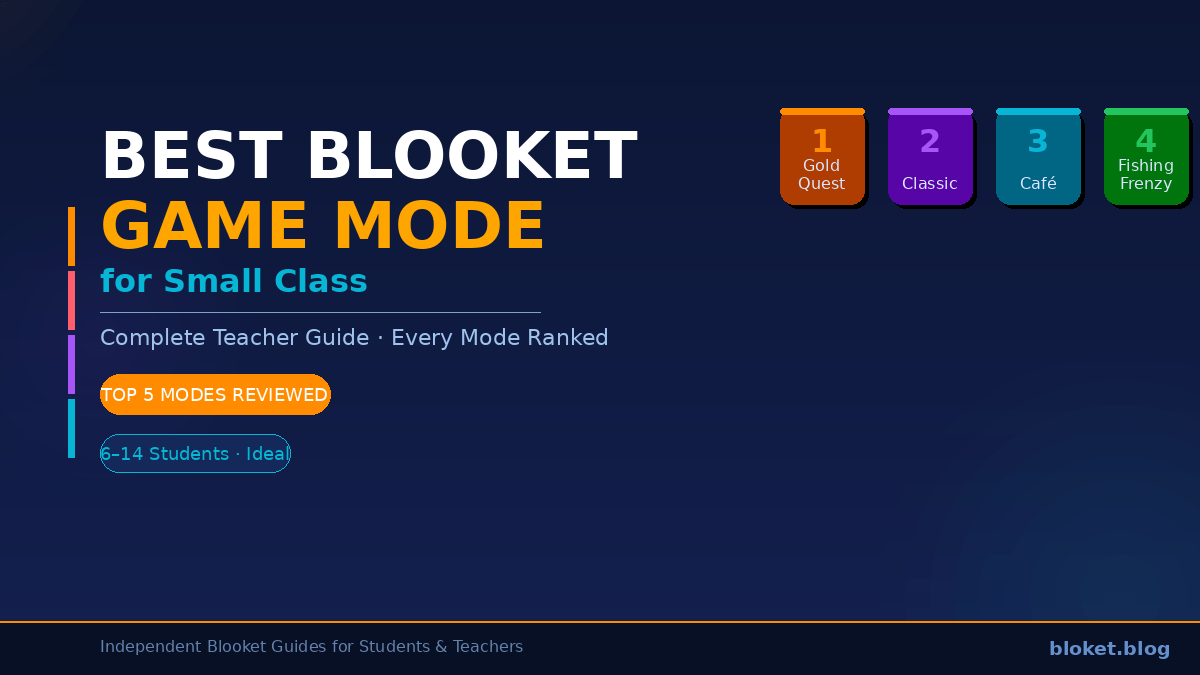
After testing across multiple small-group sessions, these five modes consistently delivered the strongest engagement with classes of 6 to 14 students.
| Game Mode | Ideal Group Size | Competition Style | Session Pacing |
|---|---|---|---|
| Gold Quest | 8–14 | Individual + steal | Medium |
| Classic | 4–14 | Individual leaderboard | Teacher-controlled |
| Café | 6–14 | Individual resource-build | Self-paced |
| Fishing Frenzy | 6–12 | Individual collection | Relaxed |
| Racing | 6–14 | Individual speed | Fast |
Gold Quest
Gold Quest is the strongest all-round mode for small classes. Students answer questions to collect gold coins, and other players can steal from them during random steal events. With 8 to 14 players, the stealing mechanic creates real tension because everyone’s total is visible and the gap between students stays close enough to matter.
The mode rewards accuracy over raw speed. A student who answers every question correctly accumulates more gold on average than one who rushes and misses, which levels the playing field between fast typists and careful thinkers.
Setting it up for small groups
Set the question timer to 15 to 20 seconds. This gives every student a genuine window to answer rather than handing the game to the fastest finger. If the group is 6 to 8 students, run two short rounds instead of one long one. The leaderboard reset between rounds gives slower starters a fresh chance, which sustains motivation across the whole session.
Classic
Classic is the most transparent mode in Blooket. Students answer questions and earn coins per correct answer, with a live leaderboard showing every position in real time. In small classes, that leaderboard works in your favor because every student can realistically see a path to the top three.
When I ran Classic with a group of 9 middle school students reviewing vocabulary, the visible leaderboard created more motivation than expected. Students who sat in the middle of the pack pushed harder than they would have in a larger room where reaching the top felt out of reach.
Best use case
Classic works with as few as 4 students and scales cleanly to any size. Use it when you need a reliable, low-setup mode for review, or when the class is short on time and needs something that can start immediately.
Café
Café tasks students with running a virtual café by answering questions to earn in-game currency, then spending it on upgrades and serving customers. The mode is primarily self-paced, which makes it one of the most inclusive options for small classes with mixed ability levels.
Faster students can pursue upgrades while slower ones focus on answering correctly without the pressure of a live score. Because Café involves no direct stealing or elimination, no student feels singled out for falling behind. Every café operates independently.
Why it scales down so well
The self-contained nature of each student’s café means group size barely changes the experience. A session with 6 students plays almost identically to one with 14, which makes Café the most reliable fallback when you are unsure of final attendance.
Fishing Frenzy
Fishing Frenzy has students answer questions to cast fishing lines, with each catch providing a random reward. The randomness element is actually an advantage in small classes because it prevents one dominant student from running away with the game on answer speed alone.
A student who answers every question correctly still draws random catches. A student who answers slightly fewer questions might land a higher-value catch and stay competitive. That built-in variance keeps the whole group engaged until the final round rather than checking out once the top of the leaderboard feels locked in.
Tip for younger learners
Fishing Frenzy works especially well for younger students in groups of 6 to 10. The visual variety of the catches holds attention across a full session in a way that a plain leaderboard sometimes does not.
Racing
Racing has students answer questions to advance a character along a track. The faster you answer correctly, the farther you move. In small classes, every track position is visible and meaningful, and a student in last place can catch up through a streak of correct answers.
The pace is fast, which suits short review sessions of 10 to 15 minutes. With a small group, races end quickly, so running two or three rounds with a brief discussion between them keeps energy consistent and gives students a reason to stay focused.
Modes that underperform with small classes
Not every Blooket mode handles a low player count well. These three create consistent problems with groups under 15.
Battle Royale
Battle Royale eliminates students as they answer incorrectly, with the last one standing winning the round. The elimination mechanic is the core problem: with 8 students, the game can end in three to five rounds, sometimes in under five minutes. Students who are eliminated early spend the rest of the session watching rather than learning.
In a class of 25, early elimination still leaves 20 students active. In a class of 8, it rapidly reaches a group of 3 or 4 with most of the room idle. Save Battle Royale for larger sessions or use it only as a very short warm-up.
Tower Defense and Tower of Doom
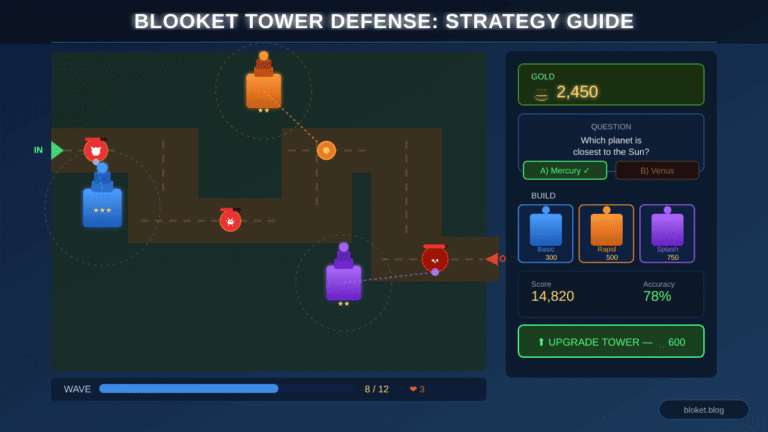
Both modes split students into teams. Tower Defense pits one team against waves of enemy blooks, while Tower of Doom has teams compete head-to-head. The team structure requires enough players on each side for genuine balance.
With a class of 8 split into teams of 4, a single high-performing student can answer enough questions to dominate their team’s output. The rest of the team contributes comparatively little, and the losing group often disengages after the first few minutes. Team modes in Blooket need at least 5 to 6 players per side to work the way they were designed.
Blook Rush
Blook Rush asks students to answer questions and use the coins earned to buy blooks that then fight automatically. In large lobbies, the randomness of those auto-battles averages out over many matchups. In small classes, the variance produces lopsided results where one student wins nearly every fight regardless of their quiz performance.
The disconnect between correct answers and game outcomes frustrates students who are trying but losing because of luck rather than effort. For small groups, this breaks the link between performance and reward that makes Blooket effective as a learning tool.
Getting the most out of any mode with fewer students
Choosing the right mode is the first step. These practical adjustments make any of the top five modes work even better in a small-class setting.
Adjust the question timer
The default timer is calibrated for mid-size lobbies. In a small class, extend it to 20 seconds minimum. This prevents the session from becoming a speed test that rewards fast typists over students who know the material but need a moment to process the question.
For Classic and Gold Quest, a slightly longer timer raises average accuracy across the class. More correct answers means more coins earned and a closer final leaderboard, which keeps more students engaged through the end.
Run shorter, more frequent rounds
Small classes move through a Blooket session faster than large ones. Instead of running a single 20-minute game, split the time into two 8-minute rounds with a 2-minute discussion in between. The leaderboard reset between rounds gives every student a fresh start, which sustains motivation across the full class period rather than letting it drop off in the second half.
Use the pause as a teaching tool
Small classes have a low student-to-teacher ratio, which means pausing mid-game to ask a student to explain their answer is practical in a way it is not with 30 students. Gold Quest and Classic both pause cleanly without disrupting the session. This turns Blooket from a reward activity into a formative assessment moment, and it signals to students that the game is connected to actual learning, not just entertainment.
Match the mode to the session goal
Not every Blooket session needs competition. If the goal is content review, Classic and Café provide low-pressure environments where accuracy matters more than speed. If the goal is energy and motivation before a test, Gold Quest and Racing create the short-term competitive tension that gets quieter students actively participating.
FAQs
What is the best Blooket game mode for a class of 5 to 8 students?
Classic and Café work best with very small groups. Classic keeps everyone on the same leaderboard, making every position meaningful. Café is fully self-paced, so it works regardless of ability spread. Avoid team-based or elimination modes with groups this small, as those mechanics break down below 8 players.
Does Blooket have a minimum number of players for each mode?
Blooket does not enforce a hard minimum for most modes, but some function poorly below 6 players. Battle Royale and Blook Rush in particular lose their core mechanics with very small groups. Gold Quest needs at least 6 players for the stealing mechanic to create meaningful tension across the session.
Can one student play Blooket alone?
Some modes allow solo play, but the competitive and social elements disappear entirely. Classic and Café function reasonably well for solo practice because they are self-contained by design. For genuine solo review, Blooket’s individual practice features are a better fit than a full hosted game with one player.
Is Gold Quest always better than Classic for small classes?
Gold Quest tends to produce more engagement in groups of 8 to 14 because the stealing mechanic creates social tension that Classic does not have. Classic is more reliable for groups of 5 to 7 and for classes where direct competition between students creates anxiety rather than motivation.
How long should a Blooket session last for a small class?
Aim for 8 to 12 minutes per round. Small classes move through rounds faster because fewer answer submissions happen simultaneously and leaderboard gaps form quickly. Two shorter rounds with a break between them consistently produce better outcomes than one long session.
What Blooket mode works best for reviewing before a test?
Classic and Gold Quest are the most effective pre-test modes. Classic gives a clean read of who knows the material. Gold Quest adds enough competitive tension to motivate students who might disengage during a standard review. Café works well when students need space to process answers without competitive pressure.
Can I use team modes effectively with a small class?
Yes, but only with deliberate setup. Keep teams at 3 to 4 students, balance them by ability level, and choose a mode where individual contributions are visible rather than absorbed into a group total. Tower of Doom can work with 10 to 12 students split into two balanced teams, but below that threshold the individual impact problem returns.
Conclusion
The best Blooket game mode for a small class is Gold Quest for most situations, Classic when reliability matters most, and Café when a lower-pressure environment serves the group better. The deciding factor is always matching the mode’s mechanics to your actual player count rather than defaulting to whatever the platform shows first.
Small classes reward intentional choices — if your group is bigger, see our best modes for large classes guide. Running the right mode with 10 students produces better learning outcomes than running the wrong one with 25. Start with Gold Quest, extend the question timer to 20 seconds, and run two shorter rounds rather than one long session. That combination alone will make a noticeable difference in your next small-class Blooket session
Gain the edge you deserve—our expert insights are packed with practical wisdom you can use right away.